
Introduction
For thousands of businesses across the United States, HubSpot has become one of the most trusted platforms for managing marketing, sales, customer service, and business growth. What started as an inbound marketing company has evolved into a comprehensive cloud-based customer platform that helps organizations attract visitors, generate leads, close deals, and build long-term customer relationships.
Headquartered in Cambridge, Massachusetts, HubSpot is one of America’s leading Software-as-a-Service (SaaS) companies. Its platform combines Customer Relationship Management (CRM), marketing automation, sales enablement, customer support, content management, analytics, and artificial intelligence into a single connected ecosystem.
Unlike many traditional enterprise software platforms that require significant technical expertise, HubSpot is designed to be approachable for startups, small businesses, mid-sized companies, and growing enterprises. Businesses can begin with free tools and expand to more advanced capabilities as their operations become more complex.
Artificial intelligence is now a major part of HubSpot’s strategy. Through Breeze AI, the company is helping organizations automate repetitive work, generate marketing content, improve customer interactions, assist sales teams, and increase productivity without sacrificing ease of use.
As digital marketing continues evolving, U.S. businesses face increasing pressure to deliver personalized customer experiences across websites, email, social media, live chat, and mobile devices. HubSpot addresses these challenges by bringing customer data, automation, AI, and collaboration tools together in one cloud platform.
Whether you’re launching a startup, managing a growing marketing agency, leading a sales team, or modernizing customer engagement for an established business, HubSpot offers solutions that support every stage of the customer journey.
This comprehensive guide explores HubSpot’s history, products, AI capabilities, pricing, strengths, limitations, security, competitors, and why it remains one of the most popular CRM and marketing automation platforms in the United States.
Why HubSpot Matters to U.S. Businesses
The American business landscape has changed dramatically over the last decade.
Today’s customers expect businesses to respond quickly, personalize communication, provide seamless online experiences, and maintain consistent engagement across multiple channels.
HubSpot helps organizations meet these expectations by connecting marketing, sales, customer service, and operations into one integrated platform.
1. All-in-One Customer Platform
Rather than using separate software for email marketing, CRM, customer support, website management, and automation, HubSpot combines these functions into one cloud-based system.
This unified approach reduces software complexity while improving collaboration between departments.
Businesses can manage:
- Customer relationships
- Marketing campaigns
- Sales activities
- Customer support
- Website content
- Business reporting
- Workflow automation
from a single platform.
2. Designed for Growing Businesses
One reason HubSpot is especially popular in the United States is its ability to grow alongside a business.
Startups can begin with free CRM tools, while larger organizations can adopt advanced enterprise capabilities as their customer base expands.
This scalability makes HubSpot attractive for:
- Entrepreneurs
- Startups
- Small businesses
- Marketing agencies
- Mid-sized organizations
- Enterprise companies
3. Marketing Automation Leadership
HubSpot is widely recognized for helping businesses automate marketing activities.
Companies use HubSpot to:
- Create email campaigns
- Capture leads
- Build landing pages
- Schedule social media content
- Nurture prospects
- Measure campaign performance
Automation reduces manual work while improving customer engagement.
4. Artificial Intelligence Integration
AI is becoming an essential part of modern business software.
HubSpot’s Breeze AI introduces intelligent features that assist users with:
- Content creation
- Email drafting
- Customer support
- Data analysis
- Workflow automation
- Sales recommendations
These tools help organizations work faster while maintaining high-quality customer experiences.
5. Trusted Across Multiple Industries
HubSpot serves businesses in nearly every major sector across the United States.
Common industries include:
- Technology
- Professional services
- Healthcare
- Education
- Real estate
- Financial services
- Manufacturing
- Retail
- Nonprofit organizations
- Marketing agencies
Its flexibility makes it suitable for companies with different goals and business models.
Why This Guide Matters for American Businesses
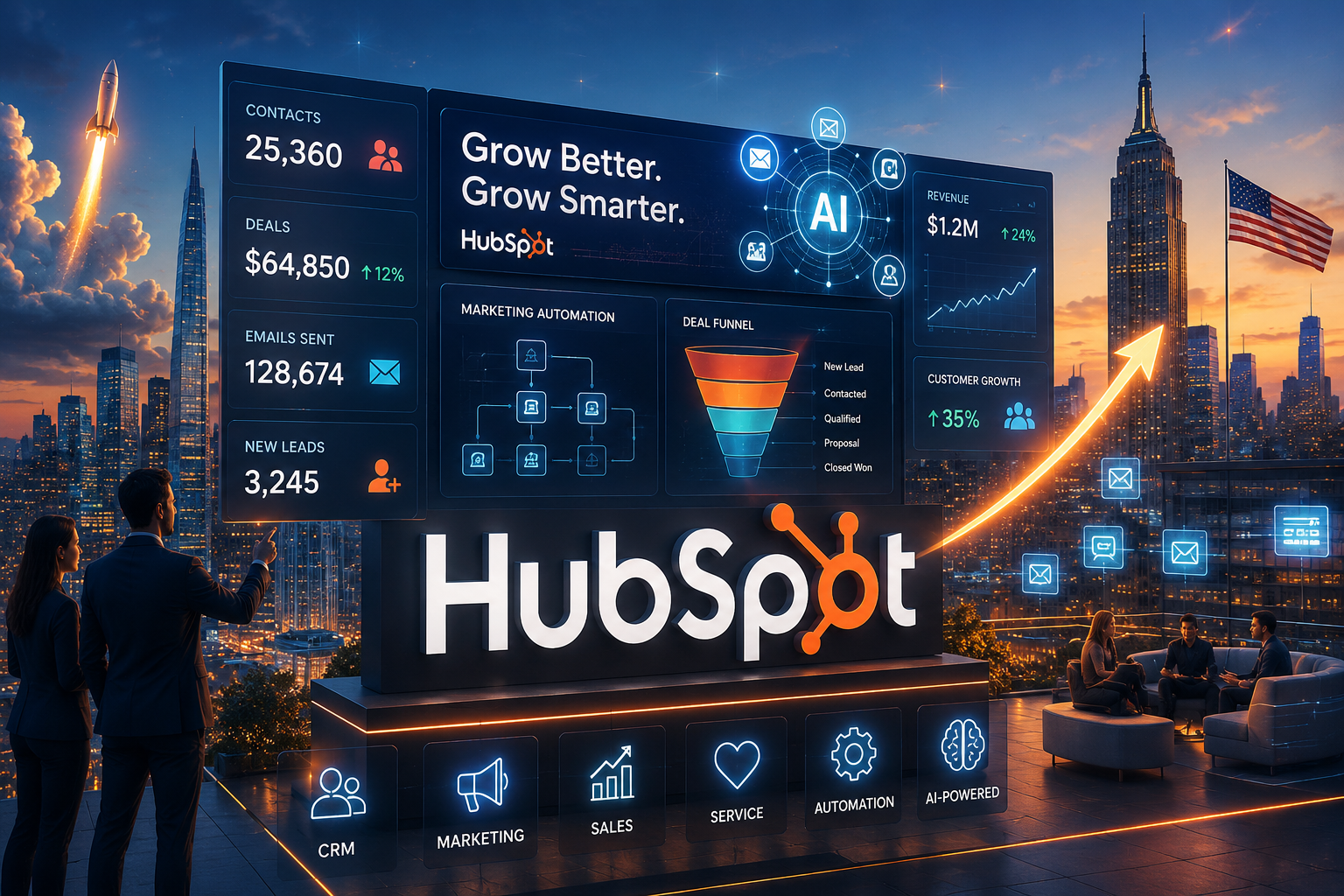
From small businesses looking for their first CRM to established companies modernizing customer engagement, HubSpot has become one of the most influential software platforms in the U.S. market.
Its combination of CRM, AI, marketing automation, and customer service tools enables organizations to simplify operations, strengthen customer relationships, and support long-term business growth in an increasingly digital economy.
HubSpot Company Overview
HubSpot is one of the most recognized customer platform companies in the United States, helping businesses attract visitors, convert leads, close customers, and build lasting relationships. Founded in 2006, the company pioneered the concept of inbound marketing, encouraging businesses to earn customer trust through valuable content rather than relying solely on traditional advertising.
Headquartered in Cambridge, Massachusetts, HubSpot has grown into a leading Software-as-a-Service (SaaS) provider with customers ranging from startups and small businesses to large enterprises. Its cloud-based platform combines Customer Relationship Management (CRM), marketing automation, sales software, customer service, content management, operations tools, and artificial intelligence into one connected ecosystem.
Unlike many enterprise software providers that focus primarily on large corporations, HubSpot is known for offering scalable solutions that are accessible to organizations of every size. Businesses can start with free tools and upgrade as their needs evolve, making HubSpot particularly popular among entrepreneurs and growing companies in the United States.
Today, HubSpot serves hundreds of thousands of organizations worldwide and continues to expand its capabilities through AI, automation, analytics, integrations, and developer tools.
Its mission is:
“Help millions of organizations grow better.”
That philosophy remains at the center of HubSpot’s approach to customer experience, emphasizing ease of use, education, and long-term business growth.
HubSpot at a Glance
| Category | Details |
|---|---|
| Company Name | HubSpot, Inc. |
| Founded | 2006 |
| Headquarters | Cambridge, Massachusetts, USA |
| Industry | CRM Software, Marketing Automation, SaaS |
| Founders | Brian Halligan and Dharmesh Shah |
| Stock Exchange | NASDAQ |
| Core Business | Customer Platform and CRM |
| AI Platform | Breeze AI |
| Major Products | Marketing Hub, Sales Hub, Service Hub, CMS Hub, Operations Hub |
| Customers | Startups, SMBs, Mid-Market Companies, Enterprises |
HubSpot’s Core Business Areas
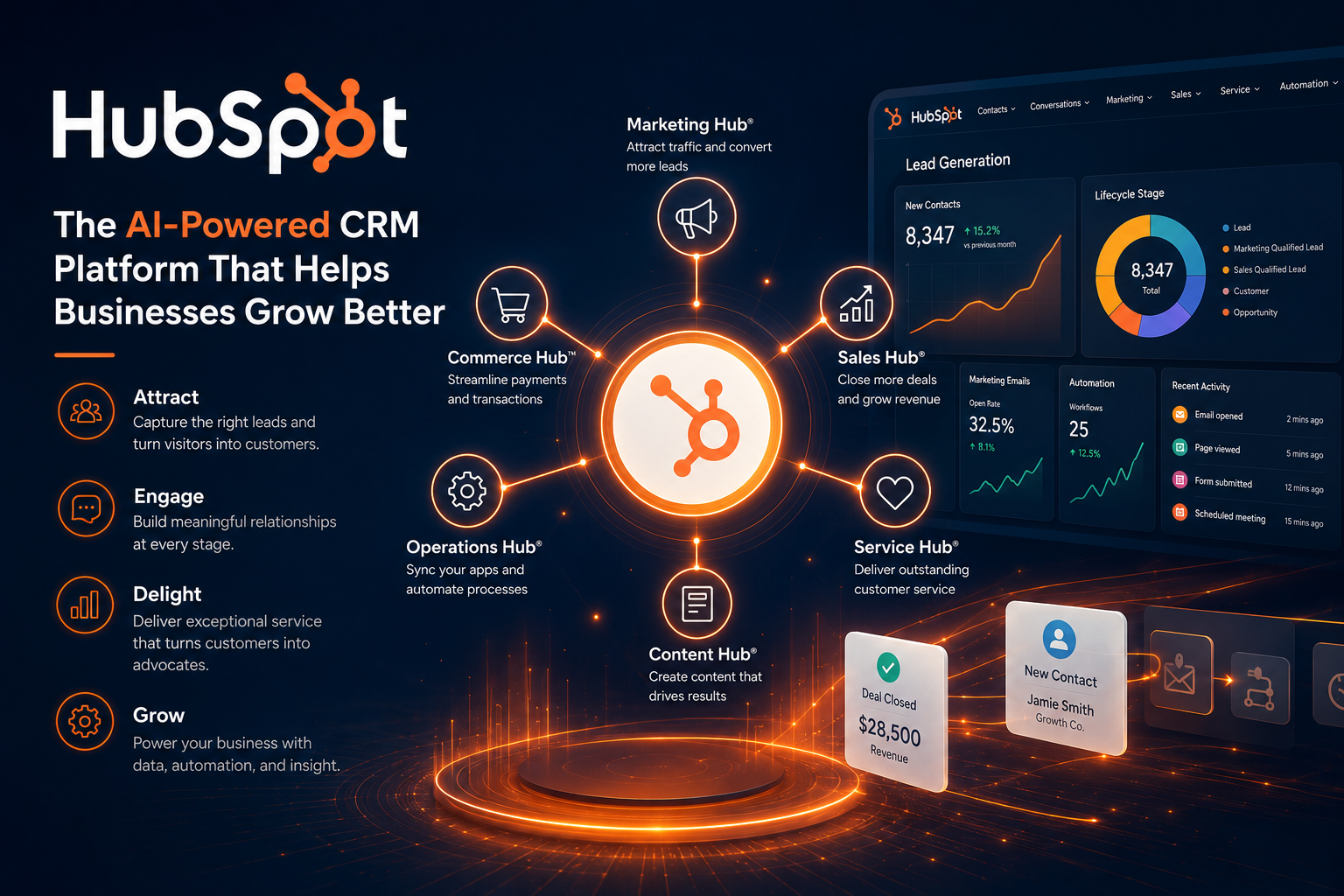
HubSpot brings together multiple business functions into a single customer platform.
Its primary business areas include:
- Customer Relationship Management (CRM)
- Marketing Automation
- Sales Enablement
- Customer Service
- Content Management System (CMS)
- Operations Automation
- Artificial Intelligence
- Business Analytics
- Workflow Automation
- Customer Experience
Instead of requiring companies to purchase several disconnected software products, HubSpot offers a unified platform that helps teams collaborate more effectively.
History and Evolution of HubSpot
HubSpot was founded in 2006 during a period when digital marketing was rapidly changing.
Traditional outbound marketing methods—such as cold calls, mass email campaigns, and intrusive advertising—were becoming less effective as consumers gained more control over how they discovered products and services online.
Recognizing this shift, HubSpot introduced the concept of inbound marketing, encouraging businesses to attract customers by creating helpful content, improving search visibility, and building trust over time.
The Beginning (2006)
Brian Halligan and Dharmesh Shah launched HubSpot with the belief that businesses could grow by educating customers rather than interrupting them.
The company introduced software that helped organizations:
- Publish blogs
- Improve search engine rankings
- Generate leads
- Manage email campaigns
- Track website visitors
- Convert prospects into customers
This approach resonated strongly with startups and small businesses looking for cost-effective ways to compete online.
From Marketing Software to Customer Platform
As customer expectations evolved, HubSpot expanded beyond marketing automation.
Over the years, it introduced:
- HubSpot CRM
- Sales Hub
- Service Hub
- CMS Hub
- Operations Hub
- AI-powered business tools
This transformation turned HubSpot into a comprehensive customer platform capable of supporting every stage of the customer lifecycle.
Expansion Through Innovation
Rather than relying heavily on acquisitions, HubSpot has focused on continuously improving its own platform.
Key innovations include:
- Free CRM software
- Marketing automation
- AI-powered productivity
- Customer journey management
- Workflow automation
- Extensive third-party integrations
This strategy has helped HubSpot maintain a reputation for simplicity while steadily expanding its capabilities.
Artificial Intelligence and the Future
Artificial intelligence has become one of HubSpot’s fastest-growing areas of investment.
The introduction of Breeze AI reflects the company’s goal of making advanced AI accessible to businesses without requiring specialized technical expertise.
Breeze AI assists users with:
- Content creation
- Marketing campaigns
- Customer support
- Sales productivity
- Data analysis
- Workflow automation
HubSpot’s Evolution
| Time Period | Focus |
|---|---|
| 2006–2010 | Inbound Marketing Software |
| 2011–2015 | Marketing Automation Expansion |
| 2016–2020 | CRM and Sales Platform Growth |
| 2021–2024 | Customer Platform Integration |
| 2025–2026 | AI, Breeze AI & Intelligent Automation |
Founders and Leadership
HubSpot was founded by Brian Halligan and Dharmesh Shah, who met while studying at the Massachusetts Institute of Technology (MIT).
Their vision was to help businesses grow by creating meaningful customer relationships instead of relying on disruptive marketing tactics.
Leadership Philosophy
HubSpot’s leadership focuses on several guiding principles:
Customer-Centric Growth
The platform is designed to help organizations create positive customer experiences throughout the buying journey.
Simplicity
Unlike many enterprise software solutions that require lengthy implementations, HubSpot prioritizes an intuitive interface and fast deployment.
Continuous Innovation
HubSpot regularly introduces new features in:
- Artificial intelligence
- Marketing automation
- CRM
- Analytics
- Customer engagement
- Business productivity
Education
One of HubSpot’s distinguishing characteristics is its investment in free educational resources.
Through HubSpot Academy, businesses and professionals can access certifications, courses, and training covering topics such as:
- Digital marketing
- Sales
- Customer service
- Content marketing
- CRM
- Artificial intelligence
This educational ecosystem has helped HubSpot build a loyal community of users and certified professionals.
HubSpot Business Model
HubSpot operates using a subscription-based Software-as-a-Service (SaaS) model.
Customers pay monthly or annual subscription fees to access cloud-based software rather than purchasing perpetual licenses.
This approach provides:
- Automatic updates
- Cloud accessibility
- Flexible pricing
- Scalable growth
- Continuous feature improvements
1. Subscription Revenue
Most of HubSpot’s revenue comes from subscriptions to its software products.
Organizations can subscribe to:
- Marketing Hub
- Sales Hub
- Service Hub
- CMS Hub
- Operations Hub
- Enterprise editions
Plans vary depending on features, contacts, users, and business requirements.
2. Professional Services
HubSpot also generates revenue through:
- Onboarding services
- Consulting
- Technical support
- Customer success programs
- Training
These services help businesses maximize the value of their HubSpot investment.
3. Partner Ecosystem
HubSpot has developed an extensive partner network consisting of:
- Marketing agencies
- CRM consultants
- Web developers
- Technology providers
- System integrators
These partners assist businesses with implementation, customization, and ongoing optimization.
4. AI and Productivity Tools
Artificial intelligence has become an increasingly important part of HubSpot’s value proposition.
Businesses use Breeze AI to:
- Generate marketing content
- Draft emails
- Summarize customer interactions
- Automate workflows
- Improve productivity
HubSpot Products and Services
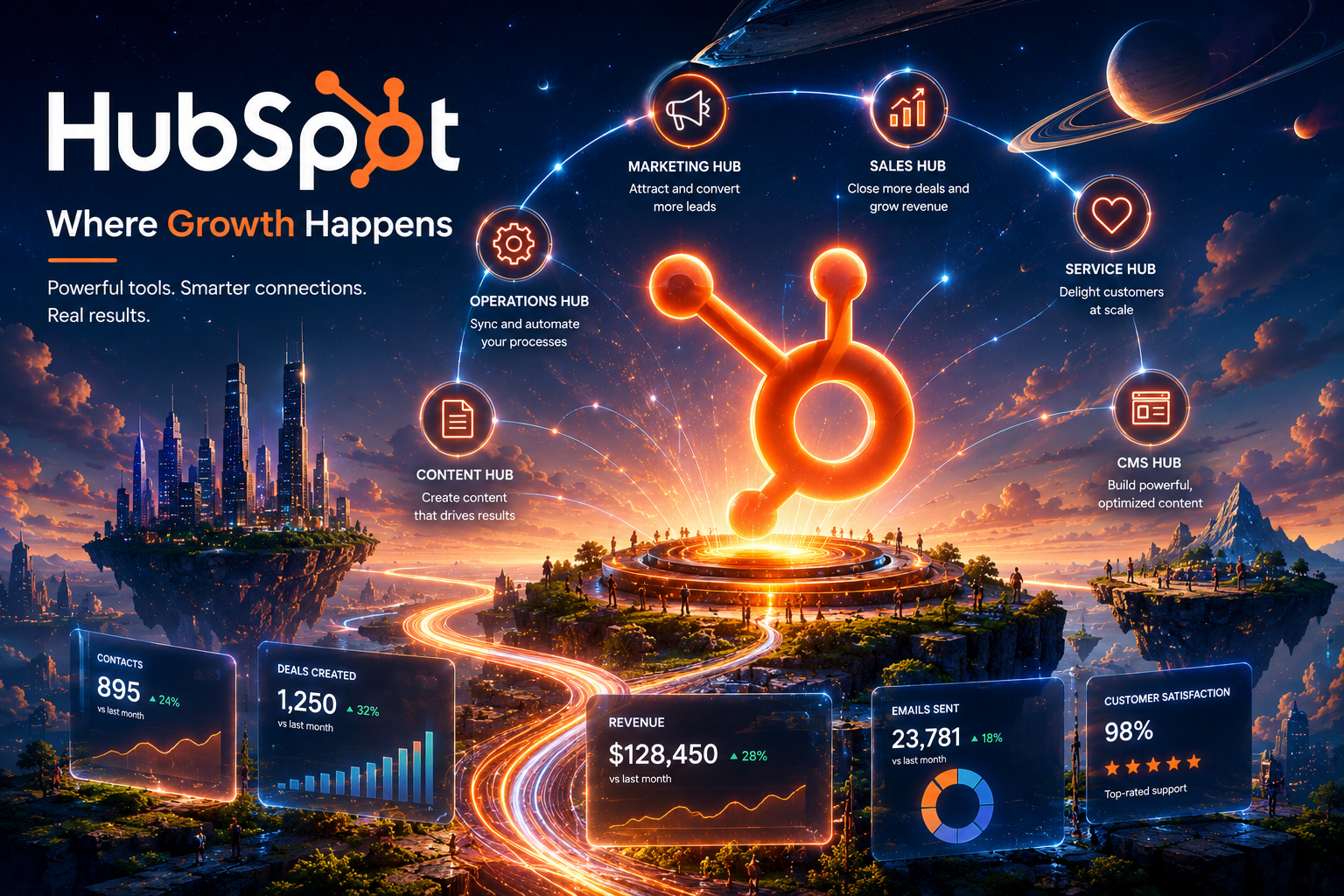
HubSpot’s software portfolio is organized into specialized “Hubs” that address different business functions while sharing the same CRM database.
Marketing Hub
Marketing Hub helps businesses:
- Create email campaigns
- Manage social media
- Build landing pages
- Generate leads
- Automate marketing
- Measure campaign performance
It remains one of HubSpot’s most widely adopted products.
Sales Hub
Sales Hub provides tools for:
- Lead management
- Sales pipeline tracking
- Meeting scheduling
- Sales automation
- Quote generation
- Deal forecasting
These features help sales teams improve productivity and close more opportunities.
Service Hub
Service Hub enables organizations to deliver better customer support through:
- Ticket management
- Live chat
- Knowledge bases
- Customer feedback surveys
- Help desk automation
CMS Hub
CMS Hub combines website management with marketing and CRM capabilities.
Businesses can:
- Build websites
- Create blogs
- Personalize content
- Optimize SEO
- Manage digital experiences
Operations Hub
Operations Hub helps businesses synchronize customer data, automate workflows, and improve operational efficiency across different software systems.
Breeze AI
Breeze AI introduces intelligent assistance throughout the HubSpot platform.
Capabilities include:
- Content generation
- Email drafting
- Sales assistance
- Customer support
- Workflow recommendations
- Data insights
Its goal is to help organizations accomplish more with less manual effort.
HubSpot Ecosystem
One of HubSpot’s biggest strengths is its integrated ecosystem.
Instead of using separate tools for CRM, marketing, sales, customer service, and websites, businesses can manage these functions from one platform.
HubSpot App Marketplace
The HubSpot App Marketplace allows organizations to connect HubSpot with hundreds of third-party applications.
Popular integration categories include:
- Accounting
- E-commerce
- Productivity
- Customer support
- Communications
- Analytics
- Project management
- Payment processing
These integrations help businesses build workflows that match their operational needs.
Developer Platform
HubSpot also provides tools that enable developers to build:
- Custom integrations
- Business applications
- CRM extensions
- Workflow automations
- Private apps
This flexibility allows organizations to tailor HubSpot to their specific business processes.
Why HubSpot Is Popular in the United States
HubSpot has become one of the fastest-growing software platforms in the U.S. because it combines:
- User-friendly CRM
- Powerful marketing automation
- Integrated sales and service tools
- AI-powered productivity
- Flexible pricing
- Extensive educational resources
- Strong partner ecosystem
- Scalable cloud architecture
- Rich integration capabilities
- Continuous product innovation
For startups and growing businesses, HubSpot provides an accessible entry point into CRM and marketing automation. For larger organizations, its enterprise editions and expanding AI capabilities offer a scalable platform for long-term digital growth.
HubSpot CRM Explained
Customer Relationship Management (CRM) software has become an essential tool for businesses of every size in the United States. Companies interact with customers through websites, email, social media, phone calls, online stores, live chat, and in-person meetings. Managing these interactions effectively requires a centralized system that keeps customer information organized and accessible.
HubSpot CRM is designed to simplify that process. It gives businesses a unified platform to manage contacts, sales opportunities, marketing campaigns, customer support, and reporting without switching between multiple applications.
One of HubSpot’s biggest advantages is that it offers a free CRM with essential features, allowing startups and small businesses to begin building customer relationships without a large upfront investment. As companies grow, they can upgrade to more advanced tools through HubSpot’s specialized Hubs.
Organizations use HubSpot CRM to:
- Store customer information
- Track sales opportunities
- Manage contacts and companies
- Automate repetitive tasks
- Monitor customer interactions
- Improve marketing campaigns
- Generate business reports
- Strengthen customer relationships
Because the platform is cloud-based, users can securely access their CRM data from anywhere using desktops, laptops, tablets, or smartphones.
Key Benefits of HubSpot CRM
Centralized Customer Database
HubSpot stores customer information in one secure location.
Teams can quickly access:
- Contact information
- Company details
- Email history
- Sales activities
- Meeting notes
- Support conversations
- Marketing engagement
- Purchase history
This shared database ensures that marketing, sales, and customer service teams work with the same up-to-date information.
Automation
Automation reduces repetitive manual work.
HubSpot allows businesses to automate:
- Lead assignments
- Follow-up emails
- Task reminders
- Customer notifications
- Workflow approvals
- Contact segmentation
These automations save time while improving operational consistency.
Reporting and Analytics
HubSpot provides customizable dashboards that help businesses monitor performance.
Users can analyze:
- Sales pipeline
- Lead generation
- Marketing campaigns
- Customer engagement
- Revenue trends
- Service performance
Real-time insights support better business decisions.
Marketing Hub
Marketing Hub is one of HubSpot’s flagship products and a key reason many U.S. businesses choose the platform.
It helps companies attract visitors, convert leads, nurture prospects, and measure marketing performance from a single interface.
Email Marketing
Businesses can create personalized email campaigns for:
- Product launches
- Promotions
- Customer newsletters
- Event invitations
- Onboarding sequences
Advanced segmentation helps ensure customers receive relevant communications.
Landing Pages
Marketing teams can build landing pages without extensive coding knowledge.
These pages are commonly used for:
- Lead generation
- Webinar registrations
- Product promotions
- Ebook downloads
- Event sign-ups
Built-in analytics help marketers measure conversion rates.
Marketing Automation
Marketing Hub automates customer journeys based on user behavior.
Examples include:
- Welcome email sequences
- Lead nurturing campaigns
- Abandoned form follow-ups
- Customer re-engagement
- Event reminders
Automation improves efficiency while delivering a more personalized experience.
SEO Tools
HubSpot includes SEO recommendations that help businesses improve search visibility.
Features include:
- Content optimization
- Topic suggestions
- Internal linking recommendations
- Performance reporting
These tools help organizations create content aligned with search intent.
Social Media Management
Marketing teams can:
- Schedule posts
- Monitor engagement
- Analyze performance
- Manage multiple social platforms
This reduces the need for separate social media management tools.
Sales Hub
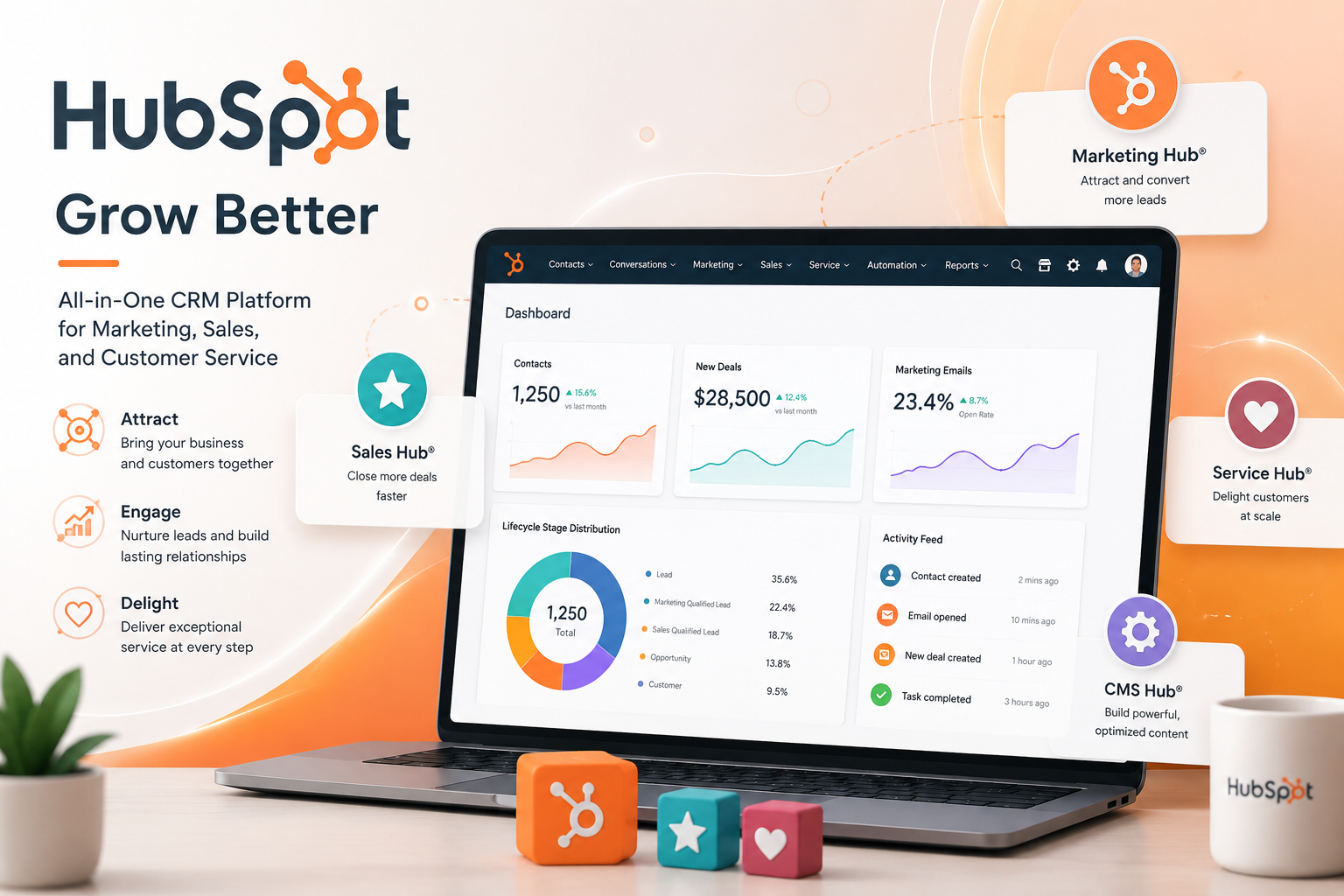
Sales Hub helps businesses streamline their sales process and improve team productivity.
Its tools assist sales professionals throughout the customer buying journey.
Lead Management
Sales representatives can organize leads based on:
- Source
- Industry
- Deal stage
- Priority
- Company size
This makes it easier to focus on high-value opportunities.
Pipeline Management
Sales teams can visualize opportunities moving through each stage of the sales cycle.
Managers gain visibility into:
- Open deals
- Forecasted revenue
- Sales performance
- Team activity
Meeting Scheduler
Customers can book appointments directly through integrated scheduling tools.
Benefits include:
- Fewer scheduling conflicts
- Reduced administrative work
- Faster meeting booking
Quote Generation
Sales Hub enables organizations to create professional sales quotes and proposals more efficiently.
Best Use Cases for Sales Hub
Sales Hub works particularly well for:
- SaaS companies
- Professional services firms
- Marketing agencies
- Technology startups
- B2B organizations
- Financial services companies
Service Hub
Excellent customer support is essential for building long-term customer loyalty.
Service Hub provides tools that help businesses deliver faster, more personalized support.
Ticket Management
Support teams can organize customer requests into tickets and track them through resolution.
This improves accountability and customer satisfaction.
Live Chat
Businesses can communicate with website visitors in real time.
Live chat helps:
- Answer questions quickly
- Qualify leads
- Resolve issues
- Improve customer experiences
Knowledge Base
Organizations can create self-service support articles covering common questions.
Benefits include:
- Reduced support workload
- Faster customer assistance
- Better user experience
Customer Feedback
Businesses can collect customer feedback through surveys and satisfaction tools.
This helps identify opportunities for improvement.
CMS Hub
HubSpot CMS Hub combines website management with CRM capabilities.
Unlike traditional content management systems, CMS Hub connects website content directly with customer data.
Website Builder
Organizations can build professional websites using drag-and-drop tools.
Features include:
- Responsive design
- SEO optimization
- Security
- Content personalization
Blog Management
Businesses can publish optimized blog content that supports:
- SEO
- Lead generation
- Customer education
- Brand awareness
Personalized Content
HubSpot allows organizations to customize website experiences based on visitor behavior.
Examples include:
- Personalized calls-to-action
- Dynamic website content
- Targeted recommendations
Operations Hub
Operations Hub focuses on improving internal efficiency.
Businesses often use multiple software platforms, creating data inconsistencies and manual work.
Operations Hub helps solve these challenges.
Data Synchronization
Businesses can synchronize information between HubSpot and third-party applications.
Examples include:
- Accounting software
- ERP systems
- E-commerce platforms
- Customer support software
Workflow Automation
Operations Hub automates repetitive business processes, reducing manual effort and improving accuracy.
Data Quality
Organizations can clean, organize, and standardize customer data to improve reporting and decision-making.
Breeze AI
Artificial intelligence is becoming a major competitive advantage for businesses.
HubSpot’s Breeze AI introduces intelligent assistance throughout the customer platform.
Its goal is to help organizations accomplish more work with fewer manual tasks.
Content Creation
Breeze AI assists users with:
- Blog outlines
- Marketing emails
- Social media posts
- Landing page copy
- Product descriptions
This helps marketers create content more efficiently.
Sales Assistance
Sales teams can use AI to:
- Draft emails
- Summarize customer interactions
- Generate follow-up suggestions
- Prioritize opportunities
Customer Support
AI helps support representatives by:
- Suggesting responses
- Summarizing conversations
- Recommending knowledge base articles
- Improving response speed
Business Insights
Breeze AI analyzes customer information and business data to identify trends and opportunities.
Organizations can use these insights to improve marketing, sales, and customer service strategies.
HubSpot App Marketplace
HubSpot integrates with a wide range of business software through its App Marketplace.
Popular integration categories include:
- Accounting
- E-commerce
- Project management
- Customer support
- Productivity
- Communications
- Payment processing
- Analytics
These integrations allow businesses to build connected workflows without replacing existing software.
HubSpot Security & Privacy
Businesses trust HubSpot with sensitive customer information, making security a top priority.
Security Features
HubSpot supports:
- Multi-factor authentication (MFA)
- User permissions
- Data encryption
- Single sign-on (SSO)
- Activity logs
- Secure cloud infrastructure
These capabilities help protect customer and business data.
Privacy & Compliance
HubSpot provides features that assist organizations in managing customer data responsibly and supporting compliance efforts with applicable privacy regulations.
Businesses should configure these tools according to their legal, regulatory, and operational requirements.
HubSpot Pricing Overview
HubSpot offers multiple pricing tiers designed for businesses at different stages of growth.
Organizations can choose from:
- Free tools
- Starter plans
- Professional plans
- Enterprise plans
Pricing varies depending on:
- Number of users
- Contacts
- Selected Hubs
- Advanced automation features
- AI capabilities
The availability of free tools makes HubSpot an attractive option for startups and small businesses, while Professional and Enterprise plans provide advanced functionality for larger organizations.
Why U.S. Businesses Choose HubSpot
Many American businesses choose HubSpot because it combines:
- User-friendly CRM
- Powerful marketing automation
- Integrated sales and service tools
- AI-powered productivity with Breeze AI
- Scalable cloud architecture
- Strong reporting and analytics
- Extensive educational resources through HubSpot Academy
- Large integration ecosystem
- Flexible pricing options
- Fast implementation compared with many enterprise CRM platforms
Whether supporting a startup in its first year or helping a rapidly growing company scale customer engagement, HubSpot provides a flexible platform that adapts as business needs evolve.
HubSpot vs Salesforce vs Microsoft Dynamics 365 vs Zoho CRM vs Pipedrive
Choosing the right CRM platform is one of the most important technology decisions a business can make. While HubSpot has earned a strong reputation for its ease of use and integrated customer platform, it competes with several established CRM providers that serve different business needs.
Below is a comparison of HubSpot with four of its biggest competitors in the U.S. market.
HubSpot vs Salesforce
Salesforce is the world’s largest CRM provider and is often considered the benchmark for enterprise customer relationship management.
| Category | HubSpot | Salesforce |
|---|---|---|
| Headquarters | Cambridge, Massachusetts | San Francisco, California |
| Primary Focus | CRM & Customer Platform | Enterprise CRM |
| AI Technology | Breeze AI | Agentforce & Einstein AI |
| Best For | SMBs & Mid-Market | Mid-Market to Enterprise |
| Learning Curve | Easy | Moderate to Advanced |
| Customization | High | Very High |
HubSpot Advantages
- Easier to learn
- Free CRM available
- Excellent marketing automation
- Fast implementation
- User-friendly interface
Salesforce Advantages
- Enterprise scalability
- Advanced workflow automation
- Extensive customization
- Larger ecosystem
- More industry-specific solutions
Best Choice
HubSpot is an excellent choice for startups and growing businesses, while Salesforce is often preferred by organizations with complex enterprise requirements.
HubSpot vs Microsoft Dynamics 365
Microsoft Dynamics 365 combines CRM and ERP capabilities with Microsoft’s business software ecosystem.
| Category | HubSpot | Microsoft Dynamics 365 |
|---|---|---|
| Ease of Use | Excellent | Moderate |
| Marketing Tools | Excellent | Strong |
| Microsoft Integration | Limited | Excellent |
| AI | Breeze AI | Copilot AI |
| Best For | Growing businesses | Microsoft ecosystem users |
Best Choice
Organizations already using Microsoft 365, Azure, Teams, and Power Platform may benefit from Dynamics 365, while HubSpot remains attractive for businesses prioritizing marketing, CRM, and ease of adoption.
HubSpot vs Zoho CRM
Zoho Corporation offers affordable CRM software for small businesses.
| Category | HubSpot | Zoho CRM |
|---|---|---|
| Ease of Use | Excellent | Good |
| Marketing Features | Advanced | Moderate |
| Pricing | Higher | Lower |
| AI | Breeze AI | Zia AI |
| Best For | Growing businesses | Budget-conscious SMBs |
Best Choice
Zoho CRM may appeal to organizations with limited budgets, while HubSpot provides a more comprehensive customer platform with stronger marketing capabilities.
HubSpot vs Pipedrive
Pipedrive focuses on sales pipeline management.
| Category | HubSpot | Pipedrive |
|---|---|---|
| CRM | Excellent | Excellent |
| Marketing Automation | Advanced | Basic |
| Customer Service | Included | Limited |
| Website Tools | Included | Limited |
| AI Features | Extensive | Growing |
Best Choice
Pipedrive is well suited for sales-focused organizations, while HubSpot offers a broader platform that combines marketing, sales, customer service, and website management.
CRM Comparison Summary
| CRM Platform | Best For |
|---|---|
| HubSpot | Startups, SMBs, Marketing Teams |
| Salesforce | Enterprise Organizations |
| Microsoft Dynamics 365 | Microsoft-Centric Businesses |
| Zoho CRM | Budget-Friendly CRM |
| Pipedrive | Sales-Driven Teams |
HubSpot Pros and Cons
Every CRM platform has strengths and limitations. Understanding both can help businesses choose software that aligns with their goals.
HubSpot Advantages
1. Easy to Use
HubSpot is known for its clean interface and intuitive navigation, making it accessible to teams with limited technical expertise.
2. Free CRM
One of HubSpot’s biggest advantages is its free CRM, which allows businesses to begin managing customer relationships without significant upfront costs.
3. Complete Customer Platform
HubSpot combines:
- CRM
- Marketing
- Sales
- Customer Service
- Website Management
- Operations
- Artificial Intelligence
This reduces the need for multiple standalone applications.
4. Strong Marketing Automation
HubSpot remains one of the leading platforms for inbound marketing and marketing automation.
Businesses can automate:
- Email campaigns
- Lead nurturing
- Customer journeys
- Social media scheduling
- Lead scoring
5. Extensive Learning Resources
HubSpot Academy provides free certifications, tutorials, and educational materials that help businesses and professionals improve their marketing, sales, and CRM skills.
HubSpot Limitations
1. Advanced Features Require Higher-Tier Plans
While HubSpot offers free tools, many advanced capabilities—including sophisticated automation and reporting—are available only in Professional or Enterprise plans.
2. Costs Can Increase as Businesses Grow
Subscription costs may rise with:
- More contacts
- Additional users
- Advanced Hubs
- Premium AI features
Organizations should evaluate long-term pricing as they scale.
3. Less Customization Than Some Enterprise Platforms
Although HubSpot offers extensive customization, organizations with highly complex workflows may find platforms like Salesforce more flexible for enterprise-specific requirements.
4. Contact-Based Pricing
Businesses with rapidly growing databases should monitor contact limits, as pricing can increase with larger customer lists.
HubSpot Pros and Cons Summary
| Pros | Cons |
|---|---|
| Easy implementation | Advanced tools require higher plans |
| Free CRM | Costs can increase over time |
| Excellent marketing automation | Contact-based pricing |
| Integrated customer platform | Less customization than some enterprise CRMs |
| Strong educational resources | Enterprise implementations may require planning |
Latest HubSpot Developments in 2026
HubSpot continues investing in artificial intelligence, automation, and customer experience to help businesses improve productivity and build stronger customer relationships.
Expansion of Breeze AI
Breeze AI is becoming a central part of the HubSpot platform.
Businesses can use AI to:
- Draft emails
- Generate blog content
- Create marketing campaigns
- Summarize customer interactions
- Assist sales representatives
- Improve workflow automation
These capabilities help teams save time while maintaining quality.
Smarter CRM Automation
HubSpot continues improving workflow automation through intelligent triggers, predictive insights, and enhanced reporting.
Organizations can automate routine tasks while gaining deeper visibility into customer behavior.
Improved Customer Platform
HubSpot is expanding the integration between its Hubs, creating a more unified experience across marketing, sales, service, content management, and operations.
This connected approach helps businesses reduce data silos and improve collaboration.
AI-Powered Customer Experiences
Businesses increasingly expect software to personalize customer interactions.
HubSpot continues adding AI-driven recommendations that help organizations deliver more relevant communications across email, websites, live chat, and customer support.
Continued Investment in Small and Mid-Sized Businesses
Unlike many enterprise software providers, HubSpot remains focused on helping startups and growing companies adopt professional CRM and marketing tools without excessive complexity.
This strategy continues to make HubSpot one of the most popular customer platforms in the United States.
Expert Recommendations: Who Should Use HubSpot?
HubSpot is a flexible platform, but it is especially well suited for certain types of organizations.
Best for Startups
Startups benefit from:
- Free CRM
- Easy implementation
- Scalable pricing
- Marketing automation
- Sales tools
Best for Small and Mid-Sized Businesses
Growing businesses can use HubSpot to:
- Manage customer relationships
- Automate marketing
- Improve sales performance
- Deliver better customer service
Best for Marketing Agencies
Marketing agencies often choose HubSpot because it supports:
- Campaign management
- Client reporting
- Lead generation
- Email marketing
- Website optimization
Best for SaaS Companies
Software companies use HubSpot to:
- Generate leads
- Manage sales pipelines
- Improve onboarding
- Support customer success
Best for Organizations Focused on Customer Experience
Businesses prioritizing customer engagement, marketing automation, and long-term relationship management will benefit from HubSpot’s integrated platform.
Frequently Asked Questions (FAQs)
1. What is HubSpot used for?
HubSpot is used for customer relationship management (CRM), marketing automation, sales management, customer support, website management, and business analytics through a cloud-based platform.
2. Is HubSpot an American company?
Yes. HubSpot is an American software company headquartered in Cambridge, Massachusetts, specializing in CRM, marketing automation, and customer engagement software.
3. Is HubSpot CRM really free?
Yes. HubSpot offers a free CRM with essential contact management, deal tracking, reporting, and customer management tools. Advanced capabilities are available through paid plans.
4. What is Breeze AI?
Breeze AI is HubSpot’s artificial intelligence technology that helps users generate content, automate workflows, summarize customer interactions, and improve productivity across the platform.
5. Is HubSpot good for small businesses?
Yes. HubSpot is one of the most popular CRM platforms for startups and small businesses because of its user-friendly interface, scalable pricing, and integrated marketing tools.
6. Is HubSpot better than Salesforce?
It depends on business needs. HubSpot is often preferred for ease of use and marketing automation, while Salesforce offers deeper customization and enterprise-scale CRM capabilities.
7. What industries use HubSpot?
HubSpot is widely used in technology, healthcare, education, professional services, manufacturing, finance, real estate, retail, nonprofit organizations, and marketing agencies.
8. Does HubSpot include marketing automation?
Yes. Marketing Hub includes automation tools for email marketing, lead nurturing, customer journeys, campaign management, and audience segmentation.
9. Can HubSpot integrate with other software?
Yes. HubSpot supports integrations with hundreds of third-party applications through its App Marketplace, including accounting, e-commerce, communication, and productivity tools.
10. Is HubSpot worth learning in 2026?
Yes. HubSpot skills remain valuable because businesses continue investing in CRM, digital marketing, customer experience, automation, and AI-powered business software.
Publish On: July 24, 2026

SoftwareCompanyNearMe Editorial Team is dedicated to researching and publishing trusted content about U.S. software companies, SaaS platforms, artificial intelligence (AI), cloud computing, cybersecurity, and enterprise technology. Our goal is to help businesses, IT professionals, and software buyers make informed decisions through accurate, well-researched, and regularly updated technology guides, company reviews, and industry insights.
1 thought on “HubSpot Review: 15 Powerful Things You Need to Know in 2026”