
Last Updated: August 10, 2026
Artificial intelligence has moved from being a future technology concept to an essential business tool across the United States. While companies once questioned whether AI would truly transform the workplace, businesses today are focused on finding practical ways to integrate it into daily operations.
From small businesses to global enterprises, organizations are using AI to automate repetitive tasks, analyze information, improve customer experiences, and help employees work more efficiently. As companies face increasing pressure to save time, reduce costs, and make smarter decisions, AI has become a valuable solution.
The challenge is no longer whether businesses should use AI, but choosing the right tools for their specific needs. With hundreds of AI platforms available for productivity, automation, marketing, software development, and customer management, companies must focus on building an AI-powered workflow that creates real business value.
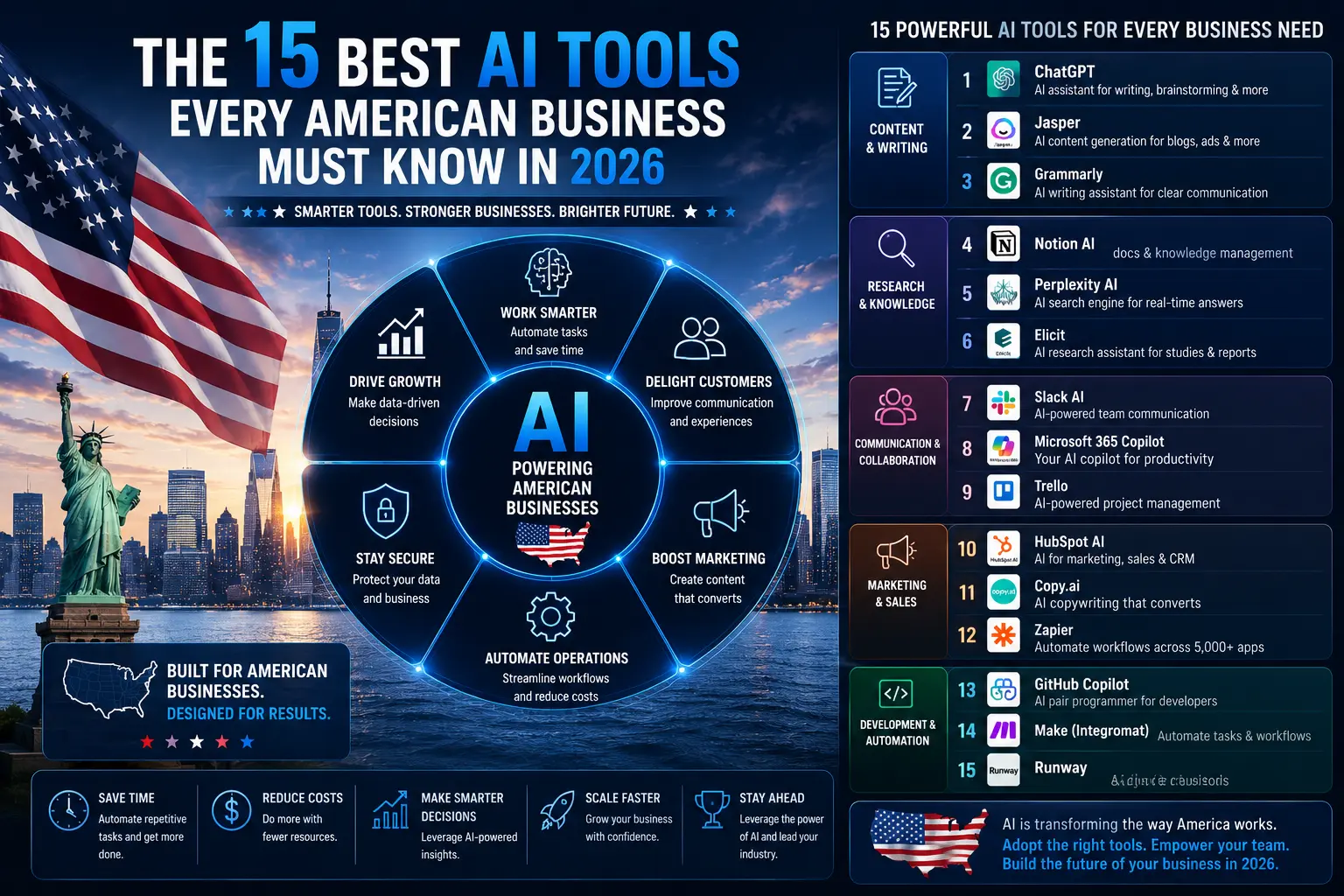
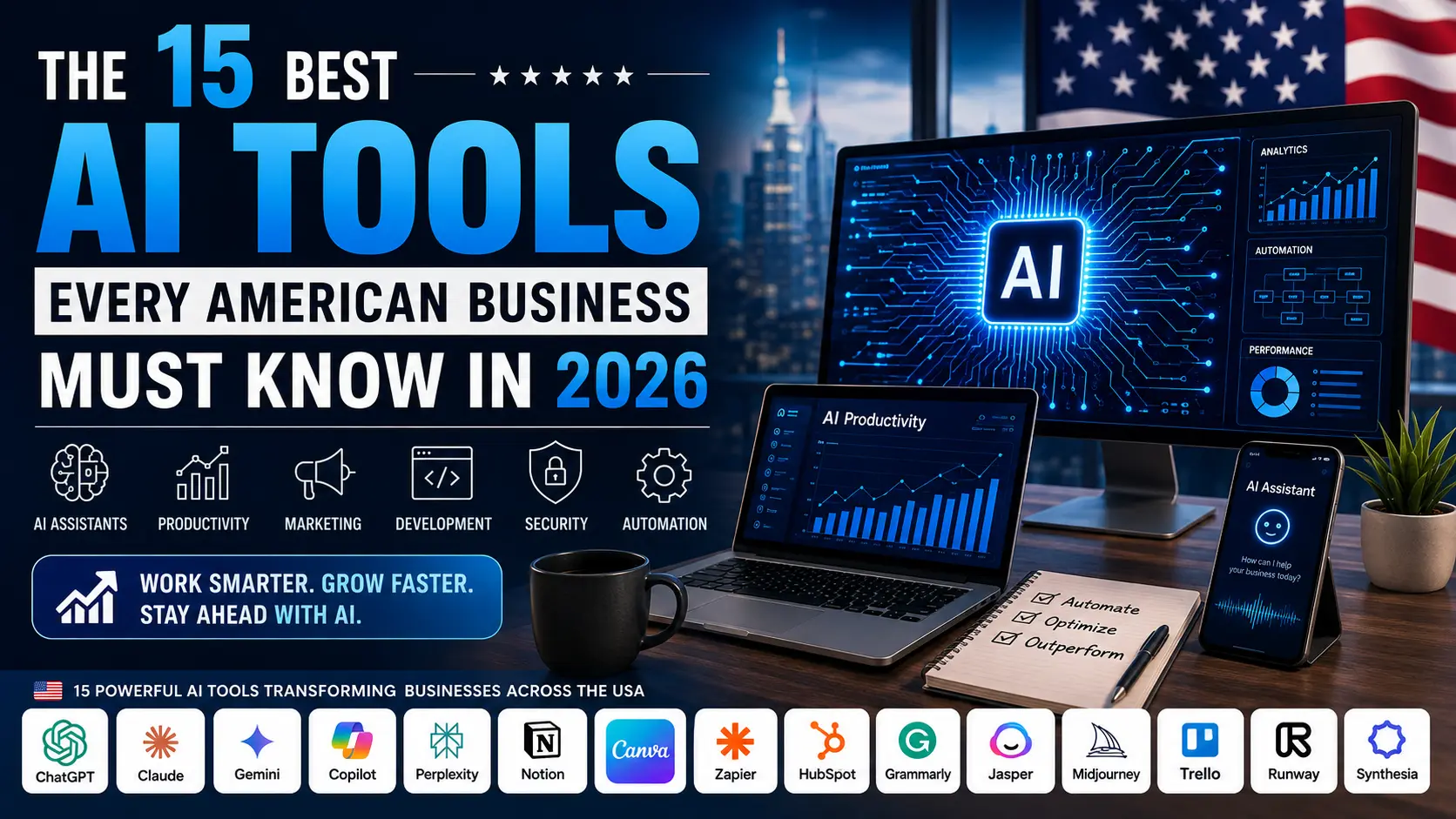
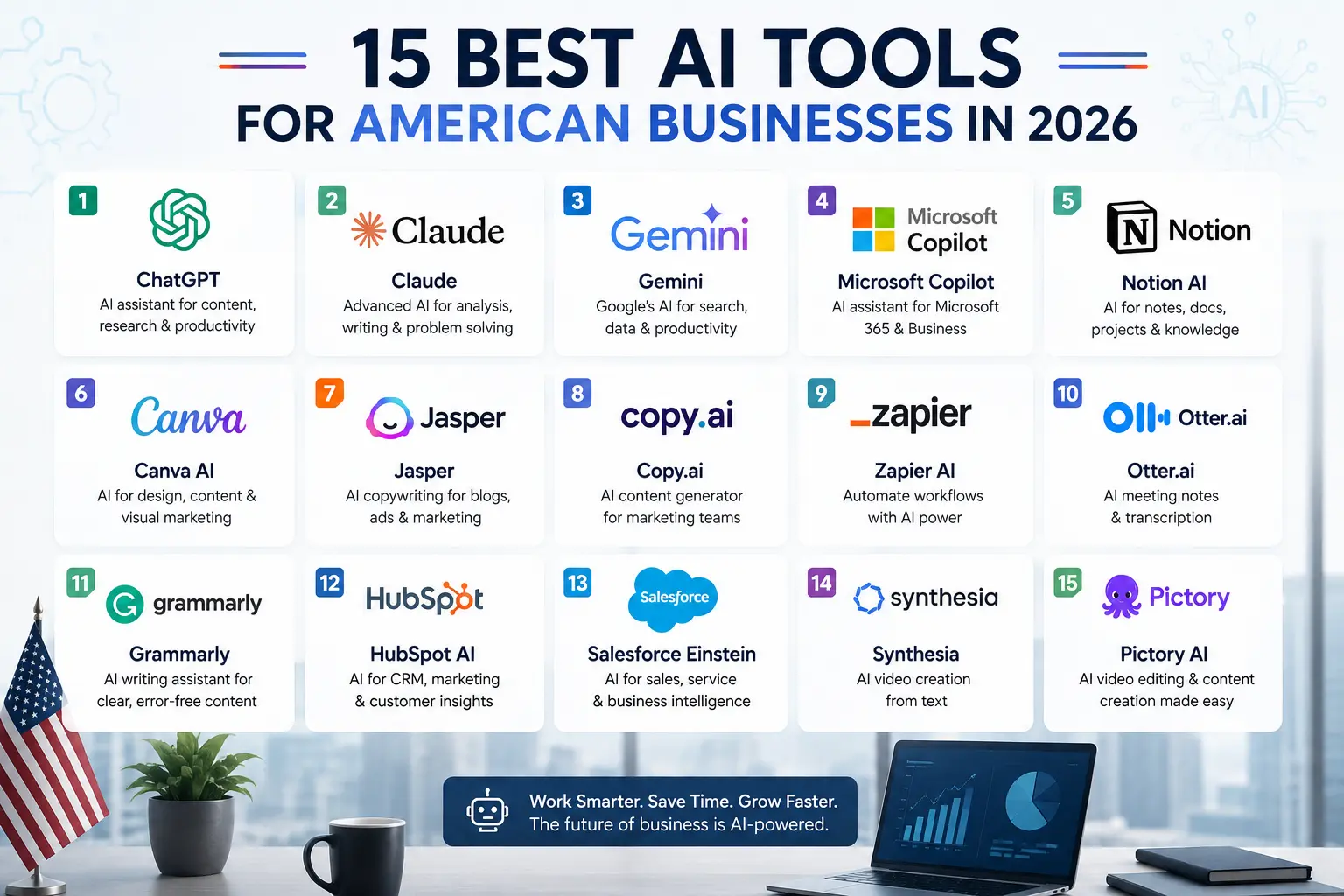
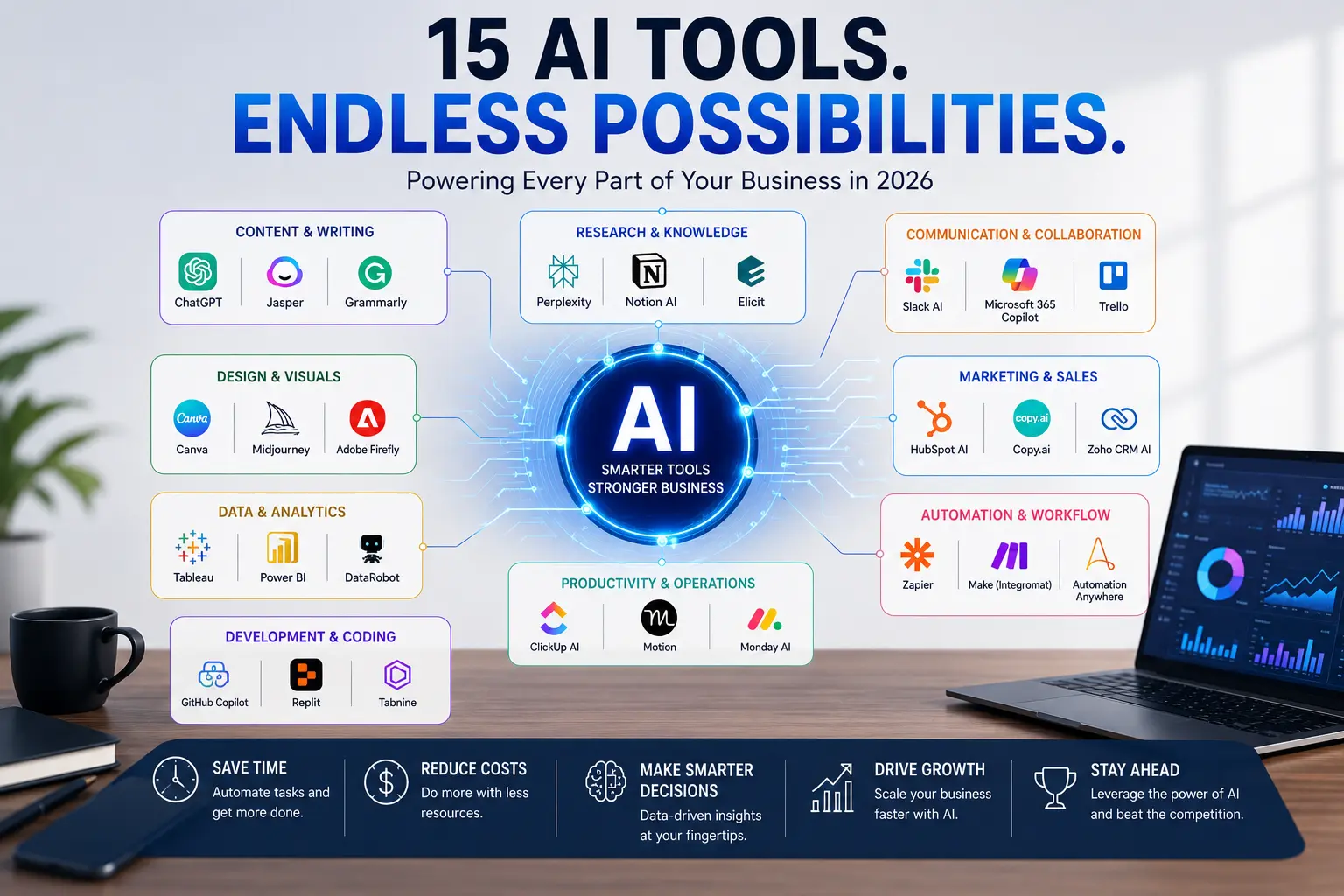
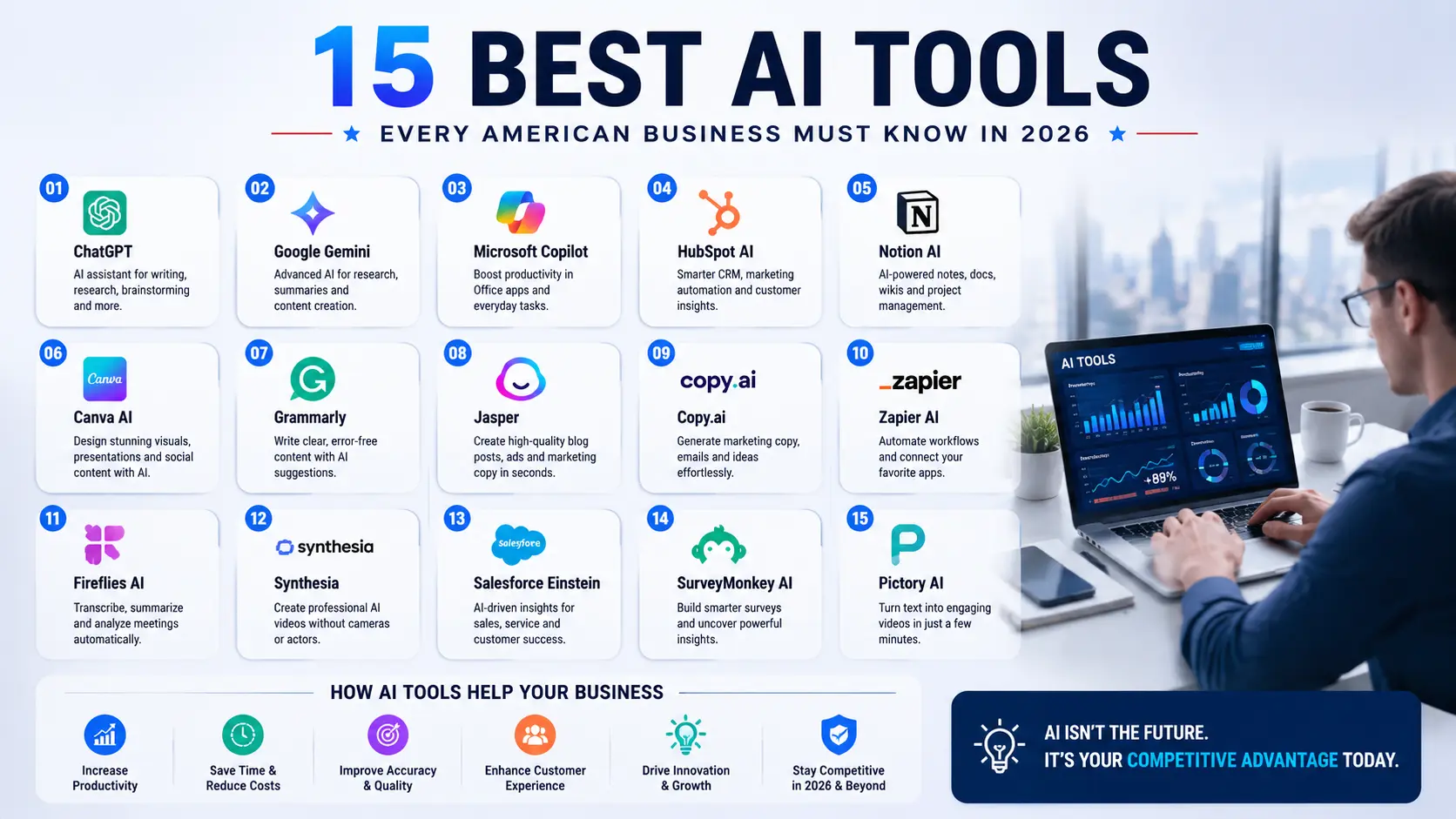
This guide explores Best AI Tools AI tools businesses should know in 2026.
AI Assistants Are Becoming Essential Business Partners
AI assistants have become one of the most important developments in modern business technology. Unlike traditional software that only performs specific tasks, AI-powered platforms can help employees write content, analyze data, summarize information, generate ideas, and support daily decision-making.
Among these tools, ChatGPT has become a popular choice for businesses because of its versatility. Companies use it for tasks such as creating emails, preparing reports, developing marketing ideas, assisting customers, and improving internal workflows. Its biggest advantage is helping teams complete routine work faster while allowing employees to focus on more strategic tasks.
However, businesses are also turning to specialized AI assistants for specific needs. Tools like Claude are becoming valuable for professionals who work with complex documents, research materials, and detailed analysis. By helping teams understand large amounts of information more efficiently, AI assistants are becoming powerful partners in everyday business operations.
Microsoft and Google Are Bringing AI Directly Into Everyday Work
The next major shift in business AI is happening inside the software platforms companies already use every day. Instead of asking employees to learn completely new systems, businesses are looking for AI features that work naturally within their existing workflows.
This is why tools like Microsoft Copilot and Google Gemini are gaining attention. Copilot brings AI capabilities directly into Microsoft 365 applications such as Word, Excel, Outlook, PowerPoint, and Teams, helping employees create documents, analyze data, summarize information, and improve productivity without changing their daily routines.
Similarly, Google Gemini integrates AI into Google Workspace tools like Gmail, Docs, Sheets, and Meet, making it especially useful for startups and remote teams. The future of workplace AI will depend not only on powerful technology but also on how easily businesses can integrate it into everyday operations..
Why AI Adoption Is Accelerating Among American Businesses
Businesses are adopting AI rapidly because it helps improve efficiency and productivity. Many daily tasks, such as managing emails, organizing documents, preparing reports, and handling customer inquiries, take valuable time but do not always require human creativity.
AI helps companies automate these repetitive processes, allowing employees to focus on more strategic and valuable work. For small businesses, it provides access to capabilities that previously required additional staff or expensive services, while larger organizations use AI to analyze large amounts of data and improve decision-making.
As a result, AI is no longer just a technology experiment. Businesses are embracing it as a practical strategy to work faster, compete effectively, and better meet customer expectations.
Quick Company Snapshot
| Category | Details |
|---|---|
| Article Type | AI Software Guide |
| Industry | Artificial Intelligence & Business Technology |
| Target Audience | Small Businesses, Startups, Enterprises |
| Primary Market | United States |
| Best Overall AI Tool | ChatGPT |
| Best Enterprise AI Assistant | Microsoft Copilot |
| Best Research AI | Claude |
| Best Marketing AI | Jasper AI |
| Best Automation AI | Zapier AI |
| Updated | August 2026 |
Author Review
Artificial intelligence has moved beyond being an experimental technology used only by large technology companies. In 2026, AI has become a practical business tool that organizations across the United States are using to improve productivity, reduce operational costs, and make faster decisions.
After analyzing the current AI landscape, one thing has become clear: the companies benefiting the most from artificial intelligence are not necessarily the ones using the most advanced technology. They are the ones that understand where AI can create real business value.
A small business owner using AI to create marketing campaigns, a startup founder automating customer communication, or an enterprise team analyzing thousands of documents are all solving different problems. The right AI solution depends on the company’s goals, workflow, and industry.
The biggest mistake businesses make is choosing AI tools because they are popular rather than because they solve a specific challenge. A successful AI strategy starts with understanding what slows your team down and finding technology that can remove those obstacles.
In this guide, we examine the most valuable AI tools shaping American businesses in 2026, including AI assistants, productivity platforms, automation software, marketing solutions, research tools, and enterprise AI systems.
AI Is Changing How Businesses Create Content and Build Their Brands
Creating content has always been one of the biggest challenges for businesses.
Whether it is writing website pages, creating advertising campaigns, publishing social media posts, preparing email newsletters, or developing sales materials, companies constantly need fresh and engaging content to attract customers.
For large organizations, this usually means dedicated marketing teams, content strategists, designers, and agencies. However, small businesses and startups often do not have the same resources. A business owner may be responsible for managing operations, serving customers, handling finances, and still finding time to market the company.
This is where AI-powered marketing tools are creating new opportunities.
Modern AI software for business is helping companies produce content faster while maintaining consistency across different channels. Instead of replacing creative professionals, these platforms are becoming productivity partners that help teams generate ideas, improve messaging, and complete projects more efficiently.
Among the companies leading this transformation is Jasper AI.
Jasper AI: Helping Businesses Scale Their Marketing Efforts
Marketing success depends on understanding customers and delivering the right message at the right time. While creativity remains at the center of marketing, businesses are increasingly using AI to speed up content creation and improve campaign efficiency.
Jasper AI has become a popular choice for companies because it is designed specifically for marketing tasks. Unlike general AI assistants, it helps businesses create blog content, advertising copy, product descriptions, emails, social media posts, and brand messaging while maintaining a consistent voice.
For growing businesses, this can save significant time. Marketing teams can use Jasper to generate ideas, create initial drafts, and test different approaches faster, allowing them to focus more on strategy and customer engagement.
However, AI works best as a creative partner rather than a replacement for marketers. Human expertise is still essential for understanding audiences, building brand identity, and making final decisions. By combining AI efficiency with human creativity, businesses can produce better marketing content while using fewer resources.
Visual Content Is Becoming Just as Important as Written Content
Modern businesses compete in a world where capturing customer attention has become increasingly difficult. Whether someone is scrolling through social media, visiting a website, or viewing an advertisement, strong visuals often influence whether they engage with a brand or move on.
This has made professional design and creative content more important than ever. However, creating high-quality graphics, presentations, and marketing materials traditionally required specialized skills and expensive resources, making it challenging for many small businesses.
Artificial intelligence is changing this process by making professional-level design more accessible. Tools like Canva AI and Midjourney are helping businesses create engaging visual content faster while allowing teams to explore new creative possibilities without relying entirely on traditional design workflows.
Canva AI: Bringing Professional Design to Every Business
Canva has become a popular design platform for businesses, marketers, and creators because of its simple and accessible approach to visual content creation. With the addition of AI-powered features, it has evolved into a more advanced tool that helps companies create marketing graphics, presentations, social media content, and branded materials faster.
For small businesses, Canva AI reduces the need for expensive design resources by allowing teams to create professional-looking visuals without advanced design skills. Larger organizations also benefit by using AI features to speed up repetitive tasks such as resizing designs, improving layouts, and creating content variations.
Rather than replacing professional designers, Canva AI helps creative teams work more efficiently by handling routine tasks and allowing them to focus on higher-value ideas. It represents a broader shift where AI is making powerful business tools accessible to organizations of all sizes.
Midjourney and the New Era of AI-Generated Creativity
While Canva AI focuses on practical design needs, Midjourney represents the creative side of artificial intelligence. As businesses increasingly rely on visual content for websites, advertisements, presentations, and social media, AI-generated images are helping teams explore new ideas faster.
Midjourney allows companies to turn concepts into unique visuals, making it useful for product planning, marketing campaigns, and creative brainstorming. Instead of replacing designers or traditional photography, it works as a tool that helps creative teams experiment with different styles and develop ideas more efficiently.
For businesses using AI-generated visuals, it is important to consider brand consistency, licensing rules, and commercial usage policies. When used responsibly, Midjourney can become a powerful creative assistant that helps brands produce engaging content faster.
AI Automation Is Helping Companies Eliminate Repetitive Work
Beyond content and design, automation has become one of the most valuable uses of artificial intelligence in business. Companies spend countless hours on repetitive tasks such as updating records, managing workflows, sending follow-ups, and organizing information.
AI automation tools are helping businesses simplify these processes by handling routine work automatically. Platforms like Zapier AI allow teams to connect different applications, reduce manual effort, and focus more time on strategic activities that drive growth.
Zapier AI: Connecting Business Workflows Through Automation
Modern businesses rely on multiple software platforms to manage sales, marketing, finance, and customer support. However, keeping these systems connected can be challenging and often creates unnecessary manual work.
Zapier AI helps solve this problem by connecting different applications and automating everyday workflows without requiring advanced technical skills. Businesses can use it to organize customer inquiries, automate follow-ups, update records, and streamline internal processes.
For small businesses and startups, AI automation tools like Zapier AI can create significant efficiency gains by reducing repetitive tasks, minimizing errors, and allowing teams to focus more on growth, innovation, and customer relationships.
Notion AI: Turning Business Information Into an Intelligent Workspace
As businesses grow, managing internal knowledge becomes increasingly challenging. Important information often gets scattered across emails, documents, and different platforms, making it difficult for teams to find what they need quickly.
Notion AI helps solve this problem by combining workspace management with artificial intelligence. Businesses use it to organize documents, summarize information, manage projects, and create a centralized knowledge hub for teams.
For startups and growing companies, an AI-powered workspace improves collaboration, saves time, and helps employees access important information faster. By making knowledge easier to manage, businesses can make better decisions and operate more efficiently.
The Growing Role of Specialized AI Tools in Business
The biggest lesson from the AI revolution is that businesses do not need one tool to handle everything. The future is moving toward specialized AI ecosystems, where companies choose different platforms based on specific needs.
For example, businesses may use ChatGPT for productivity, Jasper for marketing, Canva AI for design, Zapier AI for automation, and Notion AI for knowledge management. The most successful organizations will be those that select the right AI tools to improve their workflows rather than simply adopting every new technology trend.
AI is not about replacing business processes—it is about making them smarter, faster, and more efficient.
AI Is Transforming Software Development From the Ground Up
Software development has always required specialized skills, with developers spending significant time writing code, fixing errors, testing applications, and maintaining systems. However, artificial intelligence is changing how software teams work.
In 2026, AI coding assistants are not replacing developers; they are helping them write code faster, solve problems more efficiently, and reduce repetitive tasks. As businesses across industries become increasingly dependent on software, these tools are helping companies build and improve digital solutions more quickly.
GitHub Copilot: The AI Assistant Changing How Developers Build Software
GitHub Copilot has become one of the leading AI coding assistants, helping developers write, understand, and improve software more efficiently. Instead of creating every piece of code from scratch, developers can use AI-generated suggestions to speed up programming tasks, solve problems, and explore better solutions.
For experienced engineers, Copilot reduces repetitive work and allows more focus on areas like system design, security, and business logic. For newer developers, it acts as a learning assistant by providing examples and guidance during development.
The real value of GitHub Copilot is not replacing developers but enhancing their abilities. By combining human expertise with AI assistance, businesses can build software faster, improve productivity, and manage increasingly complex technology projects more effectively.
AI Research Tools Are Changing How Businesses Make Decisions
Business decisions have always relied on reliable information, but the amount of data available today has created a new challenge: finding meaningful insights quickly. Companies now analyze market trends, customer behavior, competitor activity, and industry research from countless sources.
Artificial intelligence is helping businesses manage this growing information overload. AI research tools allow professionals to summarize complex topics, discover relevant insights, and make better-informed decisions without spending hours manually searching through large amounts of data..
Perplexity AI: A Faster Way for Businesses to Research Information
Perplexity AI has become a valuable research tool because it helps users understand information faster than traditional search methods. Instead of only displaying links, it provides organized answers that help professionals explore complex topics more efficiently.
Businesses use AI research tools for tasks such as analyzing competitors, studying market trends, understanding customer behavior, and preparing for strategic decisions. By reducing the time spent searching through multiple sources, Perplexity helps teams focus more on analysis and planning.
However, AI should support human expertise rather than replace it. Important decisions in areas like finance, healthcare, and law still require professional evaluation. The real benefit of AI research assistants is helping businesses gather insights faster and make more informed decisions.
AI Is Making Workplace Communication More Intelligent
One of the most valuable yet often overlooked uses of artificial intelligence is improving business communication. Employees spend significant time attending meetings, managing emails, preparing reports, and sharing information across teams.
As remote and hybrid work becomes more common, keeping employees connected has become more challenging. AI-powered communication tools help businesses summarize discussions, organize information, and improve collaboration, making workplace communication faster and more efficient.
Fireflies AI: Turning Meetings Into Searchable Business Knowledge
Meetings are essential for business, but valuable information is often lost once the conversation ends. Important details such as customer feedback, decisions, deadlines, and action items can easily be missed or forgotten.
Fireflies AI helps solve this problem by automatically recording, transcribing, and summarizing meetings. Sales teams can use it to track customer conversations and follow-ups, while managers gain better visibility into team discussions.
For remote and hybrid workplaces, AI meeting assistants turn everyday conversations into organized, searchable information, helping businesses improve collaboration and reduce administrative work.
AI Is Helping Businesses Understand Their Customers Better
Customer relationships have always been a key factor in business growth, but expectations are higher than ever. Customers now want faster responses, personalized experiences, and businesses that understand their needs.
As companies grow, managing thousands of interactions across emails, websites, applications, and social platforms becomes more challenging. AI-powered customer relationship tools are helping businesses organize customer data, improve communication, and create more personalized experiences at scale.
HubSpot AI: Bringing Intelligence Into Sales and Customer Management
Traditional customer relationship management focused mainly on collecting and organizing customer information. However, modern businesses need more than stored data—they need insights that help them understand customer behavior and improve decisions.
HubSpot AI combines CRM capabilities with artificial intelligence to help businesses manage sales, marketing, and customer service more effectively. It can help identify valuable leads, suggest follow-up actions, personalize communication, and reduce repetitive tasks.
For growing companies, AI-powered CRM tools make it easier to build stronger customer relationships at scale. Instead of simply managing customer data, businesses can use AI to learn from that information and create better customer experiences.
The Rise of AI-Powered Business Ecosystems
The biggest trend in business AI is that it is evolving into an interconnected ecosystem rather than a single all-purpose tool. Developers, executives, marketers, and sales teams are using specialized AI solutions to improve different areas of their work.
The future will not belong to companies using the most AI tools, but to those choosing the right solutions for their specific challenges. Businesses that strategically integrate AI into their workflows will be better positioned to improve efficiency, make smarter decisions, and stay competitive.
Salesforce Einstein: Bringing Enterprise-Level Intelligence to Customer Relationships
Enterprise organizations face a different AI challenge compared to smaller businesses. Instead of managing simple tasks, they handle millions of customer interactions, large datasets, and complex operations across multiple departments.
This is where enterprise AI solutions like Salesforce Einstein become valuable. By combining artificial intelligence with customer relationship management, Einstein helps companies analyze customer behavior, predict opportunities, improve sales performance, and create more personalized experiences.
For large organizations, AI can transform massive amounts of data into actionable insights. Sales teams can identify better opportunities, customer service teams can respond more effectively, and marketing teams can create more targeted campaigns.
The goal of enterprise AI is not to replace human decision-making but to support leaders with better information. For companies managing complex operations and large customer networks, AI-powered CRM platforms can provide a significant competitive advantage.
Choosing the Right AI Tool for Your Business
With thousands of AI platforms available today, choosing the right solution can be challenging. Many businesses search for a single “best AI tool,” but the ideal choice depends on the specific goals and challenges of each organization.
A small business may benefit from AI assistants like ChatGPT for writing, planning, and daily productivity, while companies handling complex documents may prefer tools focused on research and analysis. Marketing teams might choose platforms like Jasper AI or Canva AI, whereas software companies may find greater value in GitHub Copilot.
Before investing in AI software, businesses should focus on a few key factors: the problem they want to solve, whether employees can easily adopt the tool, if it can scale as the company grows, and whether it provides strong security and data protection.
The most successful AI strategies are not built around using the most tools. They focus on selecting the right solutions that deliver measurable improvements and support real business goals.
Grammarly: Improving Business Communication With AI
Clear communication has always been important for businesses. Whether companies are writing emails, preparing proposals, creating marketing content, or communicating with customers, the quality of writing can influence how people see their brand.
Grammarly has evolved from a simple grammar checker into an AI-powered writing assistant that helps professionals improve clarity, tone, and overall communication. In 2026, businesses use Grammarly to create more polished emails, reports, presentations, and customer messages while reducing common writing mistakes.
For remote and hybrid teams, maintaining consistent communication standards can be challenging. Grammarly helps employees write more confidently by providing real-time suggestions and improving the quality of everyday business conversations.
How Businesses Use Grammarly
Companies use Grammarly for client emails, sales proposals, marketing content, internal documents, HR communications, and customer support responses. It also helps professionals refine reports, presentations, and online content before sharing them with their audience.
Why Businesses Trust Grammarly
Grammarly helps businesses avoid unclear messaging and writing errors that can affect professional relationships. Beyond grammar corrections, its AI features provide tone and clarity suggestions, helping employees communicate in a way that matches their audience.
Pros
- Easy to use across multiple platforms
- Strong grammar and spelling suggestions
- AI-powered tone and clarity improvements
- Helps maintain professional communication
- Useful for teams and individual professionals
Cons
- Premium business features require a subscription.
- Some technical or industry-specific terms may still need manual review.
Best For
Grammarly is best for businesses of all sizes, especially marketing teams, customer support departments, HR teams, consultants, and professionals who regularly create written content.
Common Mistakes Businesses Make When Implementing AI
Artificial intelligence can deliver significant business value, but successful adoption requires a thoughtful strategy. Many organizations rush to adopt AI because of market pressure, only to waste resources by choosing tools without clear goals.
One common mistake is trying to automate everything at once. Businesses achieve better results by introducing AI gradually, focusing on specific challenges, and measuring improvements over time.
Companies should also understand that AI is not a replacement for human expertise. While AI can automate tasks, analyze information, and generate ideas, human judgment remains essential for making important decisions.
Employee training is another key factor. Teams need to understand how to use AI effectively, evaluate results, and integrate these tools into their daily workflows.
Finally, businesses must prioritize data privacy and security. Responsible AI adoption is not just about improving efficiency—it is about creating a reliable and trustworthy technology environment.
The Future of AI in American Businesses
The future of artificial intelligence will be about deeper integration into everyday business operations rather than simply creating smarter chatbots or automation tools. Companies are moving toward AI-powered workflows that support planning, analysis, communication, customer service, and decision-making.
Businesses may use AI to understand customer behavior, improve marketing campaigns, assist software development, and streamline daily processes. However, this does not mean companies will become fully automated.
Human skills such as creativity, leadership, strategic thinking, and relationship building will remain essential. The greatest advantage for American businesses will come from combining human expertise with the capabilities of artificial intelligence.
Frequently Asked Questions About AI Tools for Business
What is the best AI tool for small businesses in 2026?
For many small businesses, ChatGPT is one of the strongest starting points because it can assist with writing, research, customer communication, planning, and everyday productivity.
However, the best choice depends on business needs. A marketing company may benefit more from Jasper AI, while an automation-focused business may prefer Zapier AI.
Can AI tools replace employees?
AI tools are unlikely to replace employees completely. Instead, they are changing how employees work.
Businesses are using AI to handle repetitive tasks, organize information, and improve productivity while allowing employees to focus on creativity, strategy, and customer relationships.
Are AI tools expensive for businesses?
AI pricing varies widely.
Many platforms offer free versions or affordable plans suitable for startups and small businesses. Enterprise AI solutions usually require larger investments because they provide advanced security, customization, and scalability.
Is AI safe for business use?
AI can be safe when businesses choose reliable providers and establish proper usage policies.
Companies should carefully review security practices, privacy controls, and data-handling policies before implementing AI solutions.
Which AI tools are best for business productivity?
AI productivity tools such as ChatGPT, Microsoft Copilot, Google Gemini, Notion AI, and Fireflies AI can help businesses improve communication, manage information, automate tasks, and save time.
Final Verdict: The Best AI Tools Are the Ones That Solve Real Problems
Artificial intelligence has become one of the most important technologies shaping modern business. What started as an emerging innovation has quickly evolved into a practical solution used by companies of all sizes across the United States to improve productivity, reduce costs, and enhance customer experiences.
However, successful AI adoption is not about using the newest tools—it is about choosing solutions that solve real business challenges. Companies are finding value in different AI platforms, from ChatGPT and Claude for productivity and research to Microsoft Copilot, Google Gemini, Jasper AI, Canva AI, Zapier AI, and GitHub Copilot for specialized business needs.
The future of AI will not belong only to large enterprises with massive budgets. Businesses of every size can benefit by developing a clear AI strategy and using technology to improve the way they work.
The question is no longer whether companies should adopt AI. The real focus is how they can use it effectively to create better experiences for customers, employees, and the organization itself.
Conclusion
Artificial intelligence is changing the way American businesses operate, compete, and grow.
The tools discussed in this guide represent only a portion of the rapidly expanding AI ecosystem, but they highlight the most important areas where businesses are already seeing results: productivity, automation, marketing, software development, research, communication, and customer management.
The companies that succeed in the coming years will not necessarily be those that adopt the most AI tools.
They will be the ones that use AI thoughtfully.
By identifying real business challenges, choosing the right solutions, training employees, and maintaining a balance between technology and human expertise, organizations can turn artificial intelligence into a powerful advantage.
In 2026, AI is no longer a future possibility.
It has become a practical business tool—and companies that learn how to use it effectively will be better prepared for the next era of innovation.

SoftwareCompanyNearMe Editorial Team is dedicated to researching and publishing trusted content about U.S. software companies, SaaS platforms, artificial intelligence (AI), cloud computing, cybersecurity, and enterprise technology. Our goal is to help businesses, IT professionals, and software buyers make informed decisions through accurate, well-researched, and regularly updated technology guides, company reviews, and industry insights.