Introduction
When business leaders discuss the companies shaping enterprise technology, one name consistently stands alongside the industry’s biggest innovators: Oracle. From powering mission-critical databases for Fortune 500 companies to delivering cloud infrastructure, artificial intelligence, enterprise resource planning (ERP), and healthcare technology, Oracle has become one of the most influential software companies in the United States.
Founded in Silicon Valley nearly five decades ago, Oracle has evolved from a database software pioneer into a global technology powerhouse serving organizations of every size. Today, thousands of government agencies, financial institutions, hospitals, manufacturers, retailers, universities, and technology companies rely on Oracle software to store data, run business operations, secure digital infrastructure, and accelerate innovation.
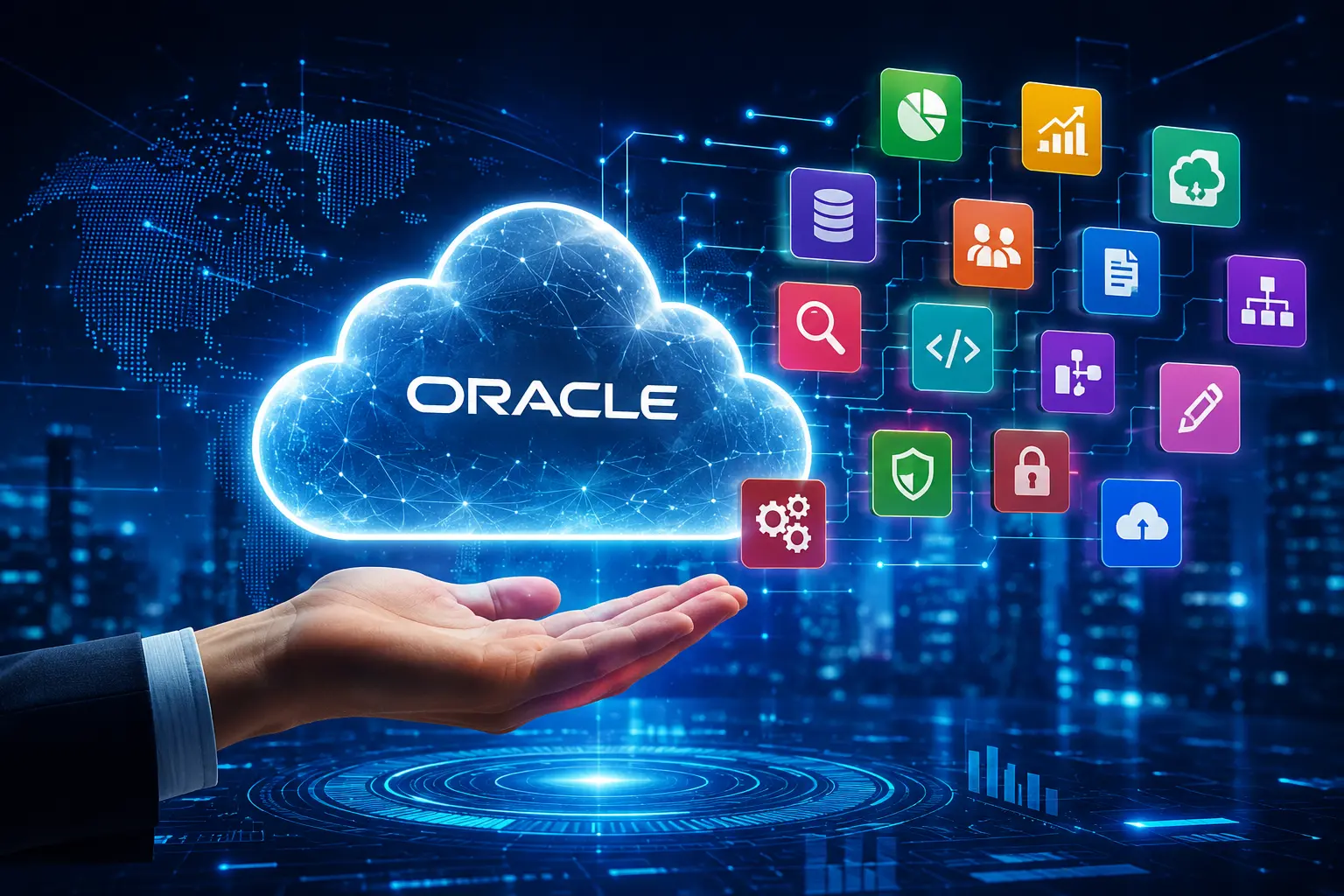
In 2026, Oracle is no longer viewed solely as a database company. It has transformed into a comprehensive enterprise technology provider with products spanning cloud infrastructure, artificial intelligence, cybersecurity, enterprise applications, analytics, healthcare systems, and industry-specific software. Its cloud platform, Oracle Cloud Infrastructure (OCI), now competes directly with Amazon Web Services (AWS), Microsoft Azure, and Google Cloud while attracting organizations that need high-performance computing, AI infrastructure, and secure enterprise environments.
One of Oracle’s biggest competitive advantages is its ability to integrate databases, cloud services, AI, and enterprise applications into a single ecosystem. Businesses can run financial management, supply chain operations, human resources, customer relationship management (CRM), analytics, and database workloads through Oracle’s cloud platform while maintaining strong security, regulatory compliance, and operational reliability.
Artificial intelligence has also become central to Oracle’s long-term strategy. Rather than treating AI as a standalone product, Oracle embeds intelligent automation into its cloud applications, databases, analytics platforms, and developer tools. Organizations can automate repetitive business processes, improve forecasting, analyze massive datasets, and build AI-powered applications without replacing their existing enterprise systems.
Oracle’s database technology remains one of its strongest assets. For decades, Oracle Database has powered some of the world’s most demanding enterprise workloads, supporting everything from banking transactions and airline reservations to healthcare records and government operations. With the introduction of AI-enhanced database capabilities, autonomous management, and improved cloud integration, Oracle continues to modernize one of the industry’s most trusted data platforms.
Beyond technology, Oracle has become a major force in digital transformation. Businesses adopting hybrid work, cloud migration, AI-driven decision-making, and enterprise automation increasingly rely on Oracle solutions to modernize legacy systems while improving scalability and operational efficiency. From startups using Oracle NetSuite to multinational corporations running Oracle Fusion Cloud Applications, the company’s portfolio addresses nearly every stage of business growth.
Security is another defining characteristic of Oracle’s strategy. As cyber threats become more sophisticated and regulatory requirements continue evolving, organizations need technology platforms capable of protecting sensitive information without sacrificing performance. Oracle integrates encryption, identity management, automated patching, zero-trust security principles, and advanced threat detection throughout its cloud infrastructure and enterprise software offerings.
For developers, Oracle provides a comprehensive ecosystem that includes Java, Oracle Database, OCI developer services, Kubernetes support, DevOps tools, APIs, and AI development platforms. This enables software teams to build, deploy, and manage modern cloud-native applications while benefiting from enterprise-grade scalability and reliability.
Oracle’s influence extends beyond private businesses. Federal agencies, state governments, educational institutions, healthcare organizations, telecommunications providers, manufacturers, and financial services companies across the United States rely on Oracle technologies to support mission-critical operations. This broad customer base highlights Oracle’s role as one of America’s most strategically important enterprise software companies.
As the technology landscape shifts toward artificial intelligence, autonomous systems, cloud-native applications, and data-driven decision-making, Oracle continues investing heavily in research, cloud expansion, and enterprise innovation. Its partnerships with leading technology companies, growing AI infrastructure, and expanding cloud footprint position it as a major player in the next generation of enterprise computing.
Whether you’re an IT professional evaluating cloud platforms, a business owner researching ERP software, a developer exploring Oracle Cloud Infrastructure, or an executive planning a digital transformation strategy, understanding Oracle’s ecosystem is essential. This comprehensive guide explains Oracle’s history, products, cloud services, AI strategy, database technologies, security capabilities, pricing, competitive position, and future outlook, helping U.S. readers make informed technology decisions.
Oracle at a Glance
Founded in 1977, Oracle Corporation has grown into one of the largest enterprise software companies in the world and remains a cornerstone of the U.S. technology industry. Headquartered in Austin, Texas, Oracle develops cloud infrastructure, enterprise software, database technologies, artificial intelligence solutions, and business applications used by organizations across virtually every major industry.
Unlike many technology companies that specialize in only one area, Oracle delivers an end-to-end enterprise technology ecosystem. Businesses can use Oracle to manage databases, migrate workloads to the cloud, automate finance and human resources, analyze business data, secure digital infrastructure, and build AI-powered applications—all within a unified platform.
Today, Oracle serves customers in more than 175 countries, including Fortune 500 corporations, federal and state government agencies, healthcare providers, universities, financial institutions, retailers, manufacturers, telecommunications companies, and startups.
Oracle’s business portfolio includes:
- Oracle Cloud Infrastructure (OCI)
- Oracle Database
- Oracle Database 23ai
- Oracle Autonomous Database
- Oracle Fusion Cloud Applications
- Oracle NetSuite
- Oracle Java
- Oracle Analytics Cloud
- Oracle AI Services
- Oracle Healthcare Solutions
- Oracle Customer Experience (CX)
- Oracle Human Capital Management (HCM)
- Oracle Enterprise Resource Planning (ERP)
- Oracle Supply Chain Management (SCM)
This extensive portfolio enables organizations to run nearly every aspect of their operations on Oracle technologies.
One of Oracle’s greatest strengths is vertical integration. Rather than relying entirely on third-party infrastructure or software, Oracle develops its own database technologies, cloud platform, enterprise applications, AI services, and developer tools. This integration helps businesses improve performance, simplify IT management, and reduce complexity.
The History and Evolution of Oracle
Oracle’s story is one of continuous innovation in enterprise computing. Over nearly five decades, the company has repeatedly adapted to changing technology trends while maintaining its leadership in data management.
The Beginning
Oracle was founded in 1977 by Larry Ellison, Bob Miner, and Ed Oates under the name Software Development Laboratories (SDL). Inspired by research on relational databases, the founders recognized that businesses would increasingly need reliable systems to store and process large amounts of information.
The company later adopted the name Oracle after its flagship database product.
The Rise of Oracle Database
During the 1980s, Oracle became one of the first companies to commercialize relational database technology on a large scale.
Oracle Database quickly gained popularity because it offered:
- High reliability
- Scalability
- Transaction processing
- Multi-user support
- Cross-platform compatibility
Large enterprises, financial institutions, government agencies, and telecommunications providers adopted Oracle Database to manage mission-critical information.
This success established Oracle as a leader in enterprise software.
Enterprise Software Expansion
Throughout the 1990s and early 2000s, Oracle expanded beyond databases into enterprise applications.
The company invested heavily in software for:
- Finance
- Human resources
- Customer relationship management
- Supply chain management
- Procurement
- Manufacturing
Oracle also strengthened its position through strategic acquisitions, bringing new technologies and customer bases into its ecosystem.
Major Acquisitions
Oracle’s growth strategy has included several significant acquisitions that expanded its capabilities.
Some of the most notable include:
- PeopleSoft
- Siebel Systems
- BEA Systems
- Sun Microsystems
- NetSuite
- Cerner
These acquisitions enabled Oracle to expand into enterprise applications, middleware, cloud services, healthcare technology, and developer platforms.
The acquisition of Sun Microsystems also gave Oracle stewardship of Java, one of the world’s most widely used programming languages.
Transition to Cloud Computing
As businesses shifted toward cloud technology, Oracle transformed its strategy.
Rather than focusing solely on on-premises software, the company invested billions of dollars into building Oracle Cloud Infrastructure (OCI).
Oracle’s cloud platform now supports:
- Enterprise applications
- AI workloads
- Databases
- High-performance computing
- Kubernetes
- Data analytics
- Disaster recovery
- Multi-cloud deployments
OCI has become one of Oracle’s fastest-growing business segments.
Oracle in 2026
Today, Oracle’s strategy is centered around several major technology pillars:
- Artificial Intelligence
- Cloud Infrastructure
- Enterprise Applications
- Autonomous Databases
- Healthcare Technology
- Data Analytics
- Multi-Cloud Services
- Cybersecurity
Rather than competing in only one technology market, Oracle now operates across nearly every major enterprise software category.
Oracle’s Product Portfolio
Oracle’s product ecosystem is designed to support organizations of every size—from startups to multinational enterprises.
Its offerings can be grouped into several core categories.
Oracle Database
Oracle Database remains the foundation of Oracle’s technology ecosystem.
It is widely used for:
- Financial transactions
- Enterprise resource planning
- Healthcare systems
- Government databases
- Retail operations
- Telecommunications
- Manufacturing
Key capabilities include:
- High availability
- Scalability
- Advanced security
- Backup and recovery
- Real-time analytics
- Multi-cloud deployment
- AI-assisted management
For many organizations, Oracle Database serves as the central repository for mission-critical business information.
Oracle Database 23ai
Oracle Database 23ai represents Oracle’s latest generation of database technology, designed to support artificial intelligence, application development, and modern data management.
Major enhancements include:
- AI Vector Search
- JSON Relational Duality
- Native support for AI-driven workloads
- Improved developer productivity
- Enhanced security controls
- Better cloud integration
These capabilities help organizations build intelligent applications without migrating to entirely new database platforms.
Oracle Autonomous Database
Oracle Autonomous Database uses machine learning and automation to reduce manual administration.
It automatically handles tasks such as:
- Patching
- Backups
- Performance tuning
- Scaling
- Security updates
- Resource optimization
Benefits include:
- Reduced operational costs
- Lower risk of human error
- Improved uptime
- Better security
- Simplified management
This autonomous approach allows database administrators to focus more on innovation than routine maintenance.
Oracle Cloud Infrastructure (OCI)
Oracle Cloud Infrastructure is Oracle’s enterprise cloud platform and one of its most strategically important products.
OCI provides:
- Compute services
- Storage
- Networking
- Containers
- Kubernetes
- Serverless computing
- AI infrastructure
- Database services
- Disaster recovery
- Identity management
Unlike traditional cloud providers that primarily target web applications, OCI is optimized for demanding enterprise workloads requiring high performance, security, and predictable pricing.
Why Businesses Choose OCI
Organizations increasingly adopt Oracle Cloud Infrastructure because it offers:
- Enterprise-grade security
- High-performance networking
- Competitive pricing
- Low-latency architecture
- Support for Oracle databases
- AI and machine learning infrastructure
- Hybrid cloud capabilities
- Multi-cloud interoperability
Many enterprises migrating legacy Oracle workloads find OCI particularly attractive because of its deep compatibility with existing Oracle technologies.
OCI for Artificial Intelligence
As generative AI adoption accelerates, Oracle has expanded OCI to support AI training and inference workloads.
OCI enables businesses to deploy:
- Large language models (LLMs)
- AI-powered applications
- Predictive analytics
- Machine learning pipelines
- Intelligent automation
- High-performance GPU computing
This positions Oracle as a growing competitor in the AI infrastructure market.
Oracle Java
Java remains one of the most widely used programming languages in enterprise software development.
Oracle continues to support Java through:
- Regular updates
- Performance improvements
- Security enhancements
- Long-term support releases
- Developer tools
Millions of enterprise applications around the world continue to rely on Java.
Oracle Analytics Cloud
Organizations generate enormous volumes of business data, but extracting useful insights requires advanced analytics.
Oracle Analytics Cloud provides:
- Interactive dashboards
- Business intelligence
- Predictive analytics
- AI-assisted reporting
- Data visualization
- Self-service analytics
Business leaders can use these tools to make faster, data-driven decisions.

Why Oracle Is a Global Enterprise Technology Leader
Oracle’s success isn’t based on a single product. Instead, its strength comes from delivering an integrated technology stack that supports every stage of an organization’s digital transformation.
For example, a large U.S. retailer can use:
- Oracle Database to manage customer and inventory data.
- Oracle Cloud Infrastructure to host applications and scale during peak shopping seasons.
- Oracle Fusion Cloud ERP to handle finance and procurement.
- Oracle HCM to manage employee records and payroll.
- Oracle Analytics Cloud to gain real-time business insights.
- Oracle AI Services to automate forecasting and customer support.
Because these solutions are designed to work together, businesses can reduce integration challenges, improve security, and streamline operations.
Oracle also stands out for its commitment to enterprise-grade reliability. Its technologies are built for environments where downtime can have serious financial or operational consequences, such as banking, healthcare, aviation, and government.
Another key differentiator is Oracle’s focus on hybrid and multi-cloud strategies. Many organizations don’t want to rely on a single cloud provider, and Oracle supports deployments that span on-premises infrastructure, OCI, and other major cloud platforms. This flexibility helps businesses modernize at their own pace while protecting existing investments.
As enterprises continue investing in artificial intelligence, automation, and cloud-native applications, Oracle’s combination of database leadership, cloud infrastructure, enterprise software, and AI capabilities positions it as one of the most comprehensive technology providers in the U.S. market.
Oracle Fusion Cloud Applications
As organizations modernize their operations, many are replacing legacy business software with cloud-native enterprise applications. Oracle addresses this demand through Oracle Fusion Cloud Applications, a comprehensive suite of Software-as-a-Service (SaaS) solutions designed to help businesses streamline operations, improve decision-making, and accelerate digital transformation.
Unlike traditional enterprise software that requires expensive on-premises infrastructure and lengthy upgrade cycles, Oracle Fusion Cloud Applications are delivered through the cloud with regular feature updates, built-in security, and AI-powered automation.
The platform includes applications for nearly every core business function, making it one of the most comprehensive enterprise software suites available.
Oracle Fusion Cloud ERP
Oracle Fusion Cloud Enterprise Resource Planning (ERP) helps organizations manage financial operations with greater visibility and efficiency.
Key capabilities include:
- Financial management
- General ledger
- Accounts payable and receivable
- Budgeting and forecasting
- Procurement
- Project management
- Risk management
- Revenue management
- Expense management
Large enterprises benefit from real-time reporting, automated workflows, and AI-assisted financial planning that improves operational decision-making.
Oracle Fusion Cloud HCM
Human Capital Management (HCM) enables organizations to manage the complete employee lifecycle.
Features include:
- Recruiting
- Employee onboarding
- Payroll
- Benefits administration
- Workforce planning
- Talent management
- Learning and development
- Performance reviews
- Employee engagement
AI-powered recommendations help HR teams identify workforce trends, automate administrative tasks, and improve employee experiences.
Oracle Fusion Cloud SCM
Supply chain disruptions have highlighted the importance of resilient logistics and inventory management.
Oracle Supply Chain Management (SCM) provides businesses with tools to manage:
- Inventory
- Manufacturing
- Procurement
- Logistics
- Warehouse operations
- Demand forecasting
- Product lifecycle management
- Order fulfillment
Advanced analytics help organizations anticipate disruptions and optimize supply chain performance.
Oracle Customer Experience (CX)
Customer expectations continue to evolve, requiring businesses to deliver personalized experiences across multiple channels.
Oracle CX supports:
- Marketing automation
- Customer service
- Sales management
- Commerce platforms
- Customer analytics
- Loyalty programs
Organizations can better understand customer behavior while improving engagement and revenue growth.
Why Businesses Choose Oracle Fusion Cloud
Oracle Fusion Cloud Applications provide several advantages:
- Unified business platform
- Built-in artificial intelligence
- Continuous software updates
- Enterprise-grade security
- Regulatory compliance
- Global scalability
- Automated business processes
- Real-time analytics
For multinational organizations, Oracle’s integrated architecture reduces complexity while improving collaboration across departments.
Oracle NetSuite
Oracle strengthened its cloud portfolio through the acquisition of NetSuite, one of the leading cloud-based business management platforms for small and mid-sized businesses.
Unlike Oracle Fusion Cloud, which primarily targets large enterprises, NetSuite focuses on organizations that need enterprise-grade capabilities without the complexity of traditional ERP deployments.
Today, thousands of startups, growing businesses, e-commerce companies, manufacturers, and professional service firms use NetSuite to manage their operations.
Core NetSuite Modules
NetSuite combines multiple business functions into a single cloud platform.
Its major modules include:
- Financial management
- CRM
- Inventory management
- Order management
- Procurement
- Project management
- Human resources
- E-commerce
- Business intelligence
- Revenue recognition
Because all modules share the same database, organizations avoid data silos and duplicate information.
Benefits for Growing Businesses
NetSuite helps companies:
- Automate accounting
- Improve cash flow visibility
- Track inventory in real time
- Manage customer relationships
- Generate business reports
- Scale internationally
- Reduce manual processes
For startups and rapidly growing businesses, NetSuite provides a scalable foundation that can grow alongside the organization.
Oracle NetSuite vs Oracle Fusion Cloud
Although both products belong to Oracle, they target different audiences.
| Feature | Oracle NetSuite | Oracle Fusion Cloud |
|---|---|---|
| Primary Audience | SMBs and mid-market businesses | Large enterprises |
| Deployment | Cloud-native SaaS | Enterprise SaaS |
| Complexity | Moderate | Advanced |
| Global Operations | Strong | Extensive |
| Customization | High | Very High |
| Best For | Fast-growing companies | Large multinational organizations |
Businesses should evaluate their size, operational complexity, and long-term growth plans when choosing between these platforms.
Oracle Artificial Intelligence Strategy
Artificial intelligence has become a major driver of enterprise innovation, and Oracle has positioned AI at the center of its cloud ecosystem.
Rather than offering AI as a standalone product, Oracle embeds AI capabilities across its databases, enterprise applications, cloud services, analytics platforms, and developer tools.
This approach allows organizations to adopt AI without rebuilding their existing technology infrastructure.
Oracle AI Across the Enterprise
Oracle integrates AI into several areas:
Business Applications
AI assists with:
- Financial forecasting
- Expense categorization
- Invoice processing
- Procurement recommendations
- Workforce planning
- Customer engagement
These capabilities reduce manual work while improving operational efficiency.
Database Intelligence
Oracle Database incorporates AI-powered features that help organizations:
- Optimize queries
- Detect anomalies
- Improve performance
- Analyze structured and unstructured data
- Support vector-based AI search
This enables businesses to develop intelligent applications while maintaining enterprise-grade reliability.
Oracle Cloud AI Services
OCI includes managed AI services that support:
- Machine learning
- Natural language processing
- Computer vision
- Speech recognition
- Document understanding
- Predictive analytics
Developers can integrate these services into enterprise applications through APIs and cloud-native development tools.
AI Infrastructure
Generative AI requires enormous computing resources.
Oracle Cloud Infrastructure provides enterprise-grade GPU environments capable of supporting:
- Large Language Models (LLMs)
- AI model training
- AI inference
- High-performance computing
- Research workloads
- Scientific computing
As demand for AI infrastructure grows, Oracle continues investing heavily in expanding its cloud capabilities.
Oracle AI Benefits for Businesses
Organizations adopting Oracle AI can:
- Improve productivity
- Automate repetitive work
- Enhance forecasting
- Reduce operational costs
- Improve customer experiences
- Strengthen decision-making
- Accelerate software development
AI becomes a productivity tool integrated directly into existing business workflows rather than requiring separate platforms.

Oracle for Business and Enterprise
Oracle has built its reputation by solving complex enterprise technology challenges.
Its customers include:
- Fortune 500 companies
- Healthcare providers
- Government agencies
- Universities
- Financial institutions
- Manufacturers
- Retail organizations
- Telecommunications companies
- Energy providers
These organizations rely on Oracle to support mission-critical operations that require high availability, security, and scalability.
Why Enterprises Choose Oracle
Comprehensive Technology Stack
Oracle provides:
- Infrastructure
- Databases
- Enterprise applications
- Analytics
- AI services
- Developer tools
- Security platforms
This integrated ecosystem reduces the need for multiple vendors.
Global Scalability
Large organizations operating across multiple countries require technology capable of supporting:
- Multiple currencies
- Multiple languages
- Regional compliance
- Global supply chains
- Distributed workforces
Oracle’s enterprise applications are designed with these requirements in mind.
Mission-Critical Reliability
Many industries cannot tolerate downtime.
Oracle technologies are widely used in:
- Banking
- Aviation
- Healthcare
- Telecommunications
- Manufacturing
where system availability directly impacts business operations.
Oracle Security and Compliance
Cybersecurity remains one of Oracle’s highest priorities.
Enterprise customers expect their technology providers to protect sensitive financial, healthcare, customer, and operational data against increasingly sophisticated threats.
Oracle incorporates security across its entire technology stack.
Major Security Features
Oracle provides:
- Data encryption
- Identity and access management
- Multi-factor authentication
- Network isolation
- Threat detection
- Security monitoring
- Automated patching
- Zero Trust architecture support
These capabilities help organizations reduce cybersecurity risks while meeting regulatory requirements.
Compliance
Oracle supports compliance with many industry standards and regulatory frameworks.
Organizations in sectors such as healthcare, finance, and government often require strict security controls, auditing, and data governance.
Oracle’s cloud platform includes tools designed to simplify compliance management and reporting.
Security by Design
Rather than treating security as an optional feature, Oracle integrates security into:
- Hardware
- Cloud infrastructure
- Databases
- Applications
- Identity management
- Development platforms
This layered approach strengthens overall enterprise protection.
Oracle Pricing Overview
Oracle offers flexible pricing models depending on the product and deployment option.
Organizations can purchase:
- Cloud subscriptions
- Software licenses
- Consumption-based cloud services
- Enterprise agreements
Pricing varies based on:
- Number of users
- Computing resources
- Storage requirements
- AI services
- Enterprise application modules
Because Oracle serves businesses ranging from startups to multinational corporations, pricing is typically customized according to organizational needs.
General Product Positioning
| Product | Market Position |
|---|---|
| Oracle Database | Enterprise database platform |
| Oracle Cloud Infrastructure | Enterprise cloud platform |
| Oracle Fusion Cloud | Large enterprise SaaS |
| Oracle NetSuite | SMB and mid-market ERP |
| Oracle AI Services | Enterprise AI platform |
| Oracle Analytics | Business intelligence |
Oracle Performance and Reliability
Performance has always been one of Oracle’s strongest differentiators.
Enterprise customers expect systems capable of processing enormous volumes of transactions while maintaining high availability.
Oracle addresses these requirements through decades of engineering investment.
High Performance
Oracle technologies support:
- Massive databases
- Real-time analytics
- High transaction volumes
- AI workloads
- Large enterprise applications
OCI’s high-speed networking and optimized infrastructure contribute to consistent application performance.
Reliability
Oracle platforms are designed for:
- High availability
- Disaster recovery
- Automatic failover
- Backup automation
- Geographic redundancy
These capabilities reduce business interruptions and improve operational resilience.
Scalability
Organizations can scale Oracle services as demand grows.
Whether supporting a rapidly expanding startup or a multinational enterprise, Oracle provides infrastructure capable of adapting to changing workloads without significant architectural changes.
Oracle Performance Summary
| Area | Evaluation |
|---|---|
| Enterprise Software | Excellent |
| Database Technology | Industry-leading |
| Cloud Infrastructure | Strong |
| AI Capabilities | Rapidly Expanding |
| Security | Excellent |
| Reliability | Enterprise Grade |
| Scalability | Outstanding |
| Business Applications | Comprehensive |
Oracle Pros and Cons
Oracle has established itself as one of the most trusted enterprise technology providers in the world. Its integrated ecosystem, cloud infrastructure, database technologies, and AI-powered business applications make it a compelling choice for organizations of all sizes. However, like any enterprise platform, Oracle has both strengths and limitations.
Understanding these factors can help business leaders, IT teams, and software buyers determine whether Oracle aligns with their long-term technology strategy.
Advantages of Oracle
1. Industry-Leading Database Technology
Oracle Database remains one of the most powerful enterprise database platforms available.
Its strengths include:
- High availability
- Excellent scalability
- Enterprise-grade security
- Strong transaction processing
- Advanced analytics
- AI-powered capabilities
- Multi-cloud support
Many of the world’s largest financial institutions, healthcare providers, and government agencies rely on Oracle Database for mission-critical operations.
2. Comprehensive Enterprise Ecosystem
Unlike vendors that specialize in only one area, Oracle offers an integrated portfolio that includes:
- Cloud infrastructure
- Enterprise applications
- Databases
- Analytics
- Artificial intelligence
- Developer tools
- Security solutions
This reduces the need to manage multiple technology vendors and simplifies enterprise architecture.
3. Strong AI and Cloud Innovation
Oracle continues expanding its AI capabilities through Oracle Cloud Infrastructure (OCI), Autonomous Database, Fusion Applications, and AI services.
Businesses benefit from:
- Intelligent automation
- AI-assisted workflows
- Predictive analytics
- Machine learning integration
- Enterprise AI infrastructure
4. Enterprise-Grade Security
Oracle incorporates security across its entire technology stack.
Key security strengths include:
- Data encryption
- Identity and access management
- Automated patching
- Threat monitoring
- Zero Trust support
- Regulatory compliance
These features make Oracle particularly attractive for organizations handling sensitive information.
5. Global Enterprise Experience
Oracle has decades of experience supporting some of the world’s largest organizations.
Its customer base spans industries such as:
- Healthcare
- Banking
- Government
- Manufacturing
- Retail
- Telecommunications
- Education
- Energy
This broad industry expertise enables Oracle to deliver specialized enterprise solutions.
Limitations of Oracle
1. Enterprise Complexity
Oracle’s product portfolio is extensive.
While this provides flexibility, it can also create a learning curve for organizations without experienced IT teams.
Implementation often requires careful planning and skilled administrators.
2. Higher Initial Investment
Enterprise-grade software and cloud infrastructure may involve significant implementation and operational costs depending on the organization’s size and requirements.
Smaller businesses may find simpler platforms more suitable for basic needs.
3. Large Product Portfolio
Oracle offers dozens of cloud services and enterprise applications.
Choosing the right combination of products may require consultation with Oracle partners or experienced solution architects.
4. Migration Challenges
Organizations moving from legacy systems or competing enterprise platforms may face data migration, application integration, and change management challenges.
A well-planned migration strategy is essential for minimizing disruption.
Oracle Pros and Cons Summary
| Pros | Cons |
|---|---|
| Industry-leading database technology | Enterprise complexity |
| Comprehensive cloud ecosystem | Higher implementation costs |
| Strong AI capabilities | Steeper learning curve |
| Excellent security | Migration planning required |
| Global enterprise experience | Large product portfolio |
Oracle vs AWS vs Microsoft Azure vs Google Cloud
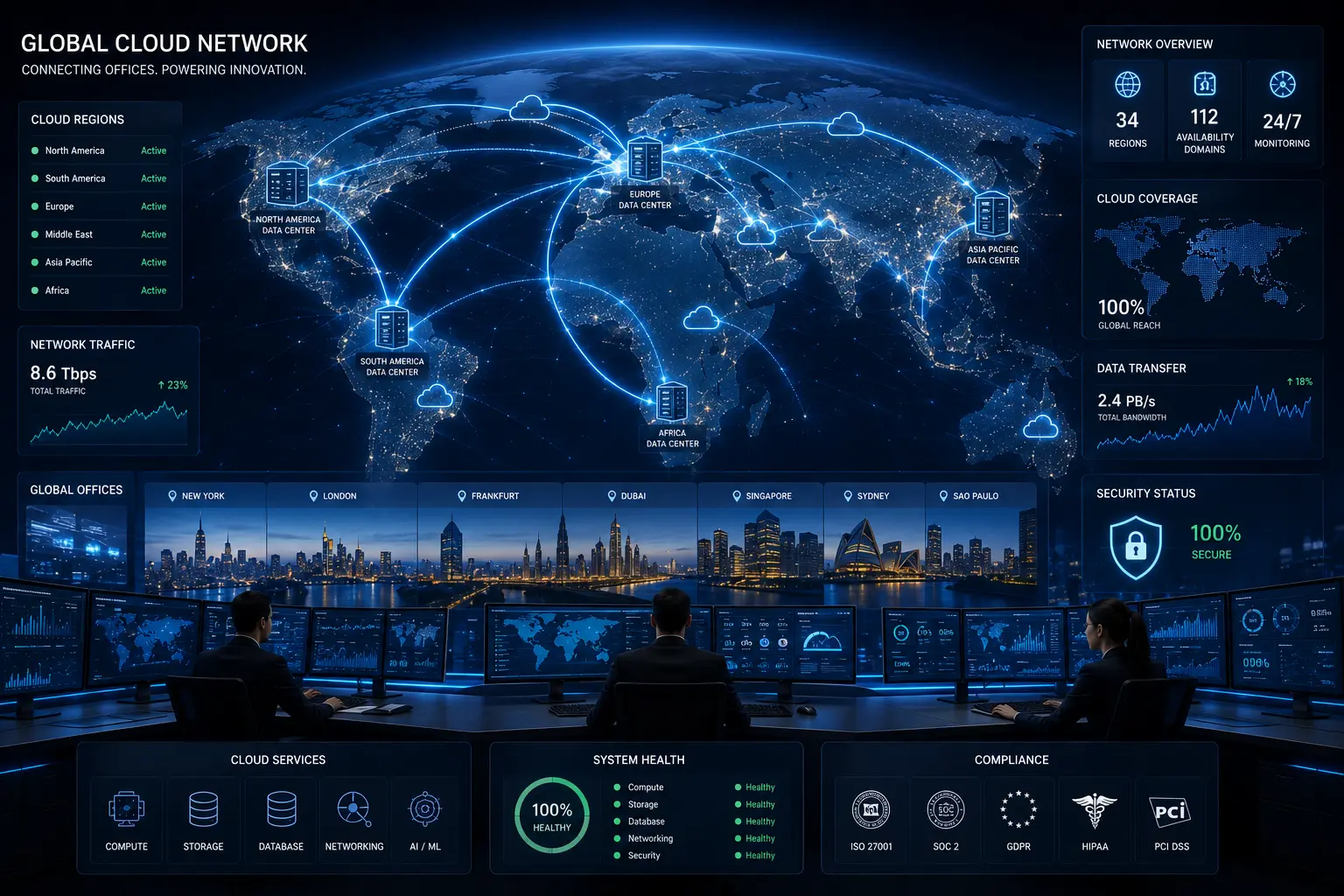
Cloud computing has become one of the most competitive technology markets. Oracle Cloud Infrastructure (OCI) competes with major providers by focusing on enterprise workloads, high-performance databases, AI infrastructure, and mission-critical applications.
Comparison Table
| Feature | Oracle OCI | AWS | Microsoft Azure | Google Cloud |
|---|---|---|---|---|
| Primary Strength | Enterprise applications & databases | Broad cloud ecosystem | Enterprise productivity | AI & data analytics |
| Database Integration | Excellent | Strong | Strong | Strong |
| AI Infrastructure | Expanding rapidly | Advanced | Advanced | Industry-leading |
| Enterprise Applications | Excellent | Limited | Strong | Moderate |
| Hybrid Cloud | Strong | Strong | Excellent | Strong |
| Multi-Cloud Support | Excellent | Moderate | Strong | Strong |
| Best For | Enterprise workloads | General cloud services | Microsoft-centric organizations | Data analytics & AI |
Oracle vs AWS
Amazon Web Services offers the largest collection of cloud services and global infrastructure.
Oracle differentiates itself through:
- Native Oracle Database optimization
- Enterprise business applications
- Predictable pricing
- High-performance networking
- Integrated AI capabilities
Organizations running Oracle workloads often achieve greater efficiency using OCI.
Oracle vs Microsoft Azure
Microsoft Azure integrates closely with Windows Server, Microsoft 365, Active Directory, and enterprise productivity tools.
Oracle focuses on:
- Enterprise databases
- ERP software
- Financial applications
- High-performance cloud infrastructure
- Autonomous database technology
Many organizations use Azure and Oracle together through multi-cloud deployments.
Oracle vs Google Cloud
Google Cloud excels in:
- Artificial intelligence
- Data analytics
- Kubernetes
- Machine learning
Oracle maintains advantages in:
- Enterprise software
- Database technology
- ERP applications
- Mission-critical workloads
- Industry-specific business solutions
Latest Oracle Developments in 2026
Oracle continues investing heavily in cloud computing, artificial intelligence, enterprise automation, and database innovation.
Several trends define Oracle’s current direction.
Expansion of Oracle AI
Artificial intelligence has become central to Oracle’s cloud strategy.
Oracle continues embedding AI into:
- Fusion Applications
- OCI
- Database services
- Analytics platforms
- Customer experience software
- Supply chain management
- Human resources applications
These AI-powered features help organizations automate business processes and improve decision-making.
Growth of Oracle Cloud Infrastructure
OCI continues expanding through additional cloud regions, improved networking, and enhanced AI infrastructure.
Businesses increasingly choose OCI for:
- Enterprise applications
- Database workloads
- High-performance computing
- AI model deployment
- Disaster recovery
Autonomous Database Innovation
Oracle continues improving Autonomous Database by expanding automation capabilities.
Organizations benefit from:
- Reduced administrative overhead
- Automated security updates
- Performance optimization
- Intelligent resource allocation
This reduces operational complexity while improving reliability.
Multi-Cloud Strategy
Rather than encouraging customers to use a single cloud provider, Oracle increasingly supports hybrid and multi-cloud deployments.
Organizations can integrate Oracle technologies with other major cloud platforms while maintaining centralized management and security.
Healthcare Technology
Oracle continues expanding healthcare solutions following its investments in digital health technologies.
Healthcare organizations increasingly use Oracle platforms for:
- Patient information management
- Clinical operations
- Healthcare analytics
- Administrative automation
Expert Recommendations
Oracle is best suited for organizations seeking enterprise-grade reliability, scalability, and integrated business software.
Best for Large Enterprises
Oracle is an excellent choice for organizations requiring:
- Global operations
- Financial management
- Complex supply chains
- Regulatory compliance
- Large databases
- Mission-critical systems
Best for Cloud Migration
Organizations modernizing legacy infrastructure can benefit from Oracle Cloud Infrastructure’s support for enterprise workloads and database migration.
Best for AI Adoption
Companies planning AI initiatives can leverage Oracle’s AI services, autonomous databases, analytics, and enterprise applications without replacing existing systems.
Best for Growing Businesses
Oracle NetSuite provides an accessible path for small and medium-sized businesses looking to automate operations and scale efficiently.
Who Should Consider Alternatives?
Organizations with very simple technology requirements or limited budgets may evaluate other solutions depending on their operational needs.
Similarly, businesses already deeply invested in another cloud ecosystem may prefer a multi-cloud approach rather than a full migration.
Frequently Asked Questions
1. What is Oracle best known for?
Oracle is best known for Oracle Database, Oracle Cloud Infrastructure (OCI), enterprise software, ERP applications, and cloud-based business solutions used by organizations worldwide.
2. What is Oracle Cloud Infrastructure (OCI)?
OCI is Oracle’s enterprise cloud platform offering compute, storage, networking, databases, AI services, analytics, and developer tools for businesses.
3. Is Oracle only a database company?
No. Oracle provides cloud infrastructure, AI services, enterprise applications, cybersecurity solutions, analytics, developer tools, and healthcare technology in addition to databases.
4. What industries use Oracle?
Oracle serves healthcare, banking, government, retail, manufacturing, telecommunications, education, energy, logistics, and many other industries.
5. What is Oracle Fusion Cloud?
Oracle Fusion Cloud is a suite of cloud-based enterprise applications covering ERP, HCM, SCM, CX, procurement, and financial management.
6. What is Oracle NetSuite?
Oracle NetSuite is a cloud-based ERP platform designed primarily for small and medium-sized businesses to manage finance, CRM, inventory, and business operations.
7. How does Oracle use artificial intelligence?
Oracle integrates AI into databases, enterprise applications, analytics, cloud infrastructure, automation, and developer services to improve productivity and decision-making.
8. Is Oracle Cloud secure?
Yes. Oracle provides encryption, identity management, automated patching, threat detection, compliance tools, and multiple security layers across its cloud platform.
9. How does Oracle compare with AWS?
AWS offers a broader range of cloud services, while Oracle focuses on enterprise applications, databases, and high-performance cloud infrastructure for business-critical workloads.
10. Is Oracle a good choice for businesses?
Oracle is an excellent choice for organizations requiring scalable enterprise software, advanced databases, cloud infrastructure, AI capabilities, and strong security.
Conclusion
Oracle has evolved from a pioneering database company into one of the world’s most comprehensive enterprise technology providers. Its portfolio now spans cloud infrastructure, artificial intelligence, enterprise applications, analytics, cybersecurity, developer tools, and healthcare technology, making it a strategic partner for organizations navigating digital transformation.
For U.S. businesses, Oracle offers a compelling combination of performance, security, scalability, and innovation. Oracle Cloud Infrastructure, Fusion Cloud Applications, NetSuite, and Autonomous Database provide organizations with the tools to modernize operations, improve efficiency, and support AI-driven growth.
While Oracle’s enterprise ecosystem may require thoughtful planning and investment, its long-term value lies in its ability to unify critical business functions on a secure and scalable platform. Organizations evaluating cloud platforms, ERP software, or database technologies should consider Oracle as a leading option—particularly for mission-critical workloads and industries with demanding compliance and performance requirements.
As artificial intelligence, cloud computing, and automation continue reshaping enterprise IT, Oracle’s investments in AI infrastructure, multi-cloud capabilities, and intelligent business applications position it to remain a key player in the next generation of business technology.

SoftwareCompanyNearMe Editorial Team is dedicated to researching and publishing trusted content about U.S. software companies, SaaS platforms, artificial intelligence (AI), cloud computing, cybersecurity, and enterprise technology. Our goal is to help businesses, IT professionals, and software buyers make informed decisions through accurate, well-researched, and regularly updated technology guides, company reviews, and industry insights.