

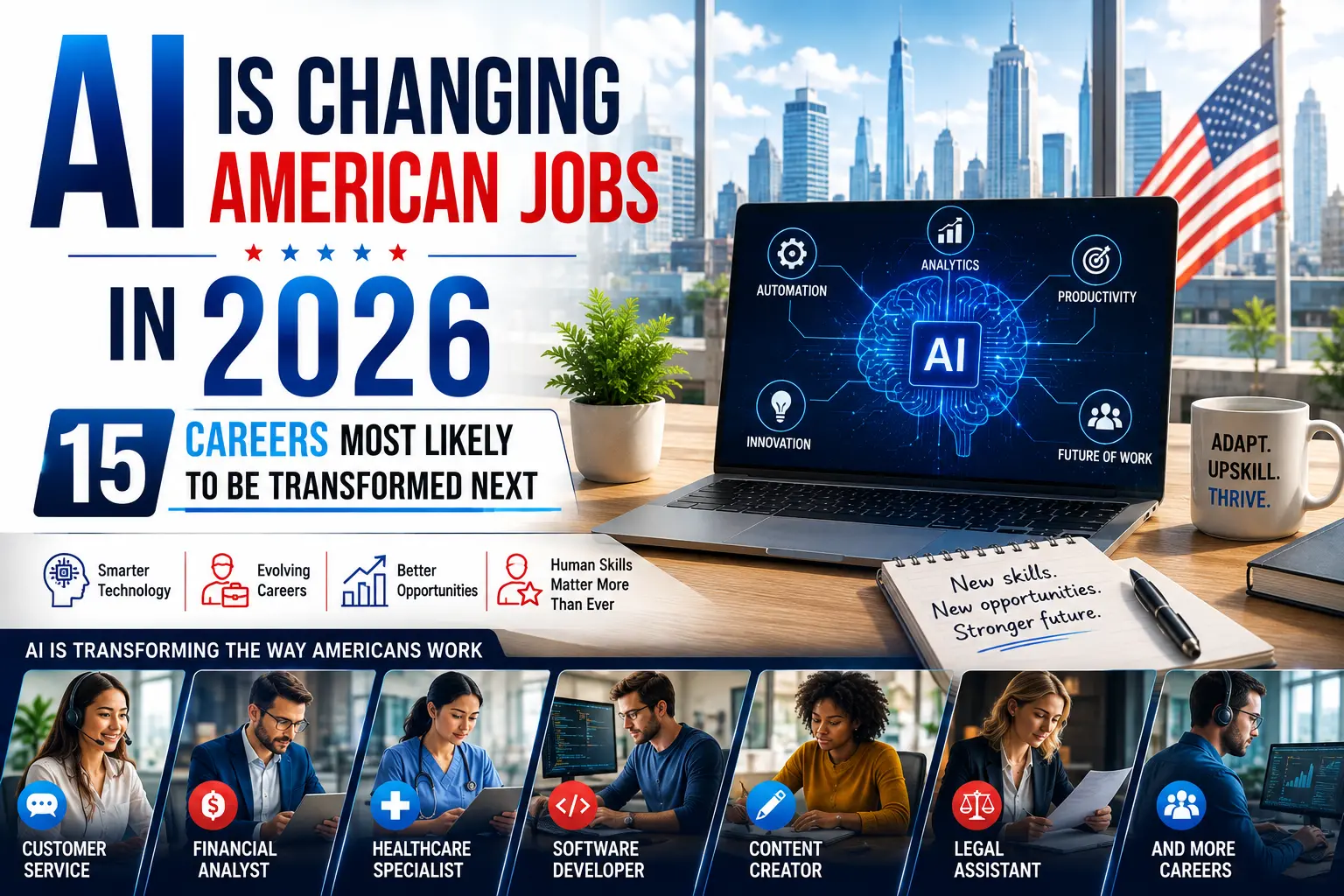
Artificial intelligence is no longer something American workers can treat as a distant workplace trend. In offices, call centers, law firms, accounting departments, marketing teams, hospitals, software companies, and financial organizations, AI is already changing how everyday work gets done. Employees are using AI to write emails, analyze information, answer customers, create documents, summarize meetings, write code, review records, and complete tasks that once required hours of manual work.
But there is an important distinction that often gets lost in the conversation about AI and jobs. AI does not necessarily have to eliminate an entire occupation to dramatically change it. In many cases, the bigger story is what happens inside the job. A worker may keep the same job title while handing more repetitive tasks to AI and spending more time on judgment, problem-solving, communication, strategy, or oversight.
That shift is already visible in U.S. employment data. The U.S. Bureau of Labor Statistics projects declines in several occupations heavily exposed to routine digital work, including customer service representatives, computer programmers, and bookkeeping, accounting, and auditing clerks. At the same time, some AI-exposed careers—including software development, financial analysis, human resources, and market research—are still projected to grow. That may sound contradictory, but it isn’t. The workplace of 2026 is increasingly becoming a place where AI changes the work before it necessarily changes the job title.
15 AI Is Changing American Jobs in 2026, which are mentioned and described below.
Author Review
AI is no longer something Americans can treat as a distant workplace trend. In 2026, it is already changing how people write, analyze data, serve customers, build software, manage information, and make everyday business decisions.
But after looking at where AI is actually making an impact, I don’t think the most useful question is simply, “Which jobs will AI replace?” The better question is, “Which parts of your job are changing—and are you ready for what comes next?”
That distinction matters. A customer service representative may use AI to handle routine questions, but human judgment still matters when a situation becomes complicated. A financial analyst can use AI to process information faster, but interpreting risk and explaining a recommendation to a client still requires experience. The same pattern is emerging across healthcare, software, marketing, legal work, and other professions.
That’s why this list focuses on careers that are likely to be transformed by AI, rather than labeling them as jobs that are simply “going away.” Some roles will shrink, some will evolve, and others may create entirely new opportunities as businesses figure out how to combine human expertise with increasingly capable AI tools.
For American workers, the takeaway is straightforward: don’t compete with AI on the tasks it does best. Learn how to work with it.
The people who understand their industry, develop strong communication and problem-solving skills, and learn how to use AI effectively may have a significant advantage over those who ignore the technology.
AI is changing the workplace—but that doesn’t automatically mean the future belongs to machines. In many careers, the biggest opportunity may belong to people who know how to make machines more useful.
Editorial note: AI adoption and its effect on individual occupations can vary significantly by industry, employer, location, and job level. The career examples in this article should be viewed as an analysis of likely workplace transformation, not a guarantee that a specific occupation will disappear.
AI Is Changing American Jobs, Not Just Eliminating Them
The easiest way to misunderstand AI’s effect on employment is to ask only one question: “Will AI replace this job?” A better question is: “Which parts of this job can AI perform, and what will the human worker do afterward?”
Consider customer service. An AI system can answer a common question, retrieve an order status, summarize a customer’s issue, or route a request. But a difficult complaint involving an angry customer, a complicated refund, or a sensitive business relationship may still require a person.
The same pattern appears in law, finance, healthcare, software development, marketing, and administration. Anthropic’s June 2026 Economic Index found that close to six in ten people surveyed expected AI to handle a larger share of their work tasks in the following year than it could handle at the time of the survey. More than one-third expected AI to be capable of handling most or nearly all of their work tasks within that period.
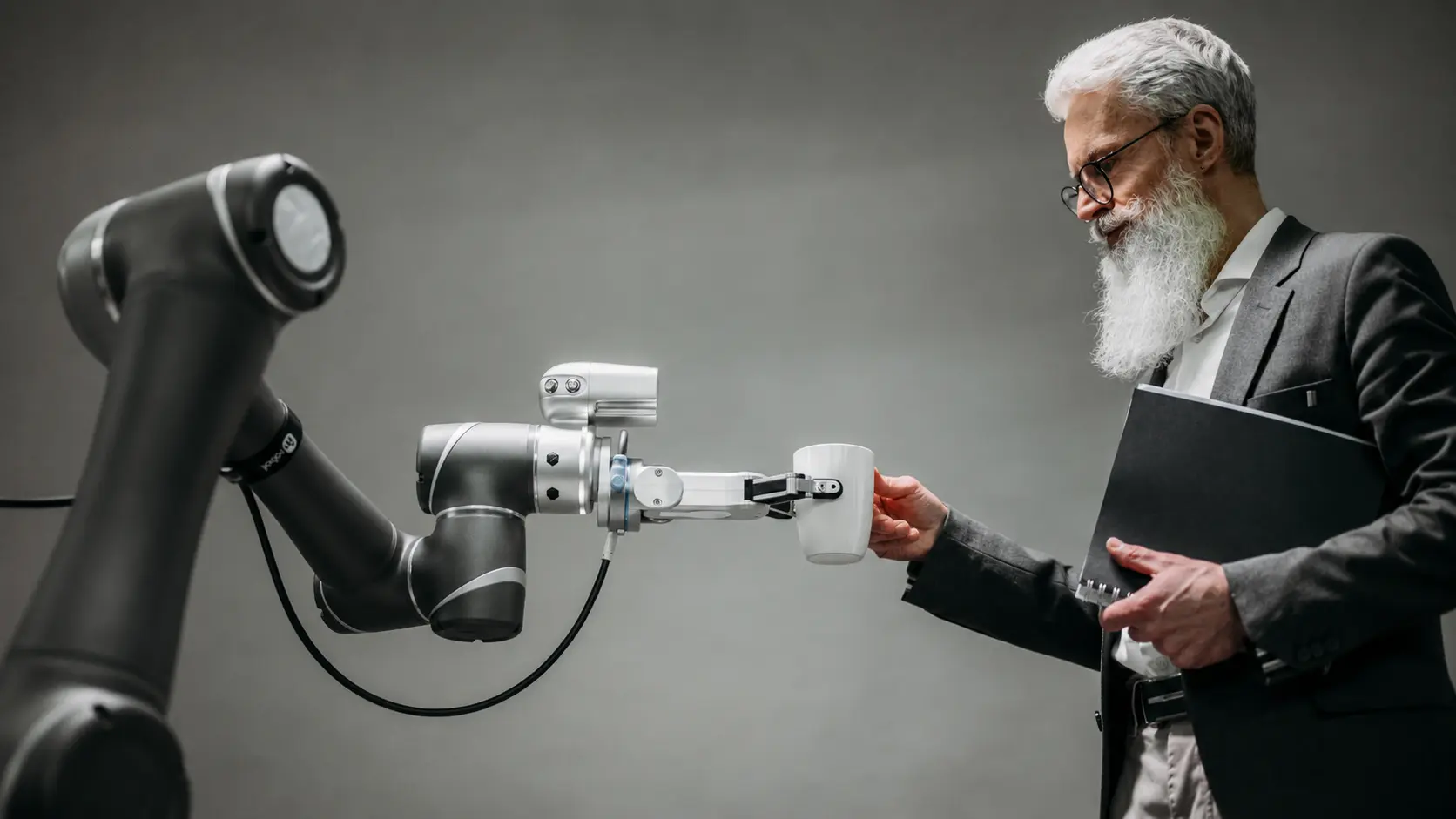
Microsoft’s 2026 Work Trend Index points toward a similar workplace shift. As AI systems and agents take on more execution, humans increasingly have more responsibility for directing work, making decisions, and owning outcomes. That is why the careers below should be viewed as highly exposed to transformation, not automatically doomed to disappear.
How We Selected These 15 Careers
This list considers three factors. First, how much of an occupation involves tasks that modern AI can potentially perform, such as writing, classification, information retrieval, data processing, document creation, analysis, and routine communication. Second, whether AI and automation are already being used for those types of tasks. Third, what current U.S. employment projections tell us about the occupation.
The Bureau of Labor Statistics projects employment across all occupations to grow about 3% from 2024 to 2034. That makes the difference between growing and declining occupations particularly useful when evaluating AI’s potential impact. Importantly, a projected decline does not prove that AI alone is responsible. Employment can be affected by many factors, including technology, consumer behavior, business conditions, demographics, and productivity. With that in mind, here are the 15 careers worth watching.
Customer Service Representatives
Customer service may be one of the clearest examples of AI changing an American occupation. Companies can now use chatbots, AI-powered knowledge bases, automated email systems, and increasingly capable voice agents to handle many routine customer interactions. A customer who wants to know an order’s status may not need to speak with an employee. Someone asking for a company’s return policy can often receive an immediate automated answer.
The U.S. Bureau of Labor Statistics projects customer service representative employment to decline 5% between 2024 and 2034. BLS also notes that self-service systems, mobile applications, and other technologies are reducing demand for some routine customer-service tasks. But that does not mean human customer service disappears. Workers will likely spend more time handling complicated cases, frustrated customers, exceptions, escalations, and situations where empathy and judgment matter.
What AI is likely to change: routine questions, ticket classification, information retrieval, basic troubleshooting, and follow-up communication.
What remains valuable: empathy, negotiation, problem-solving, relationship management, and handling unusual situations.
Data Entry Workers
Data entry is particularly exposed because much of the work involves moving information from one digital location to another. Modern AI systems can extract information from documents, recognize text, classify records, organize data, and populate structured systems. Optical character recognition has existed for years, but newer AI systems can understand more complicated documents and unstructured information.
For workers whose primary responsibility is entering predictable information into databases, that creates significant pressure.The lesson is not that every person who has performed data entry will suddenly lose their job. It is that employers have increasing incentives to automate repetitive data-processing workflows. Workers who understand databases, quality control, data analysis, or business systems may have more opportunities to move into higher-value roles.
What AI is likely to change: transcription, document extraction, form processing, classification, and repetitive data entry.
What remains valuable: data quality, verification, exception handling, and understanding how information is used.
Bookkeeping, Accounting and Auditing Clerks
Accounting itself is not disappearing, but routine bookkeeping work is becoming increasingly automated. Modern accounting platforms can categorize transactions, reconcile accounts, generate reports, identify unusual activity, process invoices, and automate other repetitive financial tasks. BLS projects employment of bookkeeping, accounting, and auditing clerks to decline 6% from 2024 to 2034.
That does not mean businesses will stop needing financial professionals. Instead, the value of human workers may increasingly shift toward interpreting financial information, reviewing unusual transactions, communicating with clients, supporting business decisions, and handling situations that software cannot confidently resolve. For someone entering accounting today, learning how to work with financial software and AI may be just as important as learning traditional bookkeeping procedures.
What AI is likely to change: transaction categorization, reconciliation, invoice processing, and routine reporting.
What remains valuable: financial judgment, review, compliance, communication, and decision support.
Secretaries and Administrative Assistants
Administrative work has always involved a combination of organization and repetitive tasks. AI is increasingly capable of helping with scheduling, email drafting, meeting summaries, document preparation, research, travel planning, and information retrieval. That means the traditional administrative role is changing.
The strongest administrative professionals may become less focused on simply completing individual tasks and more focused on coordinating people, managing workflows, supporting executives, and keeping complicated operations organized. BLS notes that AI and digital tools can allow employees to prepare documents themselves and reduce demand for some traditional administrative tasks.
What AI is likely to change: scheduling, routine correspondence, document creation, summaries, and information searches.
What remains valuable: organization, discretion, communication, coordination, and understanding the priorities of the people being supported.

Computer Programmers
Few careers demonstrate the complexity of AI’s impact better than programming. AI coding assistants can generate code, explain existing code, identify bugs, write tests, and help developers work through technical problems. That does not mean software development is disappearing. In fact, BLS projects the broader software developer, quality assurance analyst, and tester occupation to grow substantially through 2034.
But the narrower occupation of computer programmer is projected to decline 6%. BLS specifically says companies are expected to use technologies such as AI to automate repetitive programming tasks, with some higher-skilled programming work shifting toward software developers. This distinction is critical. The future may require fewer people whose primary responsibility is writing routine code line by line and greater demand for professionals who can design systems, understand business requirements, evaluate AI-generated code, manage architecture, and solve complex technical problems.
What AI is likely to change: routine coding, code generation, testing, debugging assistance, and documentation.
What remains valuable: architecture, system design, security, product thinking, technical judgment, and complex problem-solving.
Graphic Designers
Generative AI has dramatically changed the speed at which visual concepts can be produced. A designer can now generate multiple concepts, create image variations, remove backgrounds, produce mockups, and experiment with visual directions in minutes. That puts pressure on work that primarily involves producing simple, repeatable visual assets. But professional design involves much more than generating an image.
Brand strategy, creative direction, visual consistency, audience understanding, client communication, and knowing what should be designed in the first place remain human-heavy responsibilities. BLS projects graphic designer employment to grow 2% between 2024 and 2034, slower than the overall occupational average. The likely result is not “no more designers.” It is more AI-assisted designers and fewer workflows built entirely around manual production.
What AI is likely to change: basic graphics, variations, mockups, image editing, and concept generation.
What remains valuable: creative direction, brand thinking, visual judgment, originality, and client relationships.
Technical Writers
Technical writers translate complicated information into documentation people can understand. That makes parts of the job particularly compatible with generative AI.AI can create first drafts, summarize technical specifications, reorganize information, generate FAQs, simplify explanations, and help maintain documentation. BLS projects technical writer employment to grow only 1% from 2024 to 2034 and notes that AI tools may increase productivity while potentially limiting employment growth.
The opportunity for technical writers is to move higher up the value chain. Instead of spending most of their time producing basic documentation, they can focus more on information architecture, technical accuracy, user experience, subject-matter expertise, and editorial quality.
What AI is likely to change: first drafts, summaries, formatting, FAQs, and routine documentation.
What remains valuable: technical understanding, accuracy, organization, audience awareness, and editorial judgment.
Paralegals and Legal Assistants
Legal work generates enormous amounts of text and documentation. That makes tasks such as document review, legal research, summarization, information extraction, and first-draft preparation natural targets for AI assistance. BLS projects employment of paralegals and legal assistants to remain essentially flat from 2024 to 2034 and specifically notes that AI and other technologies may make these workers more efficient while potentially reducing demand.
The legal profession also illustrates why human oversight matters. Legal professionals need to verify information, understand context, protect confidential information, and work within professional and ethical requirements. AI can speed up research and drafting, but someone still needs to determine whether the result is correct and appropriate.
What AI is likely to change: document review, research assistance, summarization, and drafting.
What remains valuable: legal judgment, verification, organization, confidentiality, and case-specific understanding.
Market Research Analysts
Market research may seem like a career AI would completely disrupt, but the reality is more nuanced. AI can analyze large amounts of customer feedback, summarize surveys, identify patterns, classify responses, and produce preliminary reports much faster than traditional manual processes. Yet businesses still need people to decide what questions to ask.
A poorly designed research question can produce a beautifully analyzed but useless answer. BLS projects market research analyst employment to grow 7% from 2024 to 2034. That makes this a good example of a career that can be heavily transformed without necessarily shrinking.
What AI is likely to change: data analysis, survey summarization, trend identification, and report preparation.
What remains valuable: research strategy, business understanding, interpretation, and decision-making.
Financial Analysts
Financial analysts work with large amounts of data, research, forecasts, and reports—all areas where AI can provide substantial assistance. AI can help identify patterns, summarize financial documents, compare scenarios, automate parts of research, and generate preliminary analysis. But financial decisions often involve uncertainty.
An analyst may need to understand market conditions, management decisions, geopolitical events, competitive dynamics, or risks that cannot simply be reduced to a historical dataset. BLS projects financial analyst employment to grow 6% from 2024 to 2034. The future analyst may therefore spend less time collecting and organizing information and more time interpreting it.
What AI is likely to change: research, data analysis, summaries, forecasting support, and reporting.
What remains valuable: judgment, risk assessment, communication, and strategic interpretation.
Interpreters and Translators
AI translation has become dramatically more capable, particularly for common languages and routine written content. Businesses can use AI to translate documents, websites, emails, product descriptions, and other material quickly. But translation becomes more complicated when meaning depends heavily on context, culture, emotion, law, medicine, or specialized terminology.
Human interpreters are also required in situations where accuracy and communication have significant consequences. The likely transformation is therefore greatest in routine translation, while specialized and high-stakes work remains more dependent on human expertise.
What AI is likely to change: routine translation, localization drafts, transcription, and basic language conversion.
What remains valuable: cultural nuance, interpretation, high-stakes communication, and subject-matter expertise.

Medical Records Specialists
Healthcare produces enormous amounts of structured and unstructured information. AI can help organize records, extract information, assist with medical coding, identify missing information, and reduce administrative workload.
That creates opportunities for automation, but healthcare also has unusually high requirements for accuracy, privacy, and accountability. BLS projects medical records specialists to grow 7% from 2024 to 2034 while noting that AI-powered medical coding could affect demand. Again, growth and automation can happen at the same time.
What AI is likely to change: coding assistance, information extraction, record organization, and routine documentation.
What remains valuable: accuracy, privacy, compliance, quality control, and healthcare knowledge.
Human Resources Specialists
Recruiting and HR contain many administrative tasks that AI can assist with. AI tools can help create job descriptions, organize candidate information, schedule interviews, answer routine employee questions, and analyze workforce data. But hiring is not simply a matching problem.
Companies need people who understand culture, communicate with candidates, handle sensitive employee situations, and make decisions within legal and organizational constraints. BLS projects HR specialist employment to grow 6% from 2024 to 2034. That suggests AI is more likely to change how HR professionals spend their time than eliminate the profession altogether.
What AI is likely to change: administrative HR tasks, scheduling, job descriptions, candidate organization, and basic workforce analysis.
What remains valuable: interviewing, relationship building, judgment, employee relations, and organizational understanding.
Writers and Authors
Writing has become one of the most visible areas of generative AI. AI can brainstorm topics, create outlines, draft passages, summarize research, rewrite material, and generate multiple versions of content. That makes routine content production increasingly efficient. But there is a major difference between producing words and producing valuable journalism, analysis, storytelling, or expertise.
Readers still need trustworthy information. Businesses still need accurate messaging. Publications still need original reporting and editorial judgment. BLS projects writers and authors to grow 4% from 2024 to 2034. The writer of the future may therefore spend less time staring at a blank page and more time researching, interviewing, editing, verifying, developing ideas, and directing AI-assisted production.
What AI is likely to change: drafting, brainstorming, summarization, rewriting, and routine content production.
What remains valuable: original ideas, reporting, expertise, storytelling, fact-checking, and editorial judgment.
Insurance Claims and Policy Processing Clerks
Insurance generates large amounts of structured paperwork and documentation. Claims and policy processing often involve reviewing forms, extracting information, classifying cases, checking records, and moving information between systems. Those are exactly the types of workflows where automation can make a significant difference.
As AI becomes better at understanding documents and identifying patterns, insurers can automate more routine processing. That doesn’t eliminate the need for human workers in every situation. Complex claims, unusual circumstances, fraud investigations, customer communication, and difficult decisions still require people.
What AI is likely to change: document processing, classification, information extraction, and routine claims workflows.
What remains valuable: investigation, judgment, exception handling, customer communication, and risk assessment.
What Do These 15 Careers Have in Common?
Looking across these occupations reveals a pattern.
The careers most exposed to AI tend to contain significant amounts of:
- Repetitive digital work
- Structured information processing
- Routine communication
- Document creation
- Data entry
- Information retrieval
- Predictable workflows
- Standardized decision-making
AI is particularly useful when a task can be clearly defined and performed repeatedly.
But many jobs also contain responsibilities that are much harder to automate.
These include:
- Building relationships
- Managing conflict
- Taking responsibility for decisions
- Understanding complicated human situations
- Negotiating
- Leading teams
- Applying professional judgment
- Working in unpredictable physical environments
- Understanding context
That’s why the future of employment is unlikely to divide neatly into “AI jobs” and “human jobs.” Instead, many careers will contain a mixture of AI-performed tasks and human-performed tasks.
Will AI Actually Replace These Jobs?
Some jobs will probably shrink. Others will grow. Many will simply change. The U.S. labor market already provides examples of all three outcomes.
Computer programming is projected to decline 6%, while broader software development occupations are projected to grow. Customer service employment is projected to decline 5%, while many companies will continue hiring workers to handle complex customer issues. Paralegal employment is projected to remain roughly flat even as AI makes some legal tasks more efficient.
That is why predictions about “AI replacing jobs” should be treated carefully. A company might automate 30% of a worker’s tasks without eliminating the position. Another company might use the productivity gain to serve more customers with the same number of employees. A third company might reduce headcount.
The technology can be identical while the employment outcome is different. Microsoft’s 2026 research reinforces this organizational dimension, finding that workplace factors such as management practices, culture, and organizational readiness play a major role in determining AI’s impact.

The Skills American Workers Should Build Now
For workers, the safest response isn’t necessarily to abandon a career simply because AI has entered it. Instead, learn how to become more valuable alongside AI.
AI literacy
You don’t need to become an AI engineer to benefit from AI. Understanding how AI tools work, where they perform well, where they fail, and how to verify their output is becoming a practical workplace skill.
Critical thinking
AI can produce convincing answers that are incomplete or wrong. Workers who can evaluate information rather than blindly accept it will remain valuable.
Communication
Strong writing, speaking, listening, negotiation, and interpersonal communication don’t become irrelevant because AI gets better at generating text.
In many workplaces, they become more important.
Domain expertise
Knowing how to use AI is useful. Knowing how your industry actually works is even more valuable. A person who understands healthcare, accounting, law, engineering, finance, or marketing can often use AI more effectively than someone who knows AI tools but lacks industry knowledge.
Data literacy
Workers increasingly need to understand numbers, trends, dashboards, and data quality. AI can process information quickly, but humans still need to determine what the information means.
AI workflow design
One of the most valuable skills may be learning how to redesign everyday work around AI. Instead of asking, “Can AI do my job?” ask:
“Which five parts of my workflow should AI handle first?”
What AI Transformation Means for American Businesses
The impact of AI isn’t limited to employees. Businesses are also being forced to rethink how work is organized. Buying an AI tool is relatively easy. Redesigning a workflow around that tool is harder. Companies need to determine which tasks should be automated, where human review is necessary, how sensitive information should be protected, and how employees will be trained.
Microsoft’s 2026 Work Trend Index argues that organizations need to redesign work itself—not simply add more AI tools—to capture the technology’s potential. For American businesses, that could mean smaller administrative workloads, faster customer response times, more automated research, AI-assisted software development, and new expectations for employee productivity. But companies that automate without quality controls may create new problems.
The goal shouldn’t be maximum automation.
It should be better work.
The Bottom Line
AI is changing American jobs in 2026, but the story is more complicated than “robots are taking everyone’s jobs.” Some occupations are already facing employment declines. Others are growing while their daily responsibilities are being reshaped by AI.
And many workers will probably experience something in between: fewer repetitive tasks, faster workflows, new tools, and higher expectations for judgment and productivity. The most important question for an American worker may therefore not be:
“Will AI replace my job?”
It may be:
“How much of my current work can AI perform, and what valuable work can I learn to do better?”
That distinction matters.
A customer service representative who learns to manage AI-assisted support systems may become more valuable. A financial analyst who uses AI to spend less time collecting information and more time interpreting it may become more productive. A programmer who understands system architecture and can effectively review AI-generated code may have an advantage over someone who relies entirely on manual coding.
The workplace is changing from a model in which humans perform most tasks themselves to one in which humans increasingly direct, review, improve, and take responsibility for work performed with AI. For American workers, the opportunity is not to compete with every AI system. It’s to become the person who knows when to use it, how to use it, and when not to trust it.

Frequently Asked Questions
Is AI going to replace jobs in America?
AI is likely to eliminate some tasks and reduce demand for certain occupations, but it is not expected to affect every job in the same way. Many careers will be redesigned rather than completely eliminated.
What jobs are most at risk from AI in 2026?
Jobs with large amounts of repetitive digital work are generally more exposed. Examples include data entry, routine customer service, bookkeeping, administrative work, some programming tasks, document processing, and routine content production.
Which careers are most affected by generative AI?
Generative AI has particularly strong potential in careers involving text, images, code, research, documentation, communication, and information processing. Writing, programming, design, legal support, marketing, and administrative work are examples.
Are any jobs safe from AI?
No occupation should be described as completely “AI-proof.” However, jobs requiring physical presence, complex human relationships, unpredictable environments, high-stakes judgment, or hands-on work may be more difficult to automate completely.
Should I change careers because of AI?
Not necessarily. Before changing careers, examine which parts of your current work are exposed to automation and which skills are becoming more valuable. In many cases, learning to work effectively with AI may be a better strategy than abandoning an established career.
What skills should American workers learn for the AI economy?
AI literacy, critical thinking, communication, data literacy, industry expertise, problem-solving, creativity, and the ability to design AI-assisted workflows are all increasingly useful skills.
Will AI create new jobs?
AI can create new roles and increase demand for workers who build, manage, supervise, secure, integrate, and use AI systems. However, the number and type of new jobs created will vary by industry and over time.
What is the biggest mistake workers can make with AI?
Ignoring it is one mistake. Blindly trusting it is another. Workers need to understand both the capabilities and limitations of AI and learn how to combine automation with human judgment.
Editorial note: Employment projections in this article are based primarily on U.S. Bureau of Labor Statistics data, while workplace-AI observations draw on recent 2026 research from Anthropic and Microsoft. A career appearing on this list does not mean the occupation will disappear. It means that meaningful parts of the work are increasingly exposed to automation or AI-assisted workflows.

SoftwareCompanyNearMe Editorial Team is dedicated to researching and publishing trusted content about U.S. software companies, SaaS platforms, artificial intelligence (AI), cloud computing, cybersecurity, and enterprise technology. Our goal is to help businesses, IT professionals, and software buyers make informed decisions through accurate, well-researched, and regularly updated technology guides, company reviews, and industry insights.