
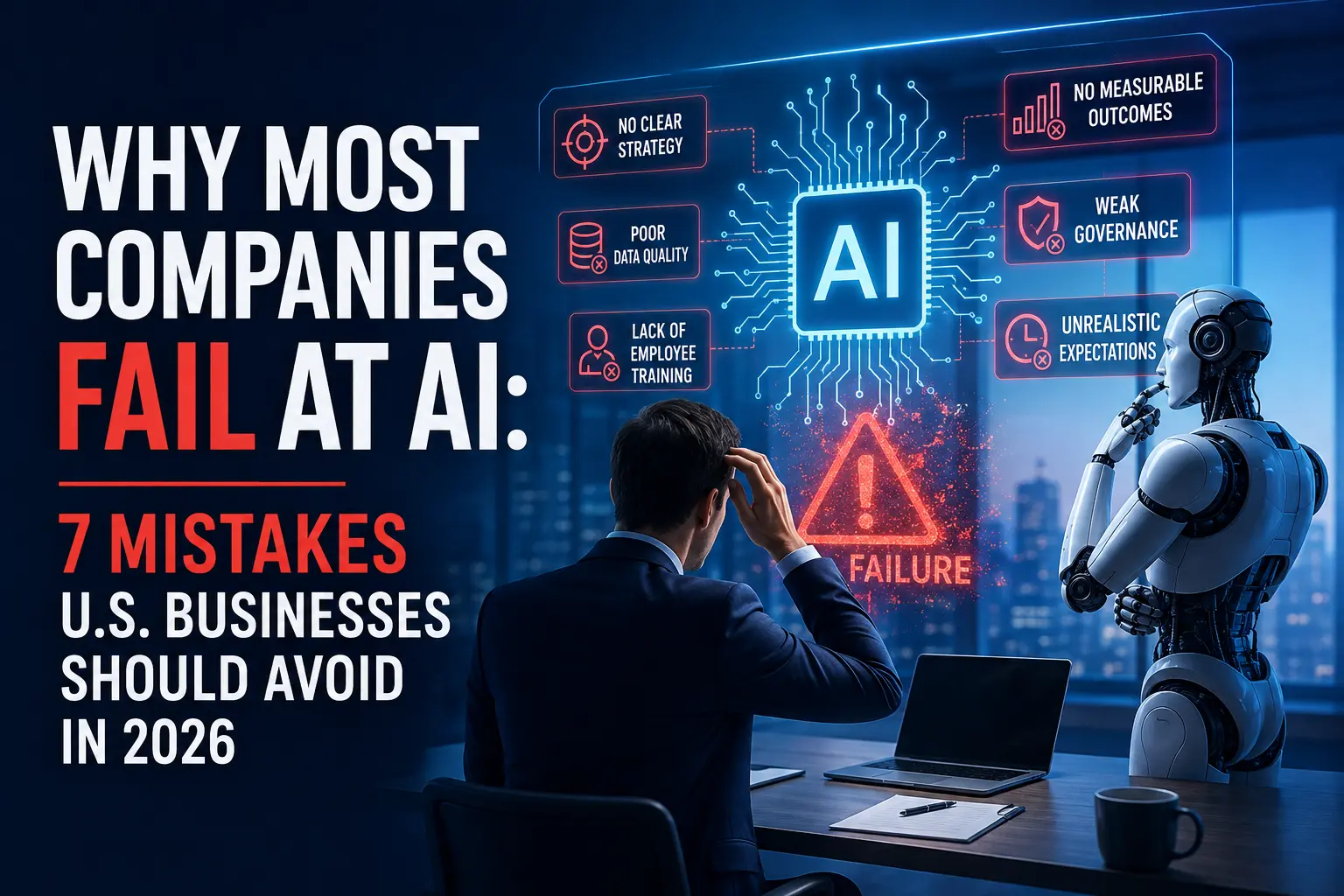
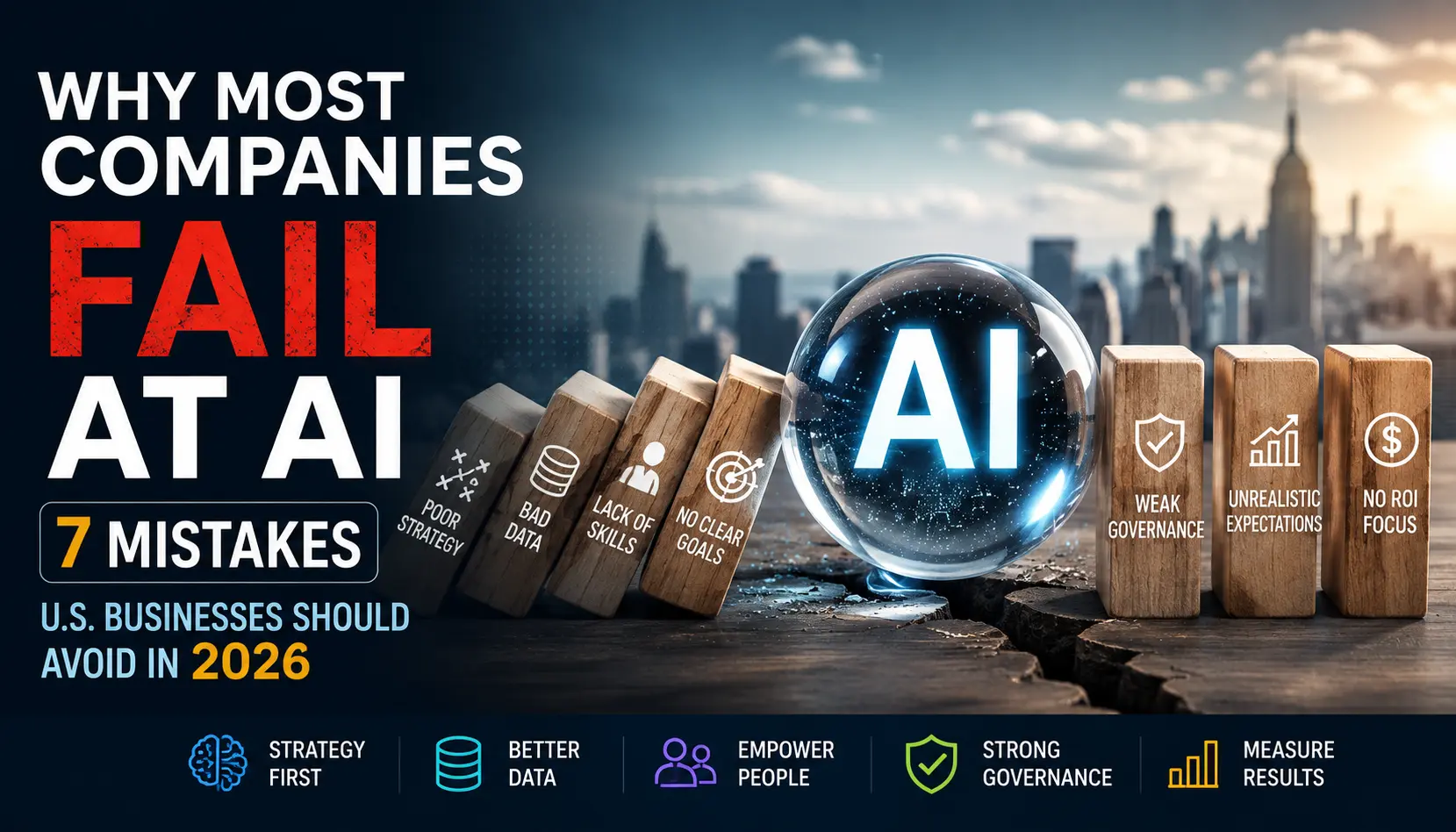
Artificial intelligence has moved from the “future of business” conversation to something companies are expected to deal with right now.
Across the United States, businesses are using AI to write emails, analyze data, answer customer questions, automate administrative work, generate software code, support sales teams, summarize documents, and build entirely new products. AI adoption is no longer limited to Silicon Valley or Fortune 500 companies. Small businesses, professional-service firms, retailers, manufacturers, healthcare organizations, financial companies, and startups are experimenting with AI in some form.
But there is an important problem hiding underneath all the excitement.
Using AI is not the same thing as creating business value with AI.
A company can spend thousands of dollars on AI subscriptions, give employees access to powerful models, launch an AI chatbot, and announce an “AI transformation” initiative—and still see little improvement in revenue, productivity, customer satisfaction, or profitability.
That is where many companies fail at AI in 2026.
Recent research into enterprise AI usage shows that companies are adopting these tools rapidly, but they are still learning how to integrate them into real workflows. Research examining more than 1,500 organizations and more than 17 million messages found that AI use is spreading across job functions, yet companies differ substantially in how quickly and effectively they integrate AI into their operations.
The lesson for U.S. business leaders is straightforward: AI success is less about buying the newest model and more about implementing the technology correctly.
If your company is considering AI adoption—or already has several AI projects underway—these are seven mistakes worth avoiding in 2026.
Quick Author Review
Author Review: 4.8/5
This article provides a practical look at why AI initiatives can struggle despite rapidly increasing adoption across U.S. businesses. Rather than focusing on hype or promising that AI will solve every business problem, it examines the operational issues that leaders need to address before scaling AI.
The strongest part of the article is its focus on measurable business outcomes, employee adoption, data quality, and responsible AI governance. These are areas that can easily be overlooked when companies become focused on the newest AI tools.
Best for: U.S. business owners, startup founders, executives, technology leaders, IT managers, and professionals evaluating AI adoption in 2026.
Editorial verdict: A useful starting point for businesses that want to move from AI experimentation toward practical, measurable implementation.
Starting With the AI Tool Instead of the Business Problem
This is probably the most common mistake. A company hears about a new AI platform and immediately asks:
“How can we use this?”
That sounds reasonable, but it puts technology ahead of strategy.
A better question is:
“What problem are we trying to solve?”
The difference may seem small, but it can completely change the outcome.
Imagine a 75-person U.S. manufacturing company spending months evaluating AI software because competitors are talking about AI. Eventually, management purchases several tools for writing, meetings, customer service, analytics, and automation. Six months later, employees are using some of them occasionally. Nobody can clearly explain whether the company is saving money, serving customers faster, reducing errors, or generating more revenue.
The company technically “adopted AI.” But the business did not necessarily improve. Successful AI projects usually begin with a measurable business problem.
That problem could be:
- Customer-service response times are too slow.
- Sales representatives spend hours researching prospects.
- Employees manually enter information into multiple systems.
- Financial teams spend days preparing recurring reports.
- Customer support receives too many repetitive questions.
- Engineers spend excessive time documenting code.
- Managers cannot quickly identify trends in operational data.
- Employees spend too much time searching internal documents.
Once the problem is clear, AI becomes a potential solution rather than the objective itself.
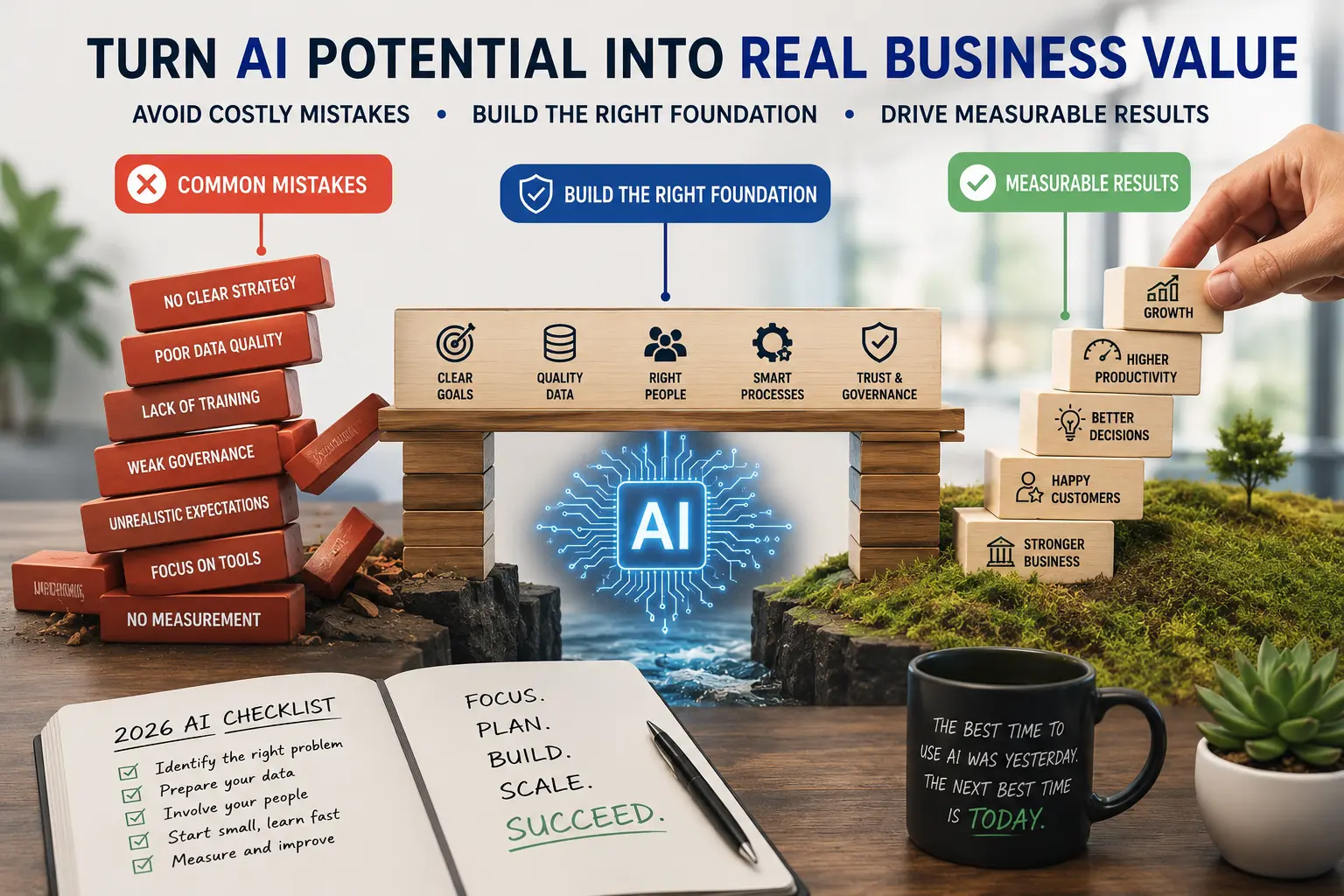
The 2026 approach: Start with friction
Before purchasing an AI platform, ask your team:
Where are we losing the most time, money, or productivity?
Then identify whether AI can realistically improve that process.
For example, instead of saying:
“Let’s introduce generative AI.”
A company could say: “Our customer-service team spends approximately 30 hours per week answering repetitive questions. Can an AI assistant safely handle first-level inquiries while allowing employees to take over complex cases?” That is a much better AI project. It has a problem, a target workflow, measurable outcomes, and a human role. It can also be tested. And that leads to the second mistake.
Treating AI as a Collection of Random Experiments
Experimentation is important. The problem is experimentation without direction. Many organizations allow different departments to independently purchase or test AI tools. Marketing uses one platform. Sales uses another. Human resources experiments with another. Developers build their own AI workflows. Employees use consumer AI applications on their own.
At first, this looks innovative. Eventually, it can become chaotic. The business may end up paying for multiple tools that perform similar tasks while creating security, data, training, and management problems.
This is especially important in 2026 because AI adoption is becoming more widespread across organizations and job functions. Research into enterprise usage shows that AI is not confined to one department; employees are using it for writing, technical work, communication, research, and information synthesis. That makes coordination more important—not less.
Create an AI portfolio
Instead of allowing dozens of unrelated experiments, establish a simple system.
Divide AI initiatives into three groups:
1. Prove it
Small experiments designed to determine whether a use case has potential.
2. Scale it
AI applications that have demonstrated measurable value and are ready for broader deployment.
3. Stop it
Projects that do not produce meaningful benefits, create unacceptable risk, or simply do not justify their cost.
This prevents an organization from confusing activity with progress. A company does not need 50 AI projects. It may need five good ones.
Look for repeatable workflows
The strongest candidates for AI adoption often involve work that happens repeatedly.
Think about:
- summarizing documents;
- classifying incoming requests;
- drafting routine communications;
- extracting information from documents;
- generating internal reports;
- assisting software development;
- answering frequently asked questions;
- analyzing large volumes of business information.
AI becomes much more valuable when it is connected to a recurring business process instead of being treated as an occasional novelty.
Ignoring Data Quality
AI gets plenty of attention. Data quality usually does not. That is a mistake. A company can purchase an impressive AI system, but if the underlying information is inaccurate, outdated, duplicated, incomplete, inaccessible, or scattered across disconnected systems, the AI application will have a difficult time producing reliable results.
This is one reason AI projects can look impressive during demonstrations but struggle in production. A demo may use clean, carefully prepared information. Real businesses rarely operate that way.
A typical U.S. company may have customer information in a CRM, invoices in an accounting platform, documents in cloud storage, employee information in an HR system, operational data in spreadsheets, and years of historical information sitting in legacy databases. The AI system does not magically solve that fragmentation.
Your AI strategy needs a data strategy
Before deploying AI against important business processes, determine:
- Where does the required data live?
- Who owns it?
- How accurate is it?
- How frequently is it updated?
- Who is allowed to access it?
- Is sensitive information properly protected?
- Can the AI system retrieve the correct information?
- Can employees verify the source?
- What happens when information is missing?
These questions may not sound as exciting as choosing an AI model. They are often more important.
In 2026, businesses are increasingly moving beyond simple AI experimentation and discovering that successful deployment depends on connecting AI to real operational systems and reliable information. The lesson is simple: Garbage in does not become intelligence just because AI is involved.
Forgetting That Employees Are Part of the AI Implementation
One of the biggest misconceptions about AI adoption is that companies can purchase the technology first and figure out the people side later. That rarely works well. AI changes how people perform tasks. Sometimes it removes repetitive work. Sometimes it changes job responsibilities. Sometimes it creates new responsibilities. Sometimes it introduces a completely different workflow.
Employees therefore need more than an account and a login. They need context.
They need to understand:
- What AI tools are approved?
- What information can be entered into them?
- When should employees verify AI-generated information?
- Which decisions must remain human?
- What should employees do when AI produces an incorrect answer?
- How will performance be measured?
- What training is available?
- Who can employees contact when something goes wrong?
Without those answers, employees may either avoid AI or use it incorrectly. There is another problem: shadow AI. Employees may turn to AI applications independently because they believe the tools will make their jobs easier. That can create an environment where the company technically has an AI policy but has little visibility into how AI is actually being used.
For businesses, banning everything is not necessarily the best answer. A better strategy is to provide employees with approved tools, clear rules, practical training, and enough flexibility to experiment safely.
Make AI training practical
AI training does not have to become a week-long corporate seminar. Start with real work. Show employees how AI can help with tasks they already perform. For example, a sales team could learn how to use AI for account research and first-draft outreach. A customer-service team could learn how to summarize conversations and identify unresolved issues.
A finance team could use AI to help organize recurring reports while keeping final financial decisions under human review. A software team could use AI for documentation, code assistance, testing, and debugging. The goal is not to make every employee an AI expert. The goal is to help employees use AI competently and responsibly.
Measuring AI Adoption Instead of Measuring Business Results
This mistake can make an AI program look successful when it isn’t. Executives may report: “Seventy percent of employees are using our AI platform.” That sounds impressive. But what does it actually mean?
Employees could be using AI to write occasional emails without producing measurable business value.
A better question is:
What changed because AI was introduced?
For every major AI initiative, establish a baseline before deployment.
Depending on the use case, that might include:
- average processing time;
- cost per transaction;
- customer response time;
- conversion rate;
- employee hours spent on a process;
- error rate;
- customer satisfaction;
- revenue per employee;
- support-ticket resolution time;
- sales-cycle length.
Then compare those numbers after implementation.
Consider ROI from the beginning
Suppose an AI system costs $60,000 per year. If it saves $150,000 worth of employee time and reduces operational losses by another $50,000, the investment may make sense. If employees rarely use it and the company cannot identify meaningful savings or revenue improvements, it may not. This sounds obvious, yet companies often measure AI success through adoption metrics rather than economic outcomes.
Recent reporting on corporate AI adoption has highlighted the gap between widespread AI investment and the ability of companies to quantify productivity or earnings effects. That gap matters. AI should eventually appear somewhere in the business metrics—not just in the technology department’s presentation.
Underestimating AI Security, Privacy and Governance
This is where an AI experiment can become a serious business problem. Employees may accidentally paste confidential customer information into an AI application. A chatbot may provide incorrect information to a customer. An AI agent may receive more system access than it actually needs. A model may generate biased or inappropriate results.
A business may not know which information was used to generate an answer. Or an automated system could make an important decision without adequate human oversight. These risks are not reasons to abandon AI. They are reasons to govern it.
The National Institute of Standards and Technology’s AI Risk Management Framework is designed to help organizations manage AI risks and promote trustworthy, responsible AI. NIST emphasizes characteristics including reliability, safety, security, accountability, transparency, explainability, privacy, and fairness. U.S. companies do not necessarily need a massive bureaucracy to begin. They do need basic controls.
Establish clear AI rules
A practical company AI policy should answer questions such as:
- What data can employees enter into AI systems?
- Which AI applications are approved?
- Which decisions require human approval?
- How should AI-generated information be verified?
- Who is responsible when an AI workflow produces an error?
- How are AI vendors evaluated?
- How is access controlled?
- How are AI systems monitored after deployment?
These questions become even more important when AI is connected to business systems.
A chatbot that only drafts internal text has a different risk profile from an AI agent that can modify customer records, approve transactions, send external messages, or access sensitive databases. The more autonomy an AI system receives, the more carefully its permissions and monitoring should be designed.
Don’t forget human oversight
“Human in the loop” should not become a meaningless phrase. It should have a specific purpose. For high-impact decisions, employees should know when they are expected to review an AI recommendation, what they should check, and when they should reject it. AI should improve human decision-making—not give organizations an excuse to stop thinking.
Expecting AI to Transform the Business Overnight
Perhaps the most expensive mistake is expecting immediate transformation. AI is powerful. It is not magic. A company does not become an AI-first organization simply because it purchases an AI platform. Real transformation usually requires changes to processes, technology, employee habits, leadership, data, and performance measurement. That takes time. Consider a company that wants to automate customer support. The obvious approach might be to install an AI chatbot.
But the real project could involve:
- Cleaning the knowledge base.
- Identifying common customer questions.
- Rewriting outdated documentation.
- Connecting the chatbot to approved information.
- Establishing escalation rules.
- Training support employees.
- Testing responses.
- Monitoring incorrect answers.
- Measuring customer satisfaction.
- Improving the workflow over time.
The chatbot is only one component. That is why companies should think about AI transformation as workflow transformation.
Redesign the process, not just the task
This is an important distinction. Suppose an employee spends 30 minutes creating a report. AI reduces that to 10 minutes. That is useful. But what happens to the other 20 minutes? If the employee simply produces more reports nobody needs, the company may not gain much.
Instead, the organization could redesign the process so that the employee spends those saved 20 minutes analyzing trends, contacting customers, improving operations, or solving higher-value problems. That is where productivity gains can become meaningful. AI should create capacity. Leadership then has to decide how that capacity is used.
What Successful U.S. Businesses Are Doing Differently
Avoiding mistakes is only half the story. Companies that want meaningful AI results should build a practical operating model around the technology.
They start small—but they don’t stay small
The best first AI project does not have to transform the entire organization. Choose one important workflow. Set a baseline. Run a controlled pilot. Measure the result. Improve the process. Then scale it. This is much safer than trying to “AI-enable” every department simultaneously.
They give business leaders ownership
AI should not belong exclusively to the IT department. Technology teams play an essential role, but business leaders understand the processes AI is supposed to improve.
A successful project might therefore involve:
- a business owner;
- IT or engineering;
- data specialists;
- security;
- legal or compliance where appropriate;
- frontline employees;
- senior leadership.
Everyone does not need equal authority. Everyone does need visibility into the project.
They choose boring use cases
This may sound strange, but some of the best AI applications are not flashy. Automating repetitive internal processes can produce more practical value than launching an impressive AI demo.
For example:
- extracting information from documents;
- routing customer requests;
- summarizing internal meetings;
- assisting employees with knowledge searches;
- identifying anomalies;
- automating routine reporting;
- helping sales representatives prepare for meetings;
- supporting software development.
The goal is not to impress people with AI. The goal is to make the business better.
A Simple AI Readiness Test for Your Business
Before launching your next AI initiative, ask these ten questions:
- What specific business problem are we solving?
- How expensive is that problem today?
- What process will AI change?
- What data will the system need?
- Is that data accurate and accessible?
- What could go wrong?
- What information must remain private?
- Which employees need training?
- How will we measure success?
- What will we do if the project does not deliver?
If your team cannot answer most of these questions, the company may not be ready to scale the project. That does not mean AI should be abandoned. It means the project needs more preparation.
The Biggest AI Advantage in 2026 May Not Be the Technology
There is a tendency to think that the company with the most advanced AI model will automatically win. Business reality is more complicated. Companies often have access to many of the same underlying AI technologies. The competitive advantage can therefore come from how effectively a company applies them.
Two businesses can use similar AI models and achieve completely different results. One may connect AI to clean internal data, redesign workflows, train employees, establish strong governance, and continuously measure performance. The other may simply give everyone access to a chatbot and hope productivity improves. The technology may be similar. The outcomes will not be.
That is particularly relevant for small and midsize U.S. businesses. AI does not have to mean building a massive internal research department. Smaller companies can focus on specific operational problems where even modest efficiency improvements can make a meaningful difference.
Final Thoughts: AI Success Is a Business Discipline
The AI conversation in 2026 has matured. A few years ago, businesses were primarily asking: “What can AI do?” Now a more important question is: “Where can AI create measurable value for our business?” That change in thinking matters. Companies fail with AI when they treat it as a trend, a collection of disconnected tools, or a shortcut around fundamental business problems.
They improve their odds when they treat AI as part of a broader business transformation.
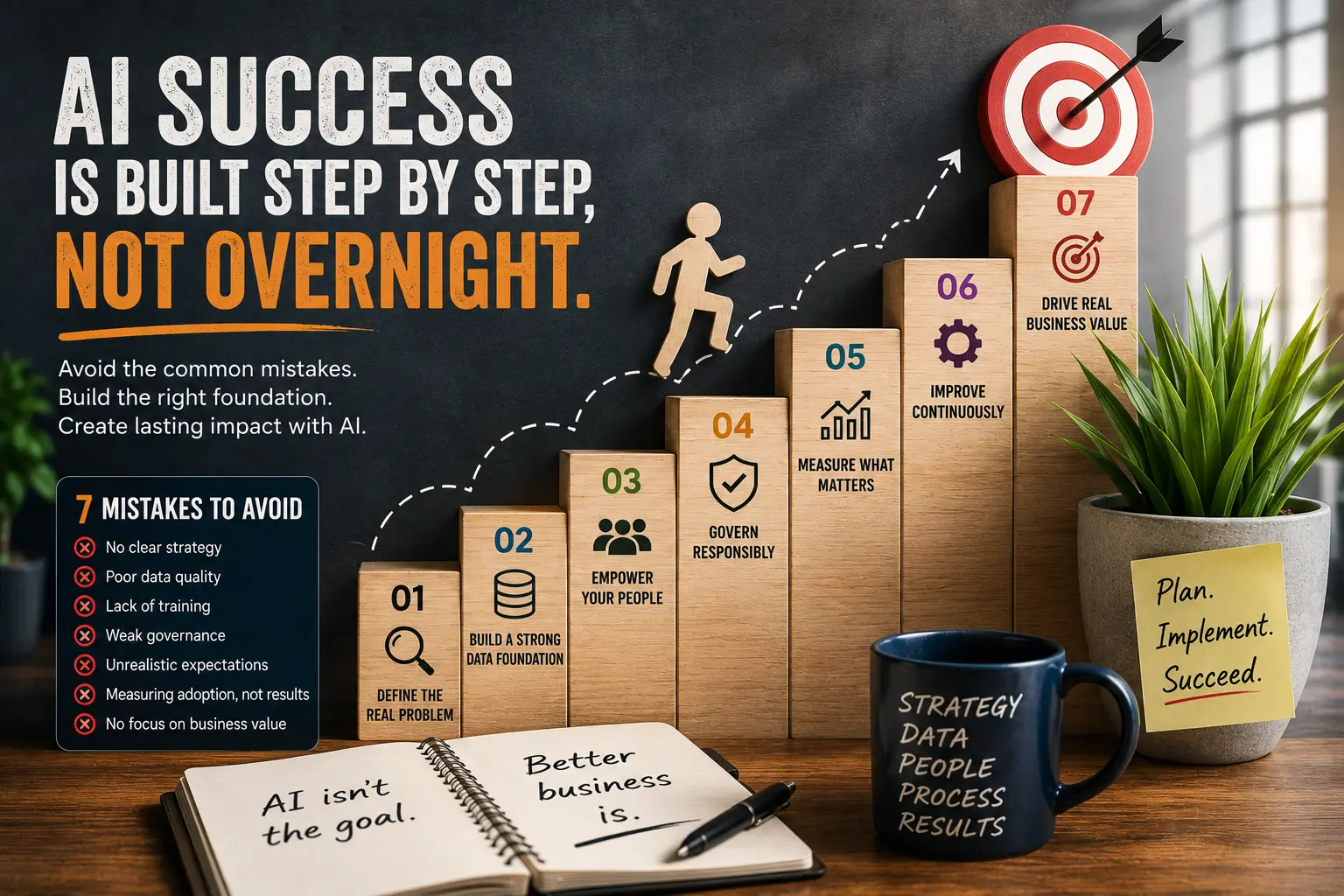
The seven mistakes are worth remembering:
- Starting with the AI tool instead of the business problem.
- Running disconnected experiments without a strategy.
- Ignoring data quality and infrastructure.
- Underestimating employee training and change management.
- Measuring AI adoption instead of business outcomes.
- Ignoring security, privacy, risk, and governance.
- Expecting AI to transform the business overnight.
None of these problems requires a more powerful AI model. They require better management.
Google’s own guidance on creating helpful content makes a similar point from the publishing side: content should primarily serve people, demonstrate real value, and provide original or useful analysis rather than being created simply to manipulate search rankings. The same philosophy applies surprisingly well to AI itself. Don’t adopt AI simply because everyone else is doing it. Don’t measure success because everyone is using it. And don’t chase the newest technology just because it is impressive.
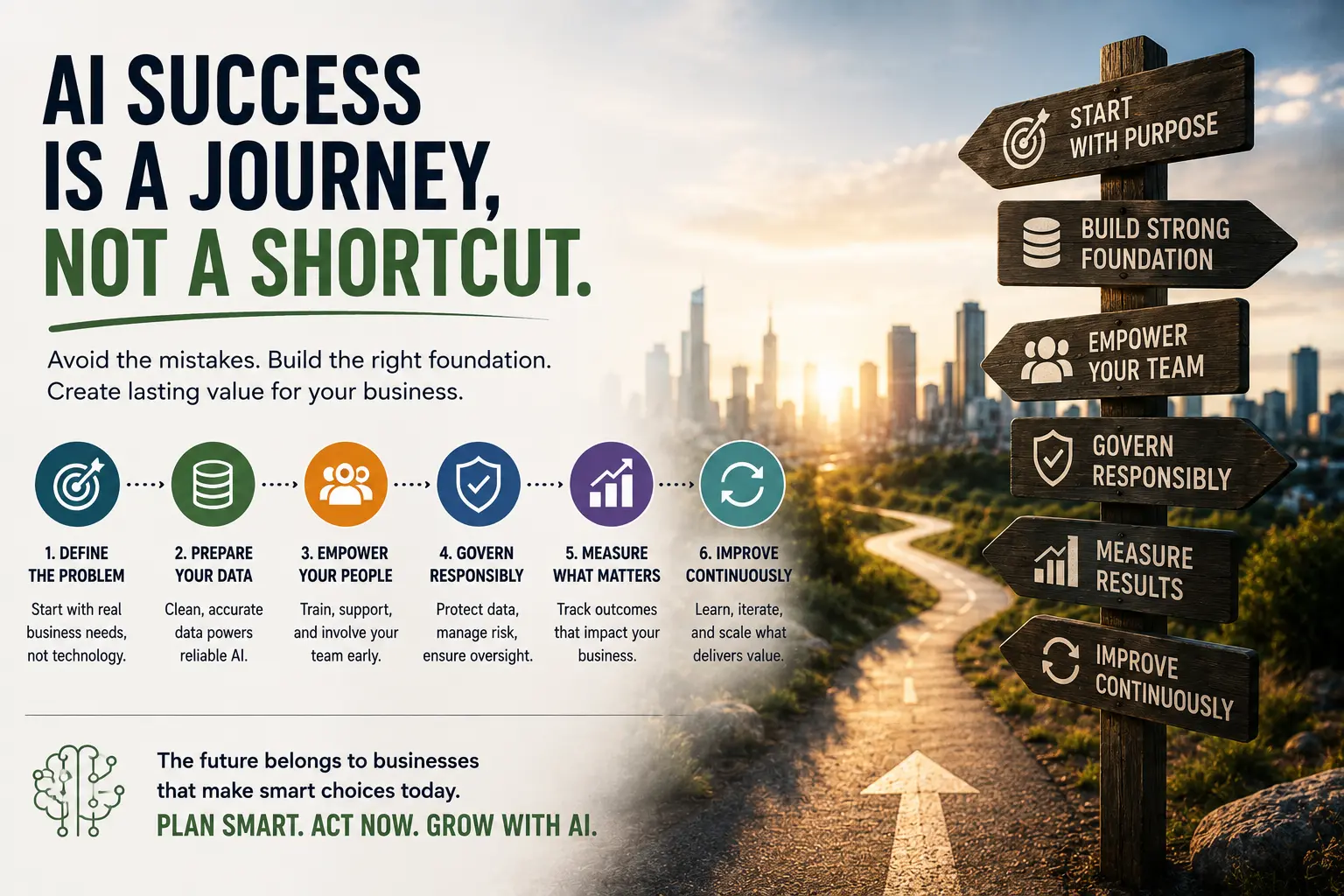
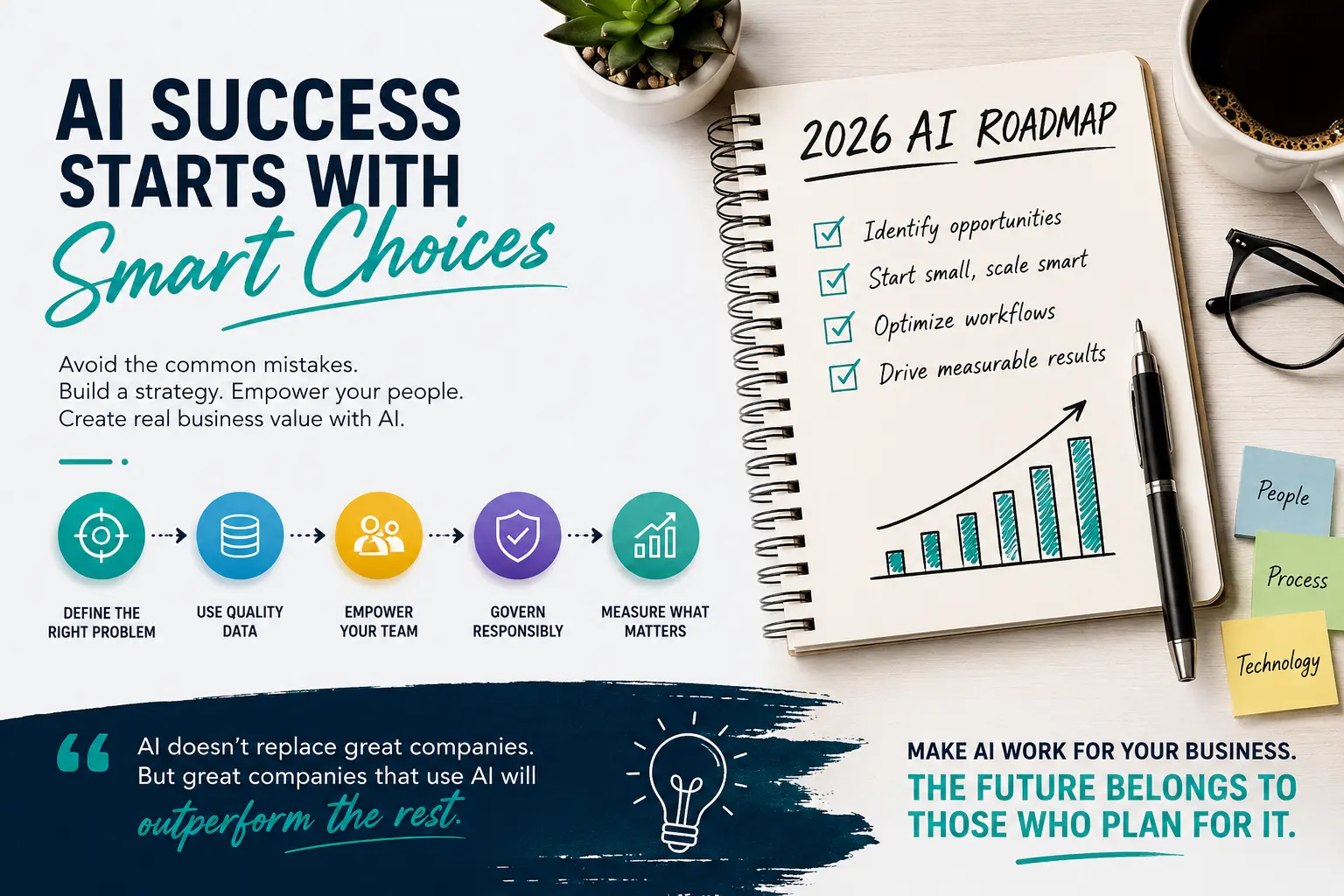
Start with a real problem. Build a sensible workflow. Protect your data. Train your people. Measure the results. Then scale what actually works. For U.S. businesses entering the next stage of the AI economy, that discipline could be far more valuable than simply having access to the latest model. The companies that win with AI will not necessarily be the companies using the most AI. They will be the companies that know where AI belongs—and where it doesn’t.
Frequently Asked Questions
1. Why do most companies fail at AI?
Most companies fail at AI because they focus too much on adopting technology and not enough on solving specific business problems. Poor data, unclear goals, weak employee training, inadequate governance, and failure to measure ROI can also prevent AI projects from delivering meaningful results.
2. What is the biggest AI mistake businesses make in 2026?
One of the biggest mistakes is starting with an AI tool instead of identifying a business problem. Companies should first determine where they are losing time, money, or productivity and then evaluate whether AI can realistically improve that process.
3. How can small U.S. businesses successfully adopt AI?
Small businesses should start with one practical, measurable use case rather than attempting a company-wide AI transformation. Customer support, document processing, marketing assistance, sales research, reporting, and administrative automation can be good starting points.
4. Is AI adoption expensive for small businesses?
It can be, but AI adoption does not necessarily require a large technology budget. Businesses can begin with affordable software and focus on workflows where even a relatively small improvement in productivity or operating costs can produce a measurable return.
5. Should employees be trained before a company introduces AI?
Yes. Employees need to understand how approved AI tools should be used, what information should not be entered into them, when AI-generated information needs verification, and which decisions still require human judgment.
6. How should companies measure the success of an AI project?
Companies should measure business outcomes rather than simply counting how many employees use an AI tool. Useful metrics can include productivity, processing time, operating costs, customer response times, error rates, customer satisfaction, sales performance, and revenue.
7. Is AI safe for businesses to use?
AI can be used safely when businesses implement appropriate security, privacy, access controls, human oversight, and governance. The level of risk depends heavily on what the AI system can access and what decisions or actions it is allowed to perform.
8. Will AI replace employees in U.S. businesses?
AI is more likely to change many job responsibilities than simply eliminate entire occupations. Businesses are increasingly using AI to automate repetitive tasks while allowing employees to focus on judgment, creativity, customer relationships, and higher-value work.
9. What should a company do before implementing an AI tool?
A company should define the business problem, establish measurable goals, review its data, evaluate security and privacy risks, identify the employees involved, determine how success will be measured, and run a controlled pilot before scaling the technology.
10. What is the most important factor in successful AI adoption?
The most important factor is aligning AI with a genuine business need. The technology itself is only part of the equation. Strong processes, reliable data, employee adoption, responsible governance, and continuous measurement are equally important.

SoftwareCompanyNearMe Editorial Team is dedicated to researching and publishing trusted content about U.S. software companies, SaaS platforms, artificial intelligence (AI), cloud computing, cybersecurity, and enterprise technology. Our goal is to help businesses, IT professionals, and software buyers make informed decisions through accurate, well-researched, and regularly updated technology guides, company reviews, and industry insights.