

Introduction
Cybersecurity has become one of the most critical priorities for organizations operating in today’s digital economy. As businesses increasingly rely on cloud computing, artificial intelligence (AI), remote work, and connected devices, cybercriminals continue to develop more sophisticated methods for stealing sensitive information, disrupting operations, and demanding costly ransomware payments. From small businesses to Fortune 500 companies, no organization is immune to cyber threats.
In the United States, cyberattacks are growing in both frequency and complexity. Data breaches, phishing campaigns, ransomware attacks, insider threats, and supply chain vulnerabilities have made cybersecurity an essential part of every organization’s business strategy. A single security incident can result in financial losses, regulatory penalties, damaged customer trust, and long-term reputational harm.
Understanding how to improve cybersecurity is no longer just the responsibility of IT departments. Business leaders, employees, and technology partners all play a role in protecting critical systems and sensitive data. Organizations that adopt proactive security measures are better positioned to prevent attacks, respond quickly to incidents, and maintain business continuity.
Improving cybersecurity involves more than installing antivirus software or firewalls. It requires a comprehensive strategy that includes employee awareness, modern security technologies, continuous monitoring, risk assessments, secure software development, identity management, and compliance with industry regulations. Businesses must also prepare for emerging threats driven by artificial intelligence, cloud environments, and increasingly connected digital ecosystems.
This guide explores the most effective ways to improve cybersecurity in 2026. Whether you operate a startup, small business, healthcare organization, financial institution, or enterprise, you’ll learn practical strategies to strengthen your security posture, reduce cyber risks, and build a resilient defense against evolving digital threats.
Quick Snapshot
| Category | Details |
|---|---|
| Topic | How to Improve Cybersecurity |
| Best For | Business owners, IT leaders, startups, enterprises, security teams, and technology decision-makers |
| Main Focus | Building stronger cybersecurity strategies to prevent modern cyber threats |
| Key Security Areas | Network Security, Cloud Security, Endpoint Protection, Identity Management, Data Protection |
| Important Technologies | Artificial Intelligence, Zero Trust, Multi-Factor Authentication, Encryption, Security Monitoring |
| Major Threats Covered | Ransomware, Phishing, Malware, Insider Threats, Supply Chain Attacks |
| Industries Covered | Healthcare, Finance, Retail, Manufacturing, Government, Insurance |
| Main Benefits | Data protection, reduced financial losses, customer trust, compliance support, business continuity |
| Biggest Challenges | Cybersecurity skills shortage, limited budgets, remote work risks, evolving attacks |
| Recommended Practices | Risk assessments, employee training, MFA, software updates, incident response planning |
| 2026 Trends | AI-powered security, Zero Trust adoption, cloud security expansion, cybersecurity automation |
| Future Outlook | Businesses that prioritize proactive cybersecurity will be better positioned to protect data and maintain digital resilience |
Quick Takeaway:
Cybersecurity is no longer just a technical requirement—it is a critical business strategy. Organizations that combine advanced security tools, strong policies, and employee awareness can reduce cyber risks, protect customer trust, and build a more resilient business in 2026 and beyond.
What Is Cybersecurity?
Cybersecurity is the practice of protecting computers, networks, software, cloud environments, and digital information from unauthorized access, cyberattacks, and data breaches. It combines technology, policies, processes, and employee awareness to defend organizations against evolving security threats.
Modern cybersecurity covers multiple areas, including:
- Network security
- Cloud security
- Endpoint protection
- Identity and access management
- Application security
- Data encryption
- Email security
- Incident response
- Disaster recovery
- Security monitoring
For example, an online retailer uses cybersecurity to protect customer payment information, while a healthcare provider safeguards electronic medical records against unauthorized access. Financial institutions rely on cybersecurity to detect fraud, secure online banking platforms, and comply with strict regulatory requirements.
Rather than focusing on a single security solution, organizations today adopt layered security strategies that combine multiple technologies and best practices to reduce risk and improve resilience.
Why Improving Cybersecurity Matters in 2026
Cybersecurity has evolved from an IT concern into a core business priority. As organizations embrace digital transformation, cloud computing, remote work, and artificial intelligence, the attack surface continues to expand.
Several factors make cybersecurity more important than ever.
Increasing Sophistication of Cyber Threats
Cybercriminals now use artificial intelligence, automation, and advanced malware to launch faster and more targeted attacks. Phishing emails have become more convincing, ransomware groups operate like organized businesses, and attackers continuously search for vulnerabilities in cloud environments and software applications.
Businesses that rely solely on traditional antivirus software are unlikely to defend against today’s complex threats.
Growing Adoption of Cloud Computing
Organizations increasingly store business-critical data in cloud environments and rely on Software as a Service (SaaS) applications for daily operations.
While cloud platforms offer scalability and flexibility, they also introduce new security challenges such as misconfigured storage, weak access controls, and identity management risks.
Implementing strong cloud security policies helps protect sensitive information while supporting business growth.
Rise of Remote and Hybrid Work
Remote work has permanently changed how employees access business systems. Staff members now connect from home offices, coworking spaces, and mobile devices, increasing the number of endpoints that require protection.
Businesses must secure laptops, smartphones, Wi-Fi networks, and remote access systems while ensuring employees follow cybersecurity best practices.
Regulatory and Customer Expectations
Customers expect organizations to safeguard personal and financial information. At the same time, businesses must comply with industry regulations governing data privacy and cybersecurity.
Strong cybersecurity programs help organizations maintain compliance, build customer trust, and reduce the financial and legal consequences of security incidents.
Protecting Business Continuity
A successful cyberattack can interrupt operations for days or even weeks. Ransomware, system outages, and data loss can prevent employees from serving customers and generating revenue.
Organizations that invest in proactive cybersecurity measures, regular backups, and incident response planning are better prepared to recover quickly and minimize operational disruptions.
As cyber threats continue to evolve throughout 2026, businesses that prioritize cybersecurity as a strategic investment—not just an IT expense—will be better positioned to protect their data, maintain customer confidence, and achieve long-term success.

Top Strategies to Improve Cybersecurity
Protecting your business from cyber threats requires a proactive, layered approach. While no organization can eliminate every risk, implementing proven cybersecurity strategies significantly reduces the chances of data breaches, ransomware attacks, and unauthorized access.
The following best practices help organizations build a stronger security posture and prepare for evolving cyber threats in 2026.
1. Conduct Regular Cybersecurity Risk Assessments
The first step in improving cybersecurity is understanding where your organization is vulnerable.
A cybersecurity risk assessment identifies weaknesses in networks, software, devices, cloud environments, and business processes before attackers can exploit them.
A comprehensive assessment should include:
- Network vulnerability scanning
- Software security reviews
- Cloud infrastructure analysis
- Third-party vendor evaluations
- Data protection assessments
- Regulatory compliance reviews
For example, a healthcare provider may discover outdated medical software that requires security updates, while a retail company might identify weak password policies affecting employee accounts.
Regular assessments allow organizations to prioritize improvements based on risk rather than assumptions.
2. Implement Multi-Factor Authentication (MFA)
Passwords alone are no longer enough to protect business systems.
Multi-Factor Authentication (MFA) requires users to verify their identity using two or more authentication methods before accessing sensitive applications or data.
Common authentication methods include:
- Passwords
- Mobile authentication apps
- Biometric verification
- Security tokens
- One-time verification codes
Organizations should enable MFA for:
- Email accounts
- Cloud platforms
- VPN access
- Administrative accounts
- Financial applications
Even if a password is stolen, MFA dramatically reduces the likelihood of unauthorized access.
3. Adopt a Zero Trust Security Model
Traditional cybersecurity assumed users inside the company network could be trusted.
Today’s organizations follow a Zero Trust approach based on one principle:
Never trust. Always verify.
Every user, device, and application must continuously prove its identity before receiving access.
Key components include:
- Identity verification
- Least privilege access
- Continuous authentication
- Network segmentation
- Device health monitoring
- Activity logging
Zero Trust significantly limits the damage caused by compromised accounts and insider threats.
4. Keep Software and Systems Updated
Cybercriminals frequently target known software vulnerabilities that organizations fail to patch.
Businesses should establish an automated patch management process covering:
- Operating systems
- Business applications
- Web browsers
- Firewalls
- Servers
- Cloud services
- Security software
Keeping systems updated closes security gaps before attackers can exploit them.
Organizations should also replace unsupported legacy software whenever possible.
5. Strengthen Endpoint Security
Every laptop, desktop, smartphone, and tablet connected to your network represents a potential entry point for attackers.
Modern endpoint protection should include:
- Next-generation antivirus
- Endpoint Detection and Response (EDR)
- Device encryption
- Mobile device management
- Application control
- Continuous monitoring
Organizations with remote employees should pay particular attention to securing personal devices used for work.
6. Secure Cloud Environments
Cloud computing provides flexibility and scalability, but it also introduces new cybersecurity challenges.
Businesses should secure cloud environments by implementing:
- Strong identity management
- Multi-factor authentication
- Secure API configurations
- Data encryption
- Access monitoring
- Regular cloud security audits
Cloud providers secure their infrastructure, but organizations remain responsible for protecting their own applications, data, and user accounts.
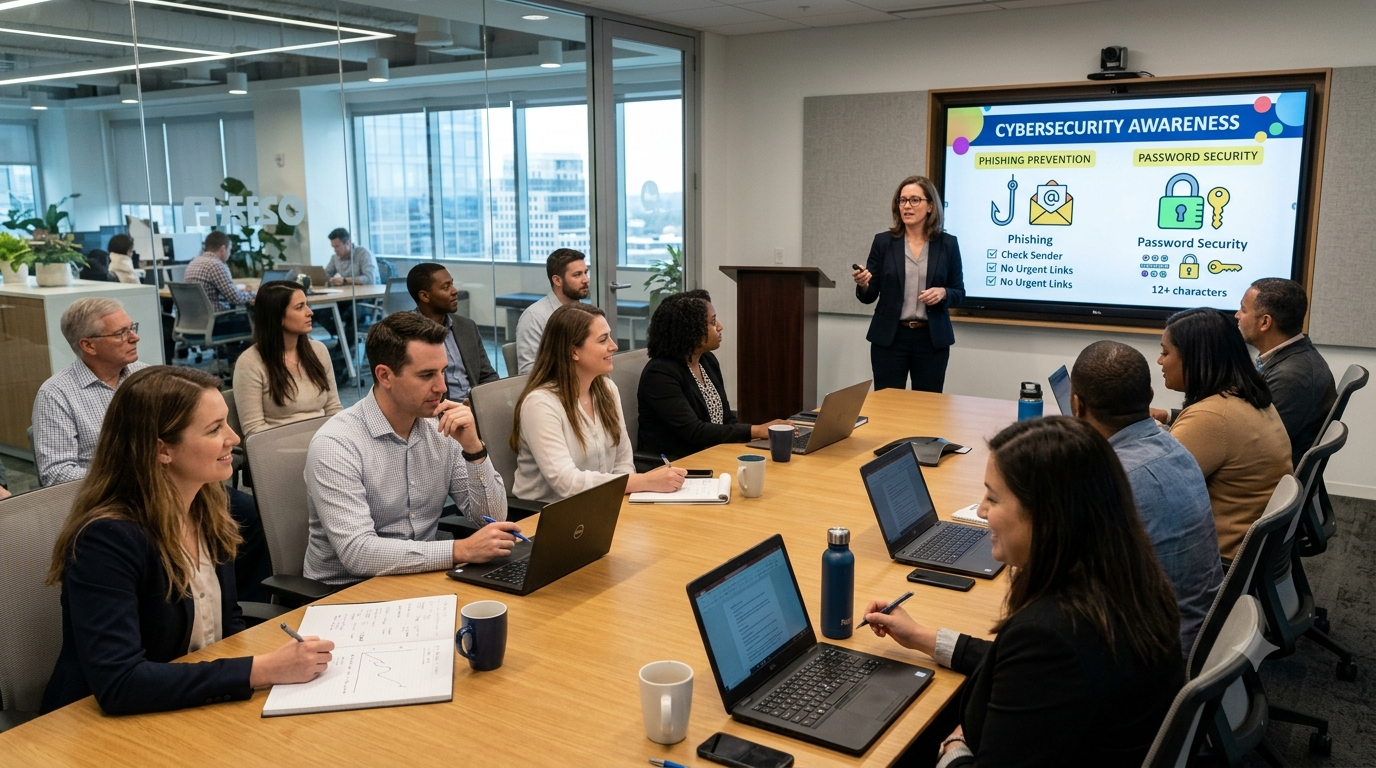
7. Train Employees on Cybersecurity Awareness
Technology alone cannot stop cyberattacks.
Employees remain one of the most important lines of defense against phishing, ransomware, and social engineering attacks.
Training programs should teach employees how to:
- Recognize phishing emails
- Create strong passwords
- Report suspicious activity
- Avoid malicious downloads
- Protect sensitive information
- Safely use remote work devices
Regular cybersecurity awareness training significantly reduces human error and improves overall security.
8. Develop an Incident Response Plan
No cybersecurity strategy is complete without preparing for potential security incidents.
An incident response plan helps organizations respond quickly and minimize damage.
A strong plan should define:
- Roles and responsibilities
- Internal communication procedures
- Threat containment steps
- Recovery processes
- Customer notification procedures
- Regulatory reporting requirements
Testing the response plan through regular cybersecurity exercises improves preparedness and reduces recovery time.
Real-World U.S. Business Examples
Organizations across the United States are adopting stronger cybersecurity strategies to protect operations and customer data.
Healthcare
Healthcare providers implement encrypted electronic health records, secure patient portals, multi-factor authentication, and continuous monitoring to protect sensitive medical information while maintaining HIPAA compliance.
Financial Services
Banks and financial institutions rely on AI-powered fraud detection, behavioral analytics, Zero Trust architecture, and advanced encryption to secure online banking systems and customer accounts.
Retail and E-Commerce
Retailers strengthen cybersecurity through secure payment gateways, tokenization, web application firewalls, fraud monitoring, and customer identity verification to reduce payment fraud and data breaches.
Manufacturing
Manufacturing companies deploy endpoint security, industrial network monitoring, predictive threat detection, and secure operational technology (OT) systems to reduce ransomware risks and protect production environments.
Building a Long-Term Cybersecurity Strategy
Cybersecurity should be viewed as an ongoing business investment rather than a one-time technology project.
Organizations that continuously evaluate risks, modernize security infrastructure, educate employees, and monitor emerging threats are better prepared to adapt to the rapidly evolving cyber landscape.
An effective long-term cybersecurity strategy includes:
- Regular risk assessments
- Continuous employee training
- Security policy updates
- AI-powered threat detection
- Disaster recovery planning
- Compliance monitoring
- Ongoing technology modernization
By combining these best practices with a culture of security awareness, businesses can reduce cyber risks, strengthen resilience, and confidently support future growth in an increasingly connected digital world.
Benefits of Improving Cybersecurity
Investing in cybersecurity is no longer just about preventing attacks—it’s about protecting business continuity, customer trust, and long-term growth. Organizations with strong cybersecurity programs are better equipped to operate confidently in an increasingly digital economy.
1. Protects Sensitive Business Data
Businesses store valuable information, including customer records, financial data, intellectual property, and employee information.
Strong cybersecurity safeguards this data through:
- Data encryption
- Secure access controls
- Continuous monitoring
- Regular security audits
Protecting sensitive information helps prevent costly data breaches and identity theft.
2. Reduces Financial Losses
Cyberattacks can result in significant financial damage through:
- Ransomware payments
- Business downtime
- Legal expenses
- Regulatory fines
- Customer compensation
- Recovery costs
Proactive cybersecurity measures reduce the likelihood of these costly incidents and help organizations avoid unexpected financial setbacks.
3. Builds Customer Trust
Customers expect businesses to protect their personal and financial information.
Organizations that demonstrate strong cybersecurity practices build confidence, strengthen customer relationships, and improve brand reputation.
A trusted business is more likely to retain customers and attract new ones.
4. Supports Business Continuity
Unexpected cyber incidents can disrupt operations for hours or even weeks.
A comprehensive cybersecurity strategy—including secure backups, disaster recovery planning, and incident response procedures—helps businesses recover quickly and minimize downtime.
This ensures essential services remain available even during security events.
5. Helps Meet Regulatory Requirements
Many industries must comply with strict cybersecurity and data privacy regulations.
Strong security practices help organizations meet compliance requirements while reducing the risk of penalties and legal action.
Industries with significant compliance requirements include:
- Healthcare
- Financial Services
- Government
- Retail
- Insurance
Maintaining compliance also demonstrates a commitment to responsible data management.

Common Cybersecurity Challenges
Although cybersecurity technologies continue to improve, organizations still face several ongoing challenges.
Increasingly Sophisticated Cyberattacks
Cybercriminals continuously develop new attack techniques using automation and artificial intelligence.
Businesses must regularly update their security strategies to defend against:
- Ransomware
- Phishing campaigns
- Malware
- Insider threats
- Supply chain attacks
- Credential theft
Cybersecurity requires continuous improvement rather than one-time implementation.
Limited Cybersecurity Budgets
Small and medium-sized businesses often struggle to allocate sufficient resources for cybersecurity.
Common budget limitations include:
- Limited IT staff
- Aging infrastructure
- Outdated security software
- Lack of employee training
Prioritizing high-impact security investments helps maximize protection without excessive spending.
Cybersecurity Skills Shortage
Demand for cybersecurity professionals continues to exceed supply across the United States.
Organizations increasingly address this challenge by:
- Upskilling existing employees
- Partnering with managed security providers
- Automating security monitoring
- Using AI-powered threat detection platforms
Building internal security awareness also reduces pressure on technical teams.
Managing Remote Work Security
Hybrid and remote work environments increase the number of devices connecting to business systems.
Organizations must secure:
- Home Wi-Fi networks
- Mobile devices
- Remote desktops
- VPN connections
- Cloud applications
Clear remote work policies help reduce security risks while maintaining productivity.
Cybersecurity Trends for 2026
Cybersecurity continues evolving as businesses adopt new technologies and cybercriminals develop more advanced attack methods.
Artificial Intelligence in Cybersecurity
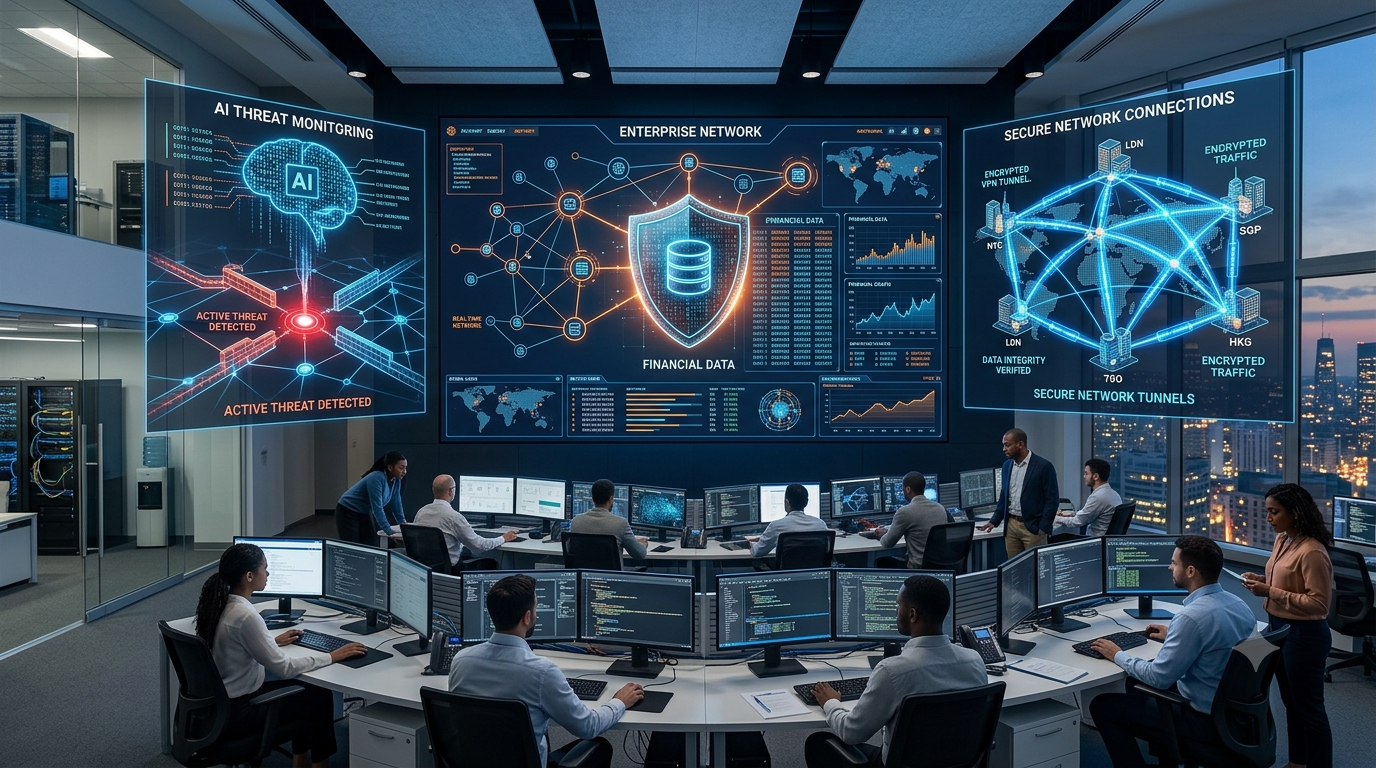
Artificial intelligence is becoming an essential part of modern cybersecurity.
AI-powered security platforms help organizations:
- Detect suspicious activity
- Identify vulnerabilities
- Analyze large volumes of security data
- Respond to threats automatically
- Reduce response times
AI enhances security teams by improving speed and accuracy.
Zero Trust Becomes the Standard
Organizations increasingly replace traditional perimeter-based security with Zero Trust architecture.
Every user, application, and device must continuously verify its identity before receiving access.
This approach significantly reduces unauthorized access and insider threats.
Cloud Security Continues to Expand
As cloud adoption grows, organizations invest in:
- Cloud workload protection
- Identity management
- Secure cloud configurations
- Cloud-native security monitoring
- API security
Cloud security remains a top investment priority for businesses across every industry.

Cybersecurity Automation
Security teams increasingly automate repetitive tasks such as:
- Threat detection
- Vulnerability scanning
- Patch management
- Incident response
- Security reporting
Automation improves efficiency while allowing security professionals to focus on higher-risk threats.
Stronger Supply Chain Security
Businesses increasingly evaluate the cybersecurity practices of software vendors, cloud providers, and third-party service partners.
Supply chain security has become a critical component of enterprise risk management.
Expert Insights
Cybersecurity professionals emphasize that security should not be viewed as only an IT responsibility. In today’s digital environment, it should be treated as a core business strategy that supports growth, protects valuable assets, and helps organizations operate with confidence.
Integrate Security Into Every Business Process
Security should be considered from the beginning of every major business activity, including software development, employee onboarding, vendor partnerships, and technology planning. Building security into daily operations from the start helps organizations identify risks earlier, prevent costly issues, and create stronger protection across the entire business.
Embrace Continuous Security Improvement
Cyber threats are constantly changing, and security strategies must evolve with them. Organizations should regularly review and improve their cybersecurity practices instead of relying on outdated protections.
Important activities include:
- Updating security policies and procedures
- Testing disaster recovery plans
- Performing security assessments and penetration testing
- Reviewing user access permissions
- Providing ongoing employee cybersecurity training
Continuous improvement helps businesses stay prepared and respond more effectively to new and emerging threats.
Maintain the Right Balance Between Security and Productivity
Strong security measures should protect business systems without creating unnecessary obstacles for employees or customers. Organizations can achieve this balance by implementing user-friendly authentication methods, automated security monitoring, and efficient security workflows. The goal is to create a secure environment where people can work effectively while sensitive information remains protected.
Common Mistakes to Avoid
Many cybersecurity incidents happen because organizations overlook basic security practices or underestimate potential risks. While advanced security tools are important, poor planning, outdated processes, and lack of awareness can leave businesses vulnerable to cyber threats.
Avoiding these common mistakes can help organizations build a stronger defense and protect their valuable data.
Relying Only on Antivirus Software
Antivirus solutions are an important part of cybersecurity, but they cannot protect against every modern threat. Today’s cyberattacks often involve phishing, ransomware, stolen credentials, and advanced social engineering techniques that require multiple layers of protection.
Businesses should combine antivirus tools with measures such as employee training, access controls, threat monitoring, and regular security assessments.
Ignoring Employee Cybersecurity Training
Employees play a major role in protecting an organization from cyber threats. Without proper training, staff members may unknowingly click malicious links, download unsafe files, or share sensitive information with attackers.
Regular cybersecurity awareness programs help employees identify phishing attempts, follow secure practices, and respond correctly to suspicious activity.
Using Weak Password Practices
Weak or reused passwords remain one of the easiest targets for cybercriminals. Simple passwords or using the same password across multiple accounts can allow attackers to gain access to important business systems.
Organizations should enforce strong password policies and combine them with Multi-Factor Authentication (MFA) to add an extra layer of protection.
Delaying Software Updates
Ignoring software updates can create serious security risks. Cybercriminals often exploit known vulnerabilities in outdated applications, operating systems, and business tools.
Regular patch management ensures security weaknesses are fixed quickly and helps keep systems protected against emerging threats.
Failing to Maintain Secure Data Backups
Without reliable backups, businesses may face significant challenges recovering from ransomware attacks, hardware failures, or unexpected data loss.
Organizations should maintain secure, regularly tested backups and ensure recovery procedures are updated. A strong backup strategy helps minimize downtime and allows businesses to restore critical operations more quickly after an incident.
Author Review
Cybersecurity has become a fundamental requirement for businesses operating in an increasingly connected digital environment. This article provides a practical overview of how organizations can strengthen their security posture by combining modern technologies, employee awareness, proactive risk management, and continuous monitoring.
The guide explains that cybersecurity is no longer limited to IT teams but has become a business-wide responsibility. It highlights essential strategies such as Multi-Factor Authentication, Zero Trust security, cloud protection, employee training, incident response planning, and regular security assessments.
For startups, small businesses, and large enterprises across the United States, investing in cybersecurity is critical for protecting sensitive information, maintaining customer trust, and ensuring business continuity. As cyber threats become more advanced through artificial intelligence, automation, and cloud-based attacks, organizations that adopt a proactive security approach will be better prepared for future challenges.
Frequently Asked Questions
1. What is the best way to improve cybersecurity?
The most effective approach combines employee training, Multi-Factor Authentication, Zero Trust security, regular software updates, and continuous monitoring.
2. Why is cybersecurity important for small businesses?
Small businesses often have fewer security resources, making them attractive targets for cybercriminals. Strong cybersecurity helps protect customer data, financial information, and business operations.
3. What is Zero Trust security?
Zero Trust is a security model that requires every user, device, and application to continuously verify its identity before accessing business systems.
4. How often should businesses conduct cybersecurity assessments?
Most organizations should perform comprehensive cybersecurity assessments at least annually, with continuous vulnerability monitoring throughout the year.
5. What are the most common cyber threats in 2026?
Ransomware, phishing, malware, insider threats, supply chain attacks, and AI-powered cyberattacks remain among the most significant threats.
6. Does Multi-Factor Authentication really improve security?
Yes. MFA dramatically reduces unauthorized access by requiring additional identity verification beyond a password.
7. How can employees help improve cybersecurity?
Employees can improve security by recognizing phishing attempts, using strong passwords, enabling MFA, reporting suspicious activity, and following company security policies.
8. Is cloud computing secure?
Cloud platforms can be highly secure when organizations implement proper identity management, encryption, secure configurations, and continuous monitoring.
9. What is an incident response plan?
An incident response plan outlines how an organization detects, contains, investigates, and recovers from cybersecurity incidents while minimizing business disruption.
10. What is the biggest cybersecurity mistake businesses make?
Many businesses underestimate cyber risks by delaying security updates, neglecting employee training, or relying on outdated security technologies instead of implementing a comprehensive cybersecurity strategy.
Conclusion
Learning how to improve cybersecurity is essential for every organization operating in today’s connected world. As cyber threats continue to evolve, businesses must move beyond basic security measures and adopt a comprehensive strategy that combines modern technology, employee awareness, proactive risk management, and continuous monitoring.
Successful cybersecurity programs are built on strong foundations, including Multi-Factor Authentication, Zero Trust architecture, cloud security, regular software updates, and ongoing employee training. These practices not only reduce the risk of cyberattacks but also protect sensitive data, strengthen customer trust, support regulatory compliance, and ensure business continuity.
Looking ahead to 2026 and beyond, organizations that treat cybersecurity as a long-term business investment rather than a one-time IT project will be better prepared to defend against emerging threats. By continuously improving security practices, embracing new technologies, and fostering a culture of cybersecurity awareness, businesses can confidently navigate the digital landscape while protecting their most valuable assets.

SoftwareCompanyNearMe Editorial Team is dedicated to researching and publishing trusted content about U.S. software companies, SaaS platforms, artificial intelligence (AI), cloud computing, cybersecurity, and enterprise technology. Our goal is to help businesses, IT professionals, and software buyers make informed decisions through accurate, well-researched, and regularly updated technology guides, company reviews, and industry insights.