
Introduction
Artificial intelligence continues to reshape industries, and few companies have benefited more than NVIDIA. Once known primarily for gaming graphics cards, the company has become the dominant supplier of AI chips powering data centers, autonomous vehicles, robotics, and enterprise AI applications.
As investors look toward the future, one question keeps appearing across Wall Street and online investing communities: What is the NVIDIA stock prediction for 2026? While no one can accurately predict future stock prices, understanding NVIDIA’s business fundamentals, industry trends, competitive position, and potential risks can help investors make informed decisions. This guide examines the factors likely to influence NVDA throughout 2026 and whether it still deserves a place in a long-term investment portfolio.
NVIDIA: Company Snapshot
| Details | Information |
|---|---|
| Company Name | NVIDIA Corporation |
| Founded | 1993 |
| Headquarters | Santa Clara, California, USA |
| Industry | Semiconductors, Artificial Intelligence, High-Performance Computing |
| Business Category | AI Chips, GPUs, Data Center Infrastructure, Accelerated Computing |
| Founders | Jensen Huang, Chris Malachowsky, and Curtis Priem |
| Primary Products | NVIDIA GPUs, CUDA Platform, AI Networking Solutions, DGX Systems, NVIDIA AI Enterprise |
| Main Purpose | Powering artificial intelligence, high-performance computing, graphics processing, and enterprise AI infrastructure |
| Target Customers | Cloud providers, enterprises, AI startups, developers, research institutions, automotive companies, and government organizations |
| Core Problem It Solves | Delivers the computing power needed to train, deploy, and scale advanced AI models and data-intensive applications |
| Technology Focus | Artificial Intelligence, Accelerated Computing, GPUs, Data Centers, Robotics, Autonomous Vehicles |
| Key Capabilities | AI model training, high-performance GPUs, AI networking, enterprise software, robotics platforms, autonomous driving technology |
| Primary Users | Enterprises, AI researchers, software developers, cloud providers, data scientists, and technology companies |
| Deployment Options | On-Premises Infrastructure, Cloud Platforms, Hybrid AI Environments |
| Major Industries Served | Healthcare, Financial Services, Manufacturing, Automotive, Retail, Cloud Computing, Education, Scientific Research |
| Best Known For | Leading the global AI chip market and powering many of the world’s largest AI data centers |
| Business Value | Accelerated AI innovation, scalable computing performance, enterprise AI adoption, and long-term infrastructure growth |
Quick Summary
NVIDIA has evolved from a graphics processor manufacturer into one of the world’s most influential AI infrastructure companies. Through its advanced GPUs, AI software ecosystem, networking technologies, and enterprise solutions, NVIDIA powers data centers, generative AI, robotics, autonomous vehicles, and high-performance computing worldwide. As demand for artificial intelligence continues to grow, NVIDIA remains a key company driving the future of enterprise AI and accelerated computing.
Why NVIDIA Dominates the AI Industry
NVIDIA has evolved into much more than a semiconductor company. Today, it powers some of the world’s largest AI systems used by cloud providers, Fortune 500 companies, research institutions, healthcare organizations, and governments. Its competitive advantage extends beyond hardware.
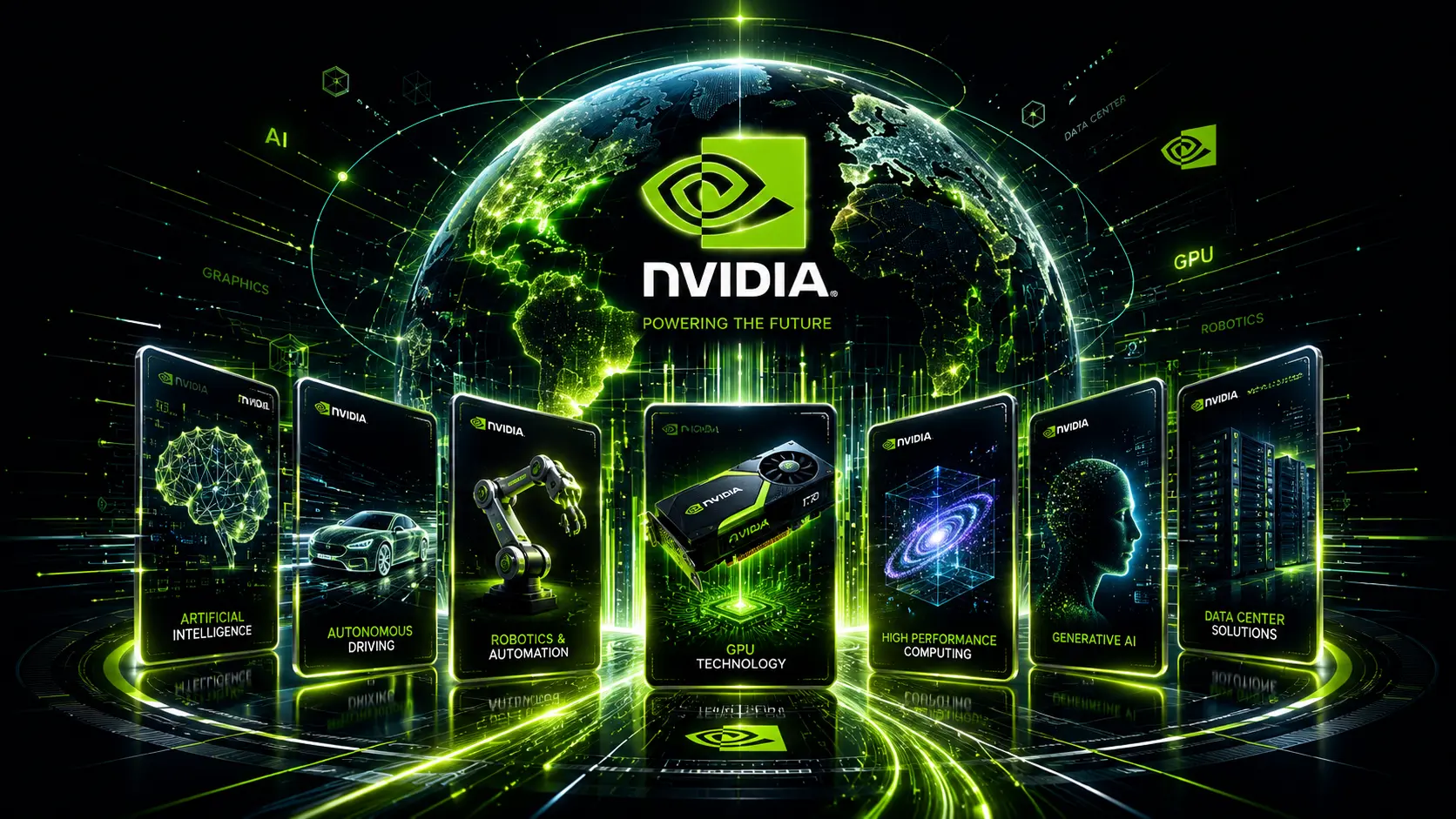
The company has built a complete AI ecosystem that includes:
- High-performance GPUs
- AI networking solutions
- CUDA software platform
- Enterprise AI tools
- Robotics platforms
- Autonomous driving technology
This integrated ecosystem makes it difficult for competitors to replace NVIDIA in enterprise environments. Many organizations have spent years building software around CUDA, creating significant switching costs.
That ecosystem remains one of NVIDIA’s strongest competitive advantages entering 2026.
Why Investors Remain Bullish on NVIDIA
Several long-term trends continue supporting NVIDIA Stock growth.
AI Infrastructure Expansion
Large technology companies continue investing billions of dollars in AI infrastructure.
Cloud providers require enormous computing power for:
- Generative AI
- Large language models
- AI assistants
- Enterprise automation
- Scientific computing
NVIDIA remains the preferred supplier for many of these deployments.
As AI adoption expands across industries, demand for advanced GPUs is expected to remain strong.
Enterprise AI Adoption
Artificial intelligence is no longer limited to technology companies. Businesses in healthcare, finance, manufacturing, retail, cybersecurity, logistics, and education increasingly rely on AI-powered applications.
Examples include:
- Customer service automation
- Fraud detection
- Medical imaging
- Predictive maintenance
- Personalized recommendations
- Intelligent search
- Software development
Every new AI workload creates additional demand for high-performance computing. This broad adoption could become one of NVIDIA’s largest long-term growth drivers.
Data Center Growth
Data centers now generate the majority of NVIDIA’s revenue. Instead of building traditional server infrastructure, cloud providers are constructing AI-focused facilities capable of training and deploying advanced machine learning models.
As organizations migrate toward AI-native infrastructure, NVIDIA stands to benefit from:
- Higher GPU demand
- Networking hardware sales
- AI software subscriptions
- Enterprise support services
The company’s business has become increasingly diversified beyond gaming.

What Could Drive NVIDIA Stock Higher in 2026?
Although stock prices depend on many variables, several catalysts could support continued growth.
Continued AI Spending
Technology companies continue allocating significant budgets to AI initiatives. If enterprise AI adoption accelerates further, NVIDIA may experience sustained demand for its products. Strong capital spending from hyperscale cloud providers would likely remain one of the biggest revenue drivers.
Software Revenue Growth
While GPUs receive most of the attention, NVIDIA is increasingly expanding its software business and NVIDIA Stocks.
Subscription-based enterprise software generally produces:
- Higher profit margins
- Recurring revenue
- Strong customer retention
- More predictable cash flow
Over time, software could become a more meaningful contributor to the company’s financial performance.
International AI Expansion
Artificial intelligence adoption is becoming a global priority. Governments and enterprises around the world continue investing in AI infrastructure to improve productivity, national competitiveness, and digital transformation. If international demand continues to rise, NVIDIA may find additional growth opportunities beyond its existing customer base.
Risks Investors Should Consider
Despite its impressive growth, NVIDIA stocks is not without risks.
Premium Valuation
One of the biggest concerns among analysts is valuation. High-growth companies often trade at premium multiples. When expectations become extremely high, even strong earnings may not satisfy investors. This can result in significant stock price volatility.
Growing Competition
Although NVIDIA leads the AI chip market, competition continues increasing. Major rivals are investing heavily in AI hardware, while some large technology companies are also developing their own custom AI processors. Greater competition could eventually pressure pricing and market share.
Geopolitical and Supply Chain Risks
The semiconductor industry depends on a complex global supply chain. Trade restrictions, export controls, manufacturing disruptions, or geopolitical tensions could affect production, sales, or future growth opportunities.These factors remain important considerations for long-term investors.
Is NVIDIA Stock Overvalued in 2026?
One of the most debated questions among investors isn’t whether NVIDIA is an exceptional company—it’s whether the stock price already reflects too much optimism.
After delivering extraordinary growth fueled by the AI revolution, NVIDIA Stocks has often traded at valuation multiples well above the broader market. Premium valuations are common for market leaders, but they also leave less room for disappointment.
Investors should focus on these key metrics instead of daily stock price movements:
- Revenue growth
- Earnings per share (EPS)
- Gross margins
- Free cash flow
- Data center revenue
- AI infrastructure demand
- Research and development spending
If NVIDIA continues delivering strong financial results while expanding into new AI markets, a premium valuation may remain justified. However, slower-than-expected growth or reduced enterprise AI spending could lead to increased volatility.

Benefits of Investing in NVIDIA
Long-term investors continue to see several compelling reasons to own NVIDIA stocks.
1. Market Leadership
NVIDIA remains the dominant provider of AI GPUs used by major cloud providers, AI startups, and enterprise customers. Its leadership position gives the company significant pricing power and a strong competitive moat.
2. Multiple Revenue Streams
While gaming helped establish NVIDIA’s reputation, today’s business is far more diversified.
Its revenue comes from:
- AI data centers
- Gaming GPUs
- Professional visualization
- Automotive AI
- Networking solutions
- Enterprise software
This diversification helps reduce dependence on any single market.
3. Innovation-Driven Culture
In NVIDIA Stocks consistently invests billions of dollars in research and development. Its focus on innovation has enabled it to stay ahead in AI hardware, accelerated computing, and software platforms.
4. Strong Financial Position
The company has generated substantial revenue growth, healthy profit margins, and robust cash flow, providing resources to invest in future technologies and strategic opportunities.
Challenges That Could Affect NVDA Stock
No investment is risk-free, and NVIDIA faces several challenges that investors should monitor.
High Expectations
Wall Street expects exceptional quarterly performance from NVIDIA. Even a slight miss in revenue guidance or earnings could trigger significant price swings.
AI Spending Slowdown
Current demand is driven by heavy investment in AI infrastructure. If businesses reduce capital spending because of economic uncertainty, GPU demand may moderate.
Increasing Competition
Companies such as AMD, Intel, and several hyperscale cloud providers continue developing advanced AI chips. While NVIDIA maintains a technological advantage, increased competition may pressure future margins.
Regulatory and Export Restrictions
Changes in international trade policies or semiconductor export rules could affect access to certain markets and customers.
AI Industry Trends Shaping 2026
Several long-term trends could continue supporting NVIDIA’s business.
Enterprise AI Everywhere
Artificial intelligence is becoming a standard business tool rather than an experimental technology. Companies are integrating AI into customer support, software development, cybersecurity, marketing, finance, and operations.
Growth of AI Factories
Large-scale AI data centers—sometimes referred to as “AI factories”—are expanding rapidly as organizations train increasingly sophisticated models. These facilities require thousands of high-performance GPUs.
Robotics and Physical AI
Manufacturing, logistics, healthcare, and warehouse automation are driving demand for intelligent robots powered by AI. NVIDIA’s software and hardware platforms position it well to participate in this growing market.
Autonomous Vehicles
Automotive companies continue investing in advanced driver-assistance systems and self-driving technology. Although still a smaller business segment, automotive AI could become a meaningful contributor over the coming years.
Expert Insights
Professional investors generally agree on one point: predicting a specific share price is impossible.
Instead of focusing on exact price targets, experienced investors evaluate whether NVIDIA can continue:
- Growing revenue
- Expanding profit margins
- Leading AI innovation
- Maintaining customer loyalty
- Developing new software platforms
- Increasing recurring revenue
If these fundamentals remain strong, NVIDIA could continue to be one of the most influential technology companies in the AI era.
Common Mistakes Investors Should Avoid
Avoid these common investing mistakes when evaluating NVIDIA stock:
- Investing based only on social media hype.
- Chasing short-term price rallies.
- Ignoring valuation metrics.
- Overlooking competitive risks.
- Expecting rapid gains without volatility.
- Failing to diversify an investment portfolio.
- Reacting emotionally to quarterly earnings reports.
A disciplined, long-term approach is generally more effective than attempting to time every market movement.
Author’s View
NVIDIA has become one of the most important companies powering the global AI revolution, and its leadership extends far beyond graphics processors. The company’s biggest strength is its complete AI ecosystem, combining high-performance GPUs, CUDA software, networking technologies, and enterprise AI solutions. This integrated approach creates a strong competitive advantage that is difficult for rivals to replicate.
For long-term investors, NVIDIA’s future will depend more on continued enterprise AI adoption and innovation than on short-term stock price movements. While growing demand for AI infrastructure supports long-term growth, investors should also consider valuation, increasing competition, and broader market conditions. Rather than focusing on price predictions alone, investors should monitor NVIDIA’s business fundamentals, AI leadership, and ability to expand its software and data center ecosystem. For investors who believe artificial intelligence will remain one of the defining technologies of the next decade, NVIDIA continues to be one of the strongest companies to watch through 2030.
Frequently Asked Questions
1. Is NVIDIA still a good stock to buy in 2026?
NVIDIA remains one of the leading companies in AI infrastructure. Whether it’s a good investment depends on your financial goals, risk tolerance, and investment horizon.
2. What is driving NVIDIA’s growth?
Key growth drivers include AI chips, cloud computing, enterprise AI adoption, networking solutions, and software platforms.
3. Can NVIDIA maintain its AI leadership?
The company currently has a strong competitive advantage, although continued innovation will be essential as competition increases.
4. Is NVIDIA overvalued?
Some investors believe the stock trades at a premium valuation, while others argue its growth potential justifies higher multiples.
5. What are the biggest risks for NVIDIA?
Competition, valuation, geopolitical tensions, supply chain disruptions, and slower AI spending are among the primary risks.
6. Does NVIDIA pay a dividend?
Yes, NVIDIA pays a dividend, but it is relatively small because the company prioritizes investing in future growth.
7. Why are data centers important for NVIDIA?
Data centers generate a significant portion of NVIDIA’s revenue because AI models require massive computing power.
8. What industries use NVIDIA technology?
Healthcare, finance, manufacturing, retail, automotive, robotics, cloud computing, cybersecurity, education, and scientific research all rely on NVIDIA technologies.
9. Should beginners invest in NVIDIA?
Beginners should evaluate their financial objectives and diversify their investments rather than relying on a single stock.
10. What should investors monitor in 2026?
Watch quarterly earnings, AI infrastructure spending, enterprise demand, new product launches, competition, and overall economic conditions.
Final Verdict: Is NVIDIA the Best AI Stock to Buy Right Now?
NVIDIA continues to occupy a unique position at the center of the global AI revolution. Its leadership in accelerated computing, expanding software ecosystem, and strong relationships with major cloud providers have helped establish a competitive advantage that few companies can match.
That said, investors should balance optimism with realism. Premium valuations, increasing competition, and macroeconomic uncertainty mean that future returns may not mirror the extraordinary gains seen during the early AI boom. For long-term investors who believe artificial intelligence will remain one of the defining technology trends of the decade, NVIDIA remains one of the strongest companies to watch. Rather than focusing on short-term price predictions, concentrate on business fundamentals, earnings growth, innovation, and long-term adoption of AI technologies.
Disclaimer: This article is for informational and educational purposes only and should not be considered financial or investment advice. Stock prices can fluctuate, and past performance does not guarantee future results. Always conduct your own research or consult a qualified financial advisor before making investment decisions.

SoftwareCompanyNearMe Editorial Team is dedicated to researching and publishing trusted content about U.S. software companies, SaaS platforms, artificial intelligence (AI), cloud computing, cybersecurity, and enterprise technology. Our goal is to help businesses, IT professionals, and software buyers make informed decisions through accurate, well-researched, and regularly updated technology guides, company reviews, and industry insights.
1 thought on “NVIDIA Stock Prediction 2026: Is NVDA the Best AI Stock to Buy Right Now?”