


Artificial intelligence has moved far beyond experimentation. In 2026, AI has become a strategic business technology that influences decision-making, customer engagement, software development, cybersecurity, operations, and enterprise productivity.
At the center of this transformation is OpenAI, one of the world’s most influential AI companies. Through products such as ChatGPT, enterprise AI solutions, APIs, and AI agents, OpenAI is helping organizations automate workflows, improve efficiency, reduce costs, and unlock new business opportunities.
For business leaders, CIOs, CTOs, startup founders, investors, and technology decision-makers, understanding OpenAI is no longer optional. It has become a critical component of digital transformation strategies across industries.
This guide explains OpenAI, its technologies, products, business applications, competitive position, pricing, security considerations, and what organizations should expect from enterprise AI in the coming years.
OpenAI: Company Snapshot
| Details | Information |
|---|---|
| Company Name | OpenAI |
| Founded | 2015 |
| Headquarters | San Francisco, California, USA |
| Industry | Artificial Intelligence, Enterprise Software, Machine Learning |
| Software Category | Generative AI, Large Language Models (LLMs), AI Platforms, Enterprise AI |
| Founders | Sam Altman, Elon Musk, Greg Brockman, Ilya Sutskever, John Schulman, Wojciech Zaremba, and others |
| Primary Products | ChatGPT, OpenAI API, Enterprise AI Solutions, AI Agents |
| Main Purpose | Helping individuals and organizations use advanced artificial intelligence to improve productivity, automate workflows, and accelerate innovation |
| Target Customers | Individuals, startups, developers, enterprises, educational institutions, and government organizations |
| Core Problem It Solves | Simplifying complex tasks through AI by improving productivity, automating repetitive work, enhancing decision-making, and supporting software development |
| Technology Focus | Generative AI, Large Language Models, AI Agents, Multimodal AI, Machine Learning, Enterprise Automation |
| Key Capabilities | Conversational AI, content generation, coding assistance, document analysis, workflow automation, API integration, AI-powered business solutions |
| Primary Users | Business professionals, developers, researchers, educators, content creators, customer support teams, and enterprise organizations |
| Deployment Options | Cloud-Based Platform, API Integration, Enterprise Deployment |
| Major Industries Served | Healthcare, Financial Services, Retail, Manufacturing, Education, Legal, Technology, Professional Services |
| Best Known For | Developing ChatGPT and driving enterprise adoption of generative AI technologies |
| Business Value | Improved productivity, faster innovation, reduced operational costs, enhanced customer experiences, and intelligent business automation |
Quick Summary
OpenAI is one of the world’s leading artificial intelligence companies, best known for developing ChatGPT and enterprise AI technologies. Its growing ecosystem of AI models, APIs, and intelligent agents helps organizations automate workflows, improve decision-making, accelerate software development, and increase productivity. As enterprise AI adoption continues to grow, OpenAI remains one of the most influential companies shaping the future of digital transformation.
Author’s View
Artificial intelligence is quickly becoming a core part of modern business, and OpenAI has positioned itself at the center of this transformation.
The company’s biggest strength is making advanced AI practical and accessible for businesses, developers, and everyday users through products like ChatGPT, enterprise AI solutions, and APIs.
Rather than offering AI as a standalone technology, OpenAI enables organizations to improve productivity, automate workflows, accelerate software development, and enhance customer experiences across multiple industries.
OpenAI’s growing focus on AI agents and enterprise solutions signals that the future of AI is moving beyond simple conversations toward intelligent systems capable of completing real business tasks.
At the same time, organizations should adopt AI strategically. Success depends on clear governance, employee training, data security, and responsible implementation—not just deploying AI tools.
For US businesses investing in digital transformation, OpenAI remains one of the most important AI companies to evaluate in 2026, with the potential to reshape how organizations work, innovate, and compete in the years ahead.
What Is OpenAI?
OpenAI is an artificial intelligence research and technology company focused on developing advanced AI systems that can understand, generate, and interact with human language and information.
The company is widely recognized for creating ChatGPT, one of the most adopted AI platforms in history.
OpenAI’s mission is to develop artificial intelligence that benefits humanity while making advanced AI capabilities accessible to businesses, developers, researchers, and consumers.
Today, OpenAI’s technology powers:
- Conversational AI
- Enterprise productivity tools
- AI-powered software development
- Customer service automation
- Business intelligence systems
- AI agents
- Knowledge management solutions
- Content generation platforms
- Workflow automation tools
As organizations increasingly embrace AI-first strategies, OpenAI continues to play a major role in shaping how businesses use artificial intelligence at scale.
The Evolution of ChatGPT
When ChatGPT launched, it quickly became one of the fastest-growing technology products ever released.
Initially viewed as a conversational chatbot, ChatGPT has evolved into a sophisticated AI productivity platform capable of assisting with:
- Research
- Writing
- Coding
- Data analysis
- Customer support
- Strategic planning
- Knowledge retrieval
- Business communication
Modern versions of ChatGPT are capable of understanding complex instructions, maintaining context across conversations, analyzing documents, generating code, and integrating with enterprise systems.
For many organizations, ChatGPT functions as an AI-powered digital employee that enhances productivity across departments.
Understanding AI Agents
One of the most important developments in 2026 is the rise of AI agents.
Unlike traditional chatbots that simply respond to prompts, AI agents can perform tasks, make decisions, interact with software, and complete workflows with minimal human intervention.
AI agents can:
- Schedule meetings
- Generate reports
- Analyze data
- Manage customer inquiries
- Conduct market research
- Monitor business systems
- Automate repetitive tasks
- Execute multi-step workflows
Businesses increasingly use AI agents to augment teams and improve operational efficiency.
For example, a sales AI agent may:
- Identify leads
- Research prospects
- Draft personalized outreach emails
- Schedule meetings
- Update CRM systems
This level of automation significantly reduces manual workload while improving consistency and scalability.
OpenAI Products and Services
OpenAI offers a growing ecosystem of AI products designed for businesses, developers, and enterprise users.
ChatGPT
ChatGPT serves as OpenAI’s flagship AI assistant.
Common use cases include:
- Content creation
- Research
- Customer support
- Coding assistance
- Business planning
- Knowledge management
OpenAI API
The API enables developers to integrate AI capabilities directly into applications and software products.
Organizations use APIs for:
- AI chatbots
- Automation tools
- Knowledge assistants
- AI-powered search
- Customer service platforms
Enterprise AI Solutions
Enterprise-focused offerings provide:
- Enhanced security
- Compliance controls
- Administrative management
- Team collaboration features
- Enterprise-grade privacy protections
AI Agent Infrastructure
Organizations can build autonomous AI agents capable of handling increasingly complex workflows and business processes.
Key Features Driving Business Adoption
Several features make OpenAI attractive to enterprise organizations.
Natural Language Understanding
AI can understand complex instructions and communicate naturally.
Multimodal Capabilities
Modern AI systems can process:
- Text
- Images
- Documents
- Audio
- Structured business data
Workflow Automation
Routine business tasks can be automated, improving operational efficiency.
Knowledge Retrieval
Organizations can connect AI systems to internal knowledge bases, enabling employees to access information instantly.
Software Development Assistance
Developers use AI to:
- Write code
- Debug applications
- Generate documentation
- Accelerate software delivery
Scalability
AI systems can support organizations ranging from startups to global enterprises.
Business Benefits of OpenAI
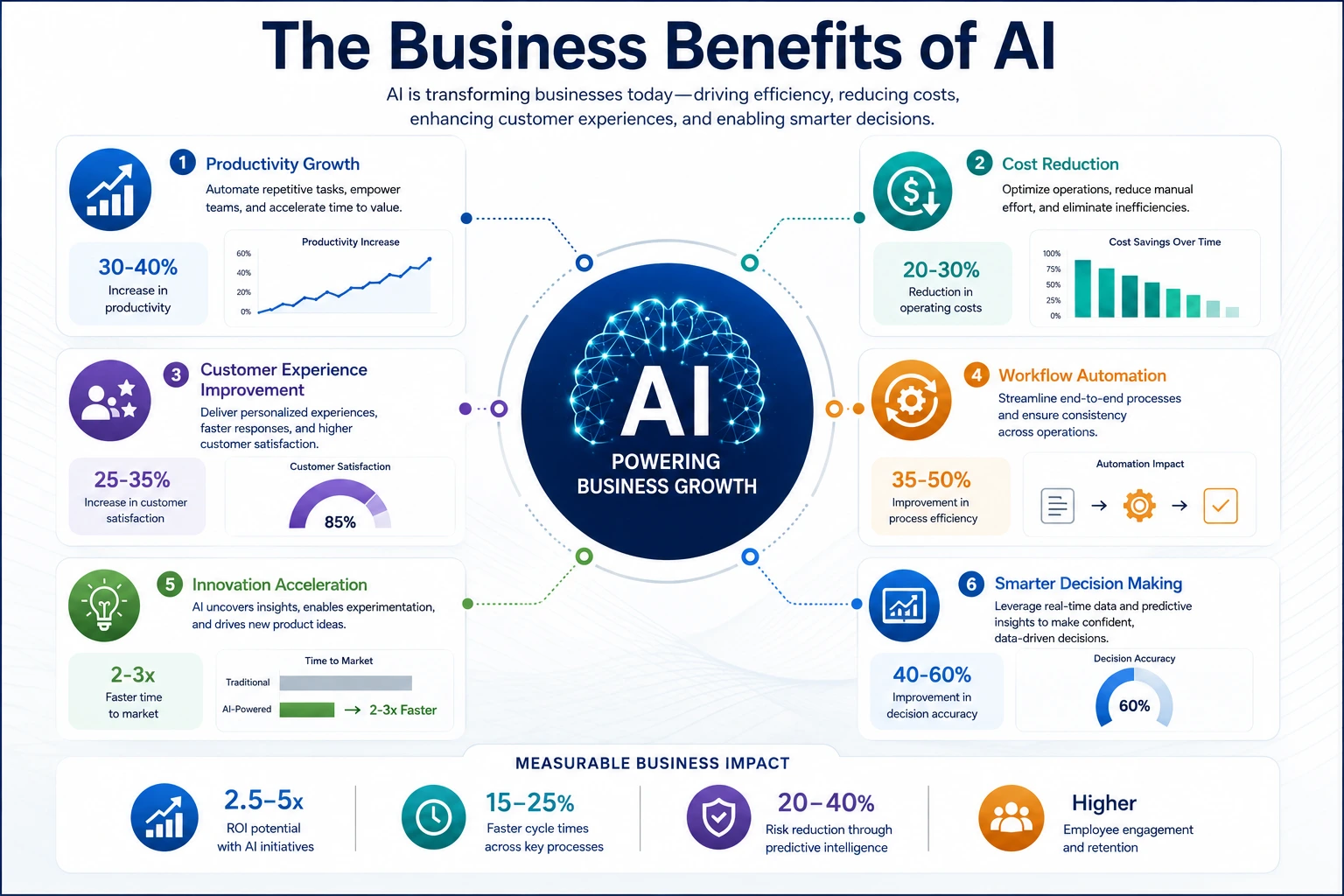
Organizations adopting OpenAI technologies often experience measurable benefits.
Increased Productivity
Employees spend less time on repetitive tasks and more time on strategic initiatives.
Faster Decision-Making
AI helps analyze large volumes of information quickly.
Improved Customer Experience
AI-powered support systems provide faster and more consistent responses.
Cost Reduction
Automation reduces labor-intensive processes and operational overhead.
Innovation Acceleration
Businesses can experiment, prototype, and launch products more rapidly.
Competitive Advantage
Organizations that effectively implement AI gain strategic advantages in efficiency and customer engagement.
Industry Use Cases
Healthcare
Healthcare organizations use AI for:
- Documentation assistance
- Research support
- Patient communication
- Administrative automation
Financial Services
Financial institutions leverage AI for:
- Risk analysis
- Customer support
- Fraud detection
- Reporting automation
Software Development
Development teams use AI to accelerate coding and software delivery.
Manufacturing
Manufacturers apply AI to:
- Predictive maintenance
- Process optimization
- Supply chain management
Retail and E-Commerce
Retailers use AI for:
- Product recommendations
- Customer support
- Inventory forecasting
- Personalized marketing
Legal Services
Law firms utilize AI for:
- Contract analysis
- Legal research
- Documentation review
Enterprise AI Market Trends in 2026
Several trends are shaping the AI landscape.
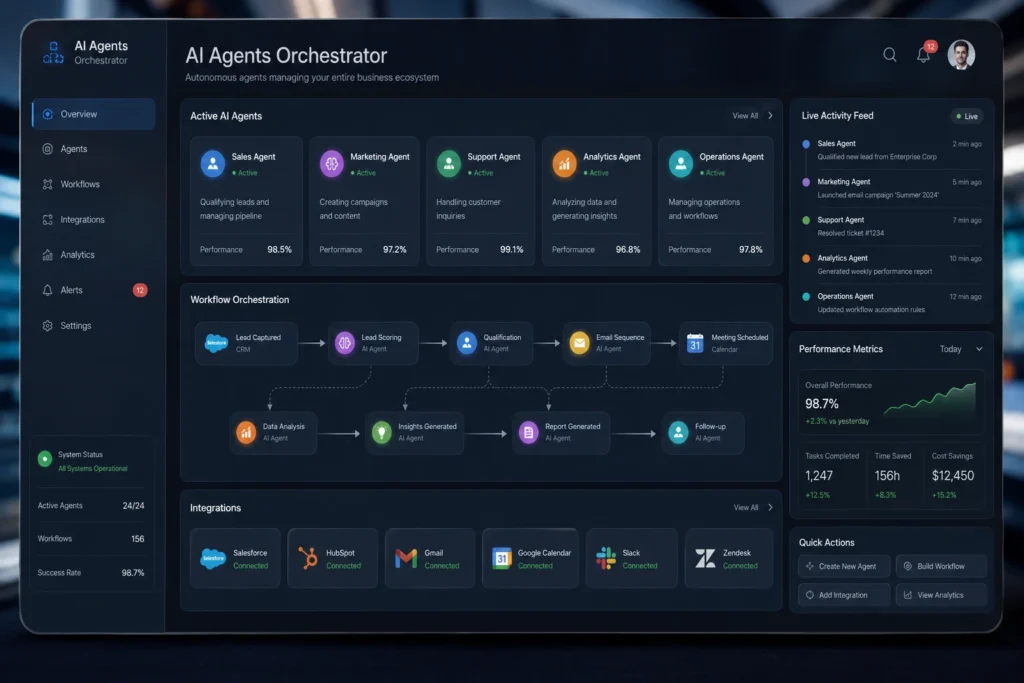
AI Agents Become Mainstream
Businesses increasingly deploy AI agents for workflow automation.
Enterprise AI Spending Continues Growing
Organizations are allocating larger budgets toward AI initiatives.
AI Governance Becomes Essential
Businesses are implementing policies to ensure responsible AI use.
Hybrid Human-AI Workforces
Employees collaborate with AI systems rather than being replaced by them.
Industry-Specific AI Solutions
Companies are adopting specialized AI tailored to their sectors.
OpenAI vs Competitors
The enterprise AI market has become increasingly competitive.
| Platform | Strengths | Primary Focus |
|---|---|---|
| OpenAI | Advanced reasoning, ecosystem, enterprise adoption | General AI and enterprise AI |
| Google AI | Search integration, cloud ecosystem | Enterprise productivity |
| Anthropic | Safety-focused AI models | Enterprise AI |
| Microsoft AI | Enterprise integration | Productivity and cloud services |
| Meta AI | Open-source innovation | AI research and consumer applications |
OpenAI maintains a strong position due to its developer ecosystem, enterprise partnerships, and continuous model improvements.
Pricing Considerations
OpenAI offers multiple pricing options for individuals, teams, developers, and enterprises.
Pricing typically varies based on:
- Usage volume
- API consumption
- Enterprise requirements
- Advanced features
- Team size
Organizations should evaluate expected workloads and business objectives before selecting an AI deployment strategy.
The total return on investment often exceeds software costs when AI is successfully integrated into productivity workflows.
Security and Compliance Considerations
Enterprise adoption requires careful attention to security.
Organizations evaluating AI platforms should consider:
Data Protection
Protecting sensitive information remains a top priority.
Access Controls
Role-based permissions help maintain governance.
Compliance Requirements
Businesses must align AI deployments with industry regulations.
Auditability
Organizations need visibility into AI-generated outputs and actions.
Risk Management
AI governance frameworks help reduce operational risks.
Security, transparency, and compliance are increasingly important factors in enterprise AI adoption decisions.
Building an Effective AI Strategy
Successful organizations approach AI strategically rather than treating it as a standalone tool.
A strong AI strategy typically includes:
Clear Business Objectives
Identify measurable outcomes.
Pilot Programs
Start with high-value use cases.
Employee Training
Ensure teams understand how to use AI effectively.
Governance Frameworks
Develop policies for responsible AI usage.
Continuous Optimization
Monitor performance and refine implementations.
Organizations that align AI initiatives with business goals often achieve significantly better results.
Expert Insights
Industry experts increasingly view AI as a foundational business technology.
Key observations include:
- AI is becoming a standard productivity layer across organizations.
- AI agents are expanding automation capabilities.
- Competitive differentiation increasingly depends on AI adoption.
- Human expertise remains critical despite automation advances.
- Enterprise AI investments are expected to continue growing.
Businesses that delay AI adoption risk falling behind more technologically advanced competitors.
The Future of OpenAI and Enterprise AI
The next phase of AI development will likely focus on:
- More capable AI agents
- Advanced reasoning systems
- Greater enterprise integration
- Industry-specific AI models
- Autonomous workflow execution
- Enhanced multimodal capabilities
As AI becomes deeply integrated into everyday business operations, organizations will increasingly rely on AI-powered systems to improve productivity, innovation, and decision-making.
OpenAI is positioned to remain one of the most influential companies shaping this future.

Frequently Asked Questions
What is OpenAI?
OpenAI is an artificial intelligence company that develops advanced AI systems, including ChatGPT, APIs, enterprise AI tools, and AI agent technologies.
What is ChatGPT used for?
ChatGPT helps with writing, research, coding, customer support, business planning, data analysis, and productivity tasks.
What are AI agents?
AI agents are intelligent systems capable of performing tasks, making decisions, and executing workflows with minimal human supervision.
How does OpenAI help businesses?
OpenAI helps organizations automate tasks, improve productivity, reduce costs, enhance customer experiences, and accelerate innovation.
Is OpenAI suitable for enterprises?
Yes. OpenAI offers enterprise-grade solutions with security, administrative controls, compliance features, and scalable deployment options.
Final Verdict
OpenAI has evolved from a research-focused AI company into a critical technology provider powering the next generation of business innovation.
Through ChatGPT, AI agents, APIs, and enterprise AI solutions, OpenAI is enabling organizations to automate operations, improve productivity, accelerate software development, and unlock new competitive advantages.
As enterprise AI adoption accelerates throughout 2026, organizations that strategically embrace AI technologies will likely achieve stronger operational performance, greater innovation capacity, and improved customer experiences.
For business leaders evaluating artificial intelligence investments, OpenAI remains one of the most important companies to watch and one of the most influential drivers of digital transformation in the modern enterprise landscape.

SoftwareCompanyNearMe Editorial Team is dedicated to researching and publishing trusted content about U.S. software companies, SaaS platforms, artificial intelligence (AI), cloud computing, cybersecurity, and enterprise technology. Our goal is to help businesses, IT professionals, and software buyers make informed decisions through accurate, well-researched, and regularly updated technology guides, company reviews, and industry insights.
2 thoughts on “OpenAI Explained: How ChatGPT, AI Agents, and Enterprise AI Are Reshaping Business in 2026”